












An 18-wheeler accident lawyer starts with the truck itself. A loaded tractor trailer can weigh up to 80,000 pounds, and that weight changes how the truck stops, turns and crashes.
It also changes the claim. A tractor and its trailer can have different owners, and each one leaves its own records.
You pay nothing unless we win. Zinda Law Group offers a free consultation about your 18-wheeler crash at (800) 863-5312.
Article summary
Key things to know
- A loaded rig is often 20 to 30 times heavier than a passenger vehicle.
- Federal rules cover how cargo is secured, how the trailer is coupled and how often each unit is inspected.
- The tractor, the trailer and the load can belong to different companies, so more than one may share fault for a truck accident.
- Driver hours logs are kept only for a limited time, so ask for records early.
Free case review
Did an 18-wheeler change your life in seconds?
One call covers what happened in the semi truck accident, from the tractor to the load, and which records to request first.
What an 18-wheeler accident lawyer does
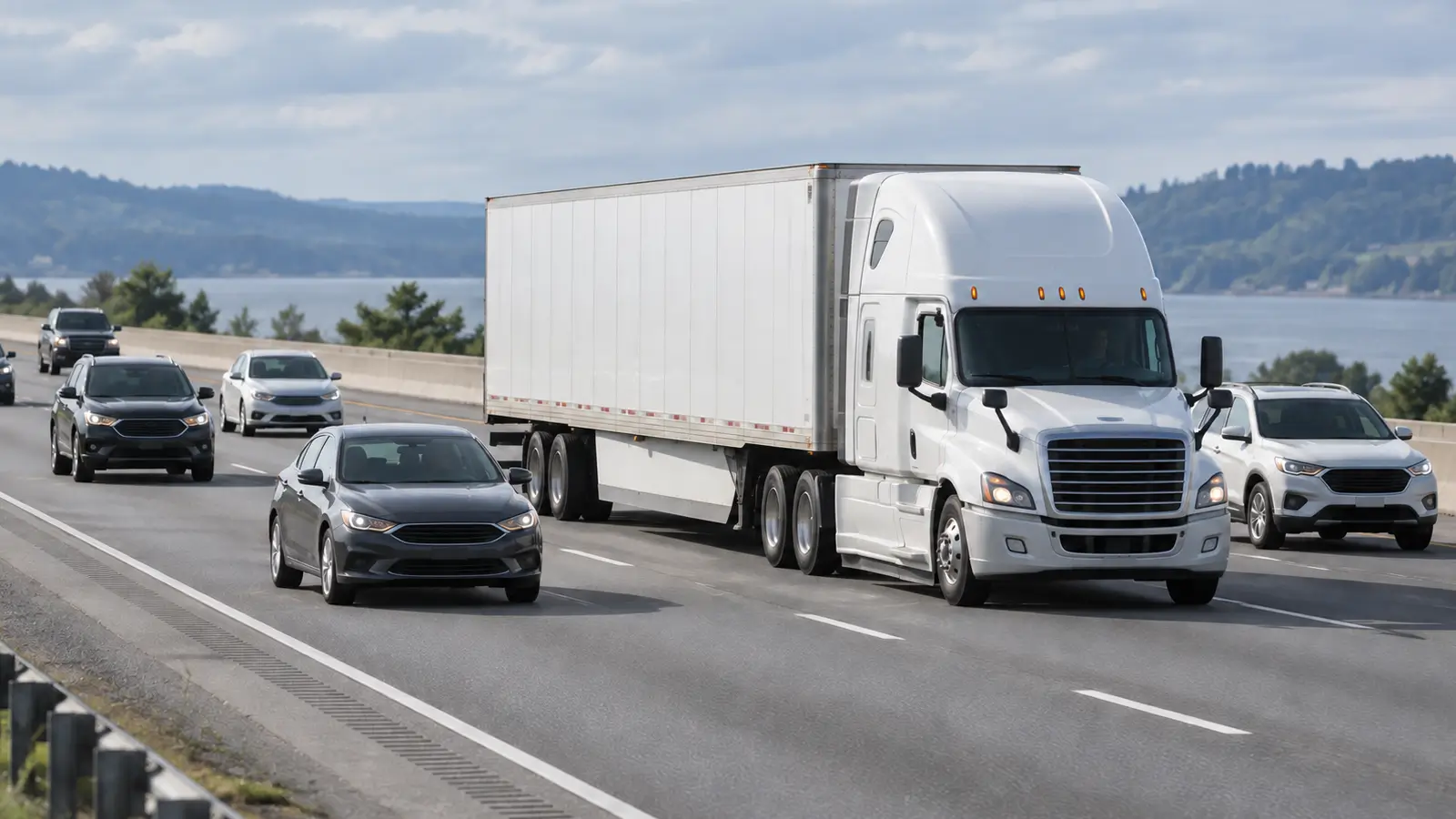
An 18-wheeler accident lawyer represents people who suffered injuries in these crashes. The claim can run against the truck driver and the trucking companies behind the rig, and against any other company responsible for the tractor, the trailer or the load. The work is a kind of personal injury law. Our truck accident lawyer page explains the federal rules on driving hours and driver files, which reach commercial truck carriers in interstate commerce.
On an 18-wheeler case, the first job is to preserve evidence. Truck accident lawyers write to the trucking companies involved and ask them to keep the hours logs, the inspection reports and the data from the truck. That request is often called a spoliation letter, and it asks the carrier to keep critical evidence and records after the crash.
The lawyer then deals with the insurance companies. Truck accident attorneys compare each offer with the client’s medical bills, lost income and future care.
How an 18-wheeler differs from other large trucks
An 18-wheeler is a truck tractor pulling a semitrailer. People also call it a semi truck, a tractor trailer or a big rig. It is one of the large commercial trucks that federal safety rules cover. A box truck or other single commercial truck has no trailer to swing or separate.
Weight and stopping distance
The Federal Motor Carrier Safety Administration (FMCSA) says a tractor trailer can weigh up to 80,000 pounds when fully loaded. It adds that trucks are often 20 to 30 times heavier than passenger vehicles. The general federal weight limit on Interstate highways is also 80,000 pounds.
Weight means distance. FMCSA says large trucks need the length of up to two football fields to stop safely. A semi truck that follows too closely may not be able to stop for slowing traffic.
Blind spots and wide turns
Large trucks have large blind spots and make wide turns. A truck turning right may first move left to make room. Our blind spot accidents page covers sideswipes and lane-change crashes next to a trailer.
Types of 18-wheeler truck accidents
The way a tractor trailer is built explains the crashes it gets into. These are the large truck accidents our truck accident lawyers see with a combination vehicle.
Underride crashes
In an underride truck crash, a car slides under the trailer. FMCSA warns that in a crash behind a truck, passenger vehicles could slide or be pushed under it, because trucks sit much higher off the ground.
Federal regulations require a rear impact guard on most trailers and semitrailers rated at 10,000 pounds or more and built on or after January 26, 1998. Some trailer types are exempt. After an underride crash, a truck accident lawyer checks whether the trailer needed a guard and what condition it was in.
Jackknife accidents
A jackknife happens when the trailer swings out and folds toward the tractor. The trailer can sweep across several lanes and hit cars that had no part in the first mistake. Hard braking, a slick road and an unbalanced load are among the things a truck accident lawyer checks.
Rollovers
A loaded trailer rides high. FMCSA notes that tall vehicles with a higher center of gravity must travel much slower on curves and ramps to avoid the risk of rollovers. How fast the truck driver took the ramp and whether the load shifted are the first questions after a rollover.
Rear-end crashes and wide turns
A semi truck accident can also be a rear-end crash in slowing traffic or a squeeze during a right turn. Our article on rear-end truck crashes explains what to do when a commercial truck hits a car from behind.
Cargo loading, coupling and the trailer
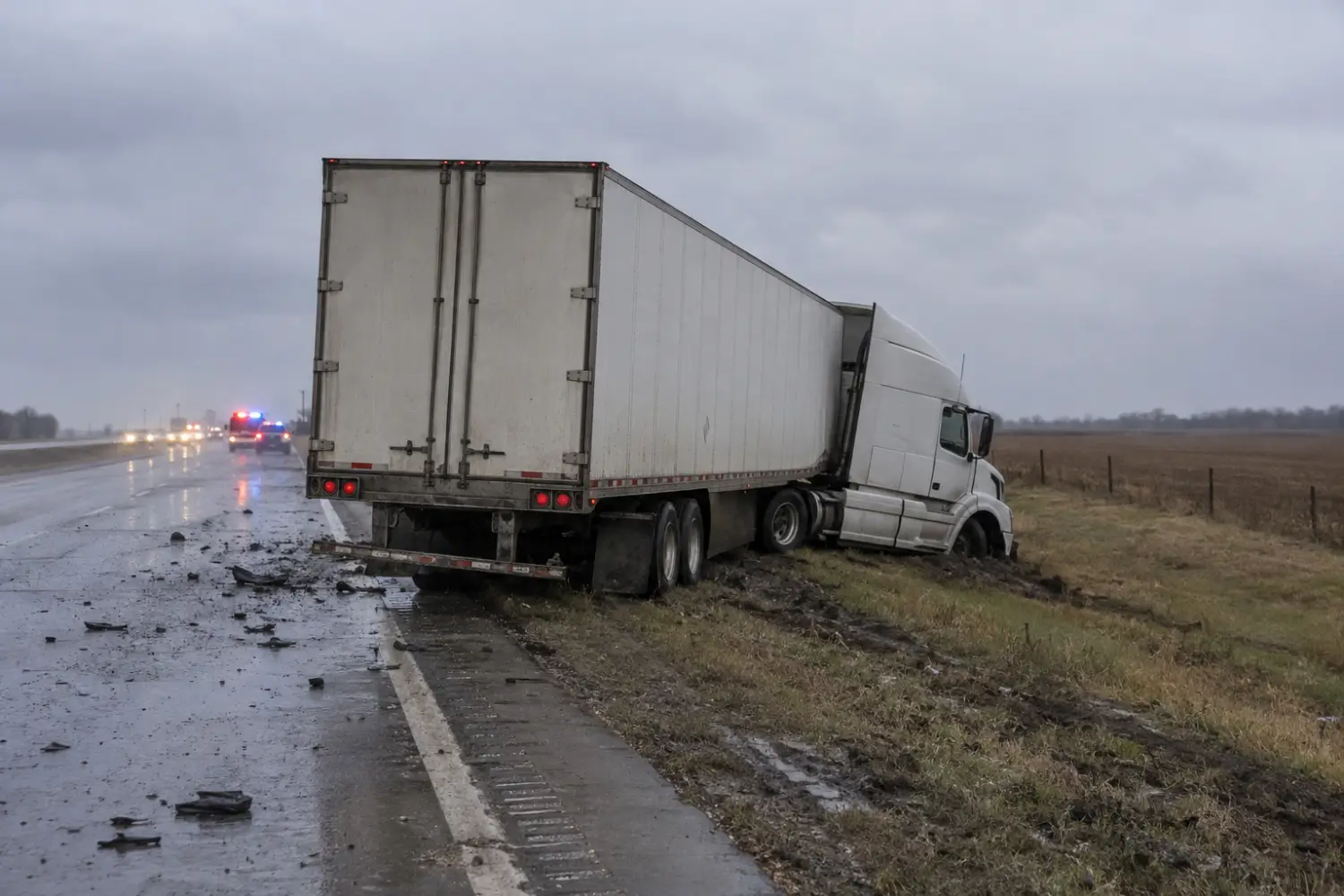
Much of what goes wrong with an 18-wheeler starts behind the cab. Federal regulations cover the load and the connection between the two units.
How cargo must be secured
Cargo must be secured so it cannot leak, spill, blow or fall from the truck. It also may not shift enough to affect the truck’s stability or handling.
The truck driver shares that duty. A driver may not drive, and a carrier may not require a driver to drive, unless the cargo is properly distributed and adequately secured. The driver must generally inspect the load within the first 50 miles of a trip and again at set points along the way.
The inspection duty has an exception for a sealed trailer the driver was ordered not to open. Cargo must still be properly secured. In those cases the cargo loading company may be the one that knows how the freight was packed.
The fifth wheel and the trailer connection
The fifth wheel couples the tractor to the trailer. Federal rules require it to have a locking mechanism that keeps the two halves together unless someone works a manual release. When a trailer separates on the road, the coupling and its inspection history are the place to look.
Records that can decide a truck accident case
A commercial vehicle accident with an 18-wheeler leaves records that most car accidents do not. Truck accident lawyers ask for these first.
Driver logs. Interstate carriers must generally have drivers record their hours on an electronic logging device. Carriers must keep the logs and their supporting documents for at least six months.
Driver inspection reports. Carriers must require drivers to report on each vehicle when the day’s work ends. A written report is generally required when the driver finds or is told of a defect. It covers the trailer brake connections, the tires and the coupling devices, among other parts.
Yearly inspections. A carrier must not use a commercial vehicle unless it passed an inspection in the preceding 12 months. In a combination, the tractor and the semitrailer must each be inspected.
Maintenance files. For a truck they control for 30 consecutive days or more, carriers must keep inspection, repair and maintenance records for one year, and for six months after the truck leaves their control.
The driver’s license and file. Driving a tractor trailer generally takes a commercial driver’s license in the combination vehicle group. The carrier also keeps a qualification file on each driver.
Hours of service rules also limit how long a truck driver may drive. A broken rule does not prove fault by itself, but a missing record is a reason to ask why.
Who can be liable for an 18-wheeler crash
Determining liability starts with what the truck driver did and who controlled each part of the truck. A truck accident claim can involve multiple parties because the tractor, the trailer and the freight can belong to different companies. A serious truck accident case can also call for an accident reconstructionist to explain how the crash happened.
The truck driver
Driver negligence is the first thing to check. Speeding, distracted driving and following too closely are forms of negligent driving that can show up in the logs and the crash report. Drivers may not drive when fatigue or illness makes it unsafe.
Trucking companies
A claim can name the trucking company along with its driver when the driver was on the job, or when the company broke one of its own duties and that caused the crash. Carriers must inspect, repair and maintain every commercial truck they control.
Loaders, repair shops and manufacturers
A cargo loading company may share fault when a shifted or falling load caused the wreck. So may a repair shop when bad brake or tire work did. Each of these companies can have its own insurer, so a claim may involve several insurance companies.
A truck manufacturer or parts maker may be liable for a defect, and our FAQ on liability for tire failure explains how that question is sorted out.
Some 18-wheelers are part of larger fleets. Our commercial truck accidents page covers claims against companies that run more than one kind of commercial vehicle.
Common causes of crashes involving large trucks
Large truck accidents can have more than one cause. A truck accident lawyer checks each of these against the records.
- Fatigue checked against the electronic logging device data
- Distracted driving checked against phone and cab data
- Shifted cargo checked against the loading papers
- Mechanical failures checked against the inspection and repair files
- Speed checked against the truck’s data and any skid marks
Our article on driver error in 18-wheeler accidents goes deeper on the mistakes semi truck drivers make.
Common truck accident injuries in 18-wheeler crashes
The size gap explains the harm. FMCSA says the weight of a truck increases the risk of more severe crash damage, injuries and fatalities. Truck accident victims in the smaller vehicle can suffer serious injuries. A truck accident can result in traumatic brain injuries or spinal cord injuries.
- Traumatic brain injuries
- Spinal cord injuries
- Broken bones and crush injuries
- Burns
- Internal injuries
Burn injuries can occur when a truck hauling fuel or other hazardous materials crashes.
These are common truck accident injuries when a tractor trailer hits a smaller vehicle. Severe injuries like these can mean months of medical care. Our article on 18-wheeler accident injuries describes them in more detail, and our catastrophic injury page covers devastating injuries that change a person’s work and home life.
Fatal accidents can leave a family with its own claim under state law. Our page on fatal truck accidents explains who can bring it.
What a truck accident claim can cover
A personal injury claim after an 18-wheeler wreck asks the people at fault to pay for what the crash cost. State law and the proof decide which losses a person can seek compensation for. Insurance companies ask for proof of each loss.
Losses you can add up
Medical expenses come first, from the ambulance to future medical expenses the evidence supports. Lost wages and lost income are next. Property damage to the car and other accident related expenses belong in the claim too.
Losses that are harder to count
Pain, emotional distress and the limits the injuries put on daily life can be part of the claim as well. State law sets when those losses can be recovered. Injury victims who suffered severe injuries can claim the future costs the evidence supports for the injuries sustained in the crash.
Deadlines and shared fault after a truck crash
Every state sets a deadline to file a truck accident lawsuit, and every state has a rule for crashes where more than one person was at fault. Both depend on the state whose law applies.
Our national truck page lists the general truck accident deadlines by state and the shared fault rules in one table. A claim against a city, a county or a state agency has its own notice rule.
State-specific deadlines
Questions about how much time you have?
What to do after a crash with an 18-wheeler
Accident victims with serious injuries can still protect a claim in the first days, or ask a family member to help.
- Get medical care. See a doctor the same day and keep your medical records.
- Call the police. The report records the truck driver, the trailer and the carrier’s name.
- Photograph the accident scene. Take pictures of the crash scene, the trailer’s markings and any skid marks.
- Keep your paperwork. Save medical bills, pay records and repair estimates.
- Wait on statements. Talk to a truck accident lawyer before you give a recorded statement.
Our FAQ explains what to do when an 18-wheeler hits a driver who has no car insurance.
When the trucking company’s insurance adjuster calls
Insurance adjusters for commercial truck carriers handle these claims every day. The truck driver’s insurance company may call accident victims within days and ask for a recorded statement. Talk to a truck accident lawyer before you give one. An early offer can leave out care a person has not had yet, which matters most with serious injuries.
If the insurance companies will not offer a fair amount, the next step can be a personal injury lawsuit. A personal injury lawyer can explain what a personal injury lawsuit would involve before that decision is made.
Choosing a law firm for a truck accident case
A law firm that has handled claims against carriers is the place to start. An experienced attorney should be able to name the tractor and trailer records to request at the first meeting.
These questions are worth asking before hiring a truck accident lawyer.
- Who on the legal team will handle my truck accident case day to day
- How soon will letters go out to preserve the carrier’s records
- Has the firm taken semi truck accident cases to trial
- How are legal fees and case costs paid
Legal fees are worth asking about before anything is signed.
When you are ready
Talk through the next step.
18-wheeler accident lawyers by city
Zinda Law Group has pages for 18-wheeler crashes in these Texas cities, along with a statewide truck accident page.
Texas
- Texas truck accident lawyers
- San Antonio 18-wheeler accidents
- Fort Worth 18-wheeler accidents
- El Paso 18-wheeler accidents
- Waco 18-wheeler accidents
A free case evaluation with our truck accident attorneys
At Zinda Law Group, a truck accident case involving an 18-wheeler starts with a free case evaluation. We listen to what happened and explain who may be liable and which records matter.
If you hire our law firm, our truck accident attorneys request the records and deal with the insurance companies while you focus on treatment. Our firm works on a contingency fee basis, so there is no out-of-pocket cost to secure the legal representation you need. You pay nothing unless we win.