



Your chances of winning a personal injury lawsuit depend on the facts, the evidence, and the law that applies to your case. Historical trial win rates cannot tell you whether you will receive a settlement, win at trial, or collect enough money to cover your losses.
Quick Answer: What Are My Chances of Winning a Personal Injury Case?
There is no reliable percentage that applies to every injured person. In a report published in 2008, the Bureau of Justice Statistics reported that plaintiffs won 52% of tort trials in state courts of general jurisdiction in 2005. That category included personal injury and property-damage claims. The figure describes historical trial outcomes and excludes settlements.
To assess your prospects, a lawyer needs to review who may be responsible, how the incident caused your injuries, what losses you can document, and what insurance or assets may be available to pay a claim.
What Does It Really Mean to “Win” a Personal Injury Lawsuit?
For most injury victims, winning a personal injury claim means recovering money for medical bills, lost wages, future medical costs, and noneconomic damages like pain and suffering. A check that barely covers your emergency room visit can leave other losses unpaid.
Several different outcomes can be called a win:
- Settlement: You and the other party agree to resolve the claim. A settlement can still be a win even if the at-fault party never formally admits wrongdoing.
- Plaintiff verdict: A judge or jury rules in your favor at trial. Post-trial proceedings and collection problems can affect what you receive.
- Collectible payment: The amount you can obtain depends on available insurance coverage, applicable limits, and the responsible party’s assets.
- Net recovery: The amount you keep after attorney fees, case expenses, unpaid medical bills, and applicable liens or repayment obligations.
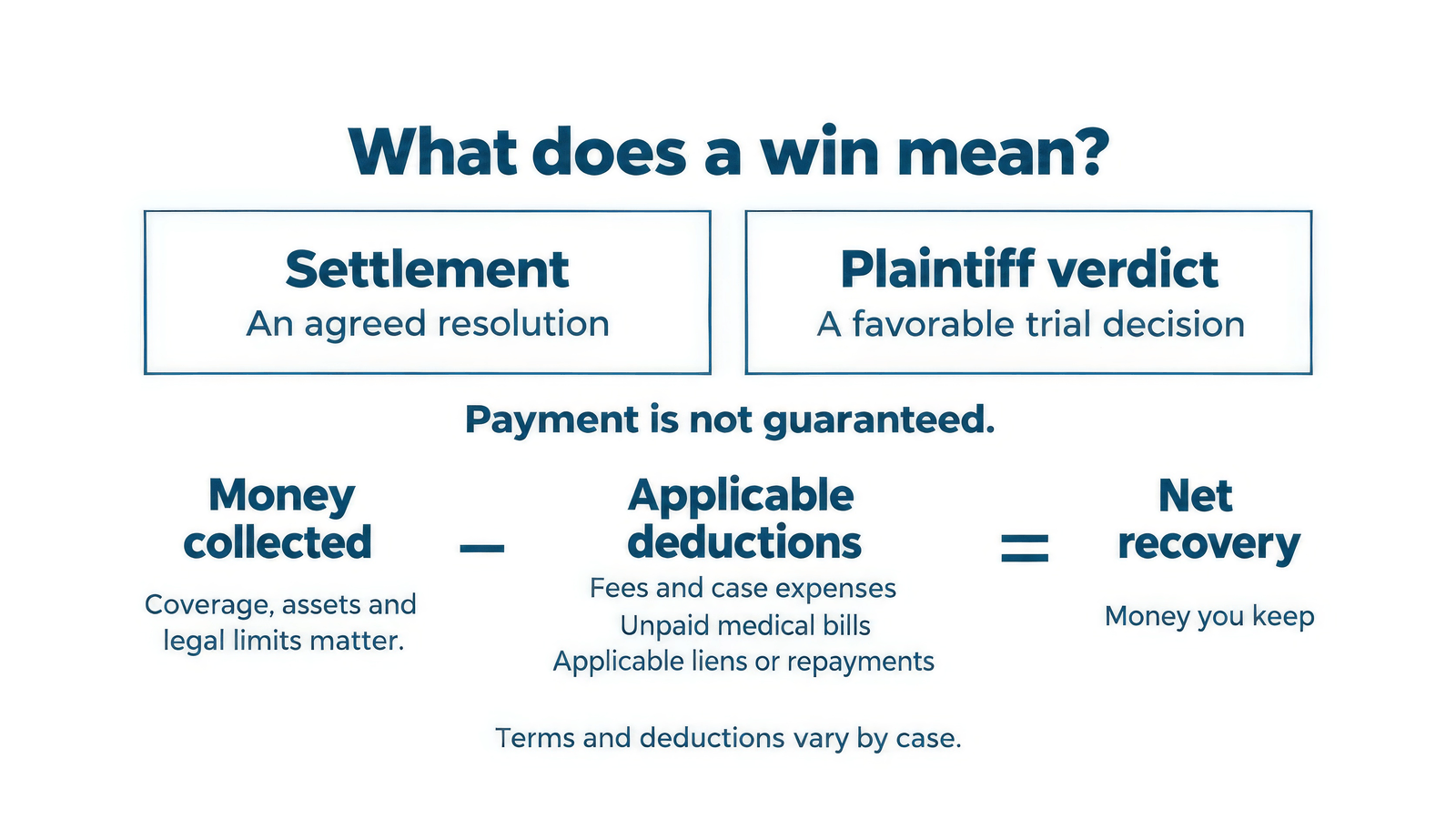
For example, the Centers for Medicare & Medicaid Services explains that Medicare repayment may be required for injury-related care it paid for conditionally before a settlement or judgment. Ask your lawyer to estimate both what can be collected and what you would receive after deductions.
Proving negligence generally requires showing a duty of care, a breach of that duty, causation, and damages. Defenses and state law can affect recovery even when you have evidence of negligence.
Key Factors That Affect Your Chances of Winning a Personal Injury Case
No attorney can guarantee a specific result. The evidence, the losses you can prove, and applicable legal rules all affect your case.
Liability and shared fault
Evidence that a driver ran a red light or drove drunk may help establish fault. You still need to connect that conduct to the accident and your injuries. A police report is one piece of evidence; it does not automatically establish liability.
Comparative negligence rules matter when more than one person shares responsibility. Depending on state law, your share of fault may reduce your compensation or prevent recovery.
Injuries and documented losses
Fractures, spinal cord damage, and traumatic brain injuries may require ongoing treatment and affect your ability to work. Records of those consequences help support a damages claim. Injury severity alone does not determine the amount you will recover.
Document current and future medical needs, lost income, reduced earning capacity, and the effects of pain on daily life. Available coverage, fault, and legal limits may restrict recovery even when losses are substantial.
| Factor | How it affects your case |
|---|---|
| Liability | Evidence must connect the responsible party’s conduct to your injuries. |
| Comparative negligence | Shared fault may reduce or bar recovery under state law. |
| Evidence quality | Photos, medical records, and witness accounts can support disputed facts. |
| Injury-related losses | Treatment records and financial documentation help establish damages. |
| Insurer’s position | Disputes about coverage, fault, or losses can affect negotiations. |
How Case Type Affects Your Chances: Car Crashes, Slip and Fall, and Malpractice
RAND analyzed 26,114 personal injury and wrongful-death verdicts recorded by VerdictSearch from 2010 through 2019. Its tables 4.1 and 3.7 report these plaintiff win rates.
| Category in RAND’s sample | Plaintiff trial win rate, 2010-2019 |
|---|---|
| Private auto | 64.6% |
| Commercial trucking | 64.0% |
| Medical malpractice | 34.8% |
| Wrongful death, classified by harm claimed | 53.9% |
Wrongful death can overlap the accident categories. The verdict sample excludes settlements, and RAND cautions that cases reaching trial are not typical claims. These historical rates cannot predict your outcome.
Car crashes may leave evidence such as police reports, dashcam footage, and witness accounts. Those records still need to show what happened and connect the crash to your injuries.
Slip and fall cases can turn on evidence of a dangerous condition and the property owner’s responsibilities under state law, including what the owner knew or should have known. Medical malpractice claims may require expert testimony about the accepted standard of care, whether the provider departed from it, and whether that departure caused harm.
A lawyer with experience in the relevant type of claim can identify the evidence and expert testimony the case may require.
Why Evidence Is Often the Deciding Factor
Evidence needs to support what happened, who was responsible, and how the incident affected you.
Reports and medical records
Police reports and incident reports can identify witnesses and document observations at the scene. Their accuracy and use in court may be disputed. For workplace incidents, OSHA findings and internal incident reports may help document conditions.
Emergency room notes, diagnostic imaging such as X-rays, MRIs, and CT scans, specialist records, and physical therapy logs can document harm and help connect it to the incident. Keep records of medical expenses, lost income, and out-of-pocket costs as well.
Expert testimony and treatment history
Medical professionals, accident reconstructionists, and economists can explain causation, future treatment needs, and lost earning capacity. Whether expert testimony is needed depends on the claim and applicable law.
Seek prompt medical care and follow your clinician’s advice. Accurate records help show when symptoms began and how they developed. If you have gaps in treatment, explain the reasons accurately so your attorney can address questions about your medical history.
Settlement vs. Trial: How Personal Injury Cases Are Resolved
The American Bar Association explains that lawyers resolve most personal injury cases through insurance negotiations. A lawsuit can also end through dismissal or another ruling before trial, so a nontrial outcome does not necessarily mean the injured person received money.
Trials can involve substantial time and expense for both sides. A settlement lets the parties agree on payment and release terms, but the agreement does not by itself guarantee collection.
Before accepting an insurer’s first offer, consider your medical needs, documented losses, available coverage, and estimated net recovery. Preparing evidence and witnesses helps your lawyer assess the offer and the risks of trial.
| Aspect | Settlement | Trial |
|---|---|---|
| Timing | Depends on treatment, negotiations, and agreement | Depends on discovery, court scheduling, and possible appeals |
| Decision | Parties agree on the terms | A judge or jury decides contested issues |
| Expenses | May avoid further trial expenses | May require additional expert and court expenses |
| Payment | Depends on the agreement and ability to pay | A favorable judgment may still require collection |
How to Improve Your Chances of Winning Your Injury Lawsuit
You cannot control every variable, but concrete steps after an accident can help preserve your claim.
- Seek prompt medical attention. Get care appropriate to your symptoms and follow your clinician’s treatment advice.
- Gather evidence safely. Photograph the scene, damaged vehicles, visible injuries, and hazards such as broken steps. Preserve belongings such as torn clothing. Do not remove or alter someone else’s property.
- Obtain reports and witness details. Save police reports, workplace incident reports, and witness contact information before memories fade.
- Handle insurance requests carefully. Meet your own insurer’s reporting and cooperation requirements. Ask a lawyer before giving a voluntary recorded statement to the other party’s insurer or signing a release.
- Preserve social media evidence. Vacation photos or gym selfies can be misinterpreted without context. Avoid discussing the accident publicly, and preserve existing posts and messages. Do not delete or alter potential evidence.
- Contact a personal injury attorney early. An attorney can assess deadlines and request evidence that may otherwise be lost.
Costs, Legal Fees, and Legal Representation
Zinda Law Group works on a contingency fee basis. Under the firm’s published fee terms, clients owe no attorney fees, court costs, or litigation expenses if the firm does not win. If the firm recovers compensation, attorney fees apply under the agreement, and expenses and unpaid medical bills are deducted from the client’s share.
Before signing an agreement, ask:
- What fee percentage applies to settlement, trial, or appeal?
- Which expenses may be deducted, and are they deducted before or after the attorney fee is calculated?
- Which medical bills, liens, or repayment obligations may remain?
- What would I receive after those deductions?
An attorney can investigate liability, organize records, retain experts when needed, and negotiate with the insurer. Those services do not guarantee a win or a larger net recovery.
Deadlines, Comparative Negligence, and Other Legal Rules That Can Hurt Your Odds
Even a strong case can be lost if a filing deadline is missed. State law and the type of claim determine which rules apply.
Filing deadlines
Texas Section 16.003 generally requires a personal injury lawsuit to be filed within two years after the claim accrues, subject to exceptions. Determining when a claim accrues and which deadline applies may require a review of the facts. This is a Texas illustration, not a nationwide filing period.
Do not assume insurance negotiations extend the time to file suit. Claims against government entities may have separate notice requirements, and some claims have special deadlines. Ask an attorney to confirm the deadlines that apply to you.
Shared fault and other limits
For cases governed by Texas Chapter 33, a claimant who is more than 50% responsible cannot recover damages. When recovery is allowed, Section 33.012 reduces damages by the claimant’s percentage of responsibility. For example, a 20% responsibility finding reduces otherwise recoverable damages by 20%, before other applicable adjustments.
Other states use different fault rules. Ask an attorney which rules, defenses, and any damages caps apply to your claim.
Talk to Zinda Law Group About Your Case
Discuss the facts of your accident, your medical treatment, and any interactions with insurance companies so far. Review Zinda Law Group’s practice areas and ask whether the firm can help with your claim and location.
Call (800) 863-5312 or request a free consultation.
FAQs About Your Chances of Winning a Personal Injury Lawsuit
How long does it usually take to resolve a personal injury case?
There is no reliable timeline that fits every case. Your treatment, disputed fault, evidence gathering, negotiations, and the court’s schedule can affect the duration. Ask your attorney for an estimate tied to the next stage of your case.
Can I still win if I was partially at fault?
Possibly. State law and your share of responsibility determine whether you can recover and how much an award may be reduced. Ask which rule applies to your claim.
Do most personal injury cases go to trial?
No. The American Bar Association describes trials as uncommon in personal injury cases. Cases can settle through negotiation, while some lawsuits end without payment through dismissal or other rulings.
Will I have to pay legal fees upfront?
Zinda Law Group handles personal injury cases on a contingency fee basis, without upfront attorney fees. If the firm recovers compensation, the agreement determines the attorney fee. Review how case expenses, unpaid medical bills, and repayment obligations affect your share.
What can I do right now to improve my chances of winning?
Seek prompt medical care, follow your clinician’s advice, and preserve photographs, bills, reports, and messages. Meet your own insurer’s reporting requirements and ask an attorney about deadlines and voluntary statements to the other party’s insurer.

John (Jack) Zinda
Founder / CEO
Over 100 years of combined experience representing injured victims across the country.
Available 24 / 7|Free Consultation
Neil Solomon
Partner
Real results matter. We do not get paid unless we win your case.
Available 24 / 7|Free Consultation