



Rain, ice, fog, and snow create dangerous conditions for everyone on the road. For commercial trucks weighing up to 80,000 pounds, those conditions multiply the risk considerably.
Bad weather does not remove a driver’s responsibility. Truck drivers are trained professionals held to a higher standard than ordinary motorists, and liability in a weather-related crash depends on whether the driver and their employer took appropriate precautions for the conditions they encountered.
In this article, we cover why weather does not excuse negligent driving, what federal rules require of truck drivers, how driver and company liability is evaluated, and what evidence investigators use to determine fault.
Why Weather Does Not Automatically Excuse Truck Drivers From Liability
Weather is a foreseeable hazard. Drivers, dispatchers, and trucking companies know that rain, ice, and fog occur. Planning and responding to those conditions is part of operating a commercial vehicle professionally.
A truck driver who encounters heavy rain and maintains highway speed has not responded to a hazard. A driver who pushes through dense fog because a delivery deadline is tight has made a choice that prioritizes schedule over safety.
Courts evaluate these situations using the reasonable professional standard: would a reasonably careful, trained truck driver have operated the vehicle the same way under those conditions? When the answer is no, liability follows.
Federal Safety Rules Truck Drivers Must Follow in Dangerous Weather
Federal Motor Carrier Safety Administration regulations require commercial truck drivers to use extreme caution when conditions deteriorate. These are not general guidelines. They are enforceable legal obligations.
Under federal rules, drivers must:
- Reduce speed during rain, snow, ice, or fog to a level appropriate for actual conditions
- Increase following distance to compensate for longer stopping distances on slick roads
- Stop operating the vehicle entirely if conditions become too hazardous to continue safely
A driver who presses forward through conditions that demand stopping has violated federal safety standards. That violation becomes evidence of negligence in any resulting injury claim.
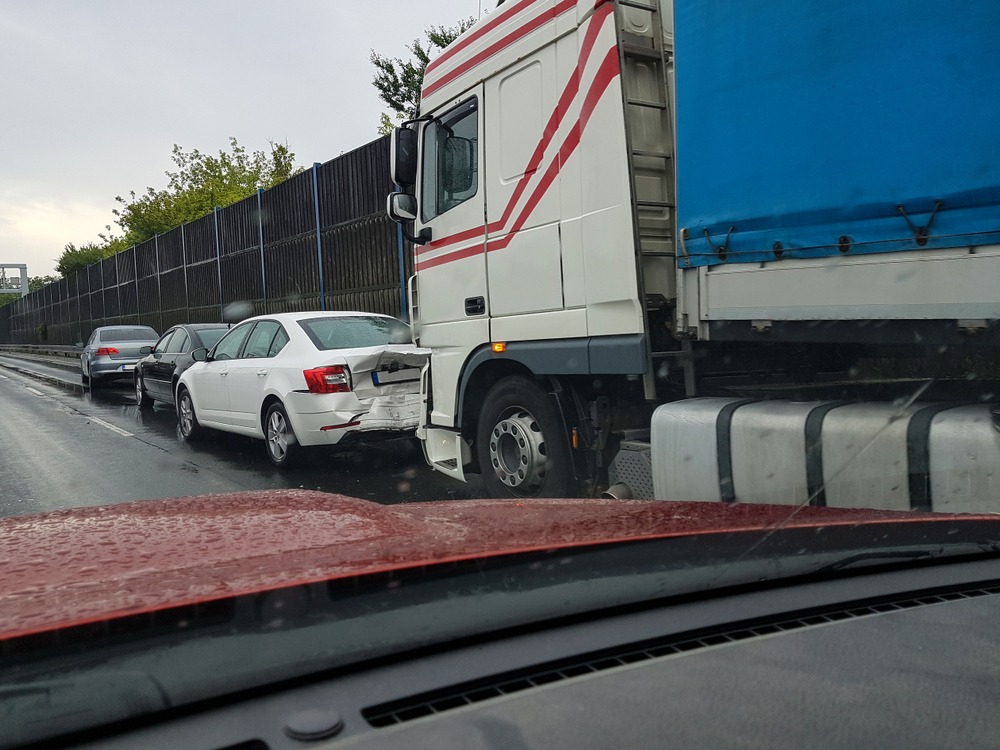
Common Weather Conditions That Contribute to Truck Accidents
Each weather condition creates a distinct set of risks for commercial trucks. Recognizing which hazard was present at the time of the crash is an important part of establishing what the driver was required to do.
- Heavy rain reduces traction on road surfaces and limits visibility, particularly at highway speeds
- Ice causes sudden loss of control that braking and steering cannot recover from
- Dense fog limits how far ahead a driver can see, shrinking the distance available to react to stopped or slowing traffic
- High winds destabilize tall trailers and can push a truck across lanes without warning
- Snow-covered roads extend stopping distances significantly and obscure lane markings
Each of these conditions is foreseeable. Each requires a specific reduction in speed and a specific increase in caution. A driver who treats icy roads like dry pavement has not adjusted to the conditions.
How Driver Negligence Can Lead to Weather-Related Truck Crashes
Negligence in bad weather usually comes down to a failure to adapt. The conditions changed. The driver’s behavior did not.
Common forms of negligent driving in poor weather include:
- Maintaining speed at or near the posted limit when rain, ice, or fog demands a significant reduction
- Following other vehicles too closely to allow adequate stopping distance on slick roads
- Braking abruptly on ice or wet pavement, triggering a jackknife or loss of directional control
- Continuing to drive after receiving weather alerts or observing conditions that warrant stopping
Each of these behaviors reflects a decision. Decisions made behind the wheel of a fully loaded commercial truck carry serious legal weight when those decisions result in a crash.
When a Trucking Company May Also Be Liable
The truck driver is often the most visible party in a weather-related crash, but the trucking company can share or bear the primary liability depending on what led to the driver being on the road in those conditions.
Companies can be held responsible when they:
- Pressured drivers to meet delivery deadlines during storms or severe weather events
- Encouraged drivers to continue routes despite weather warnings or road closures
- Failed to implement or enforce safety policies requiring drivers to pull over in hazardous conditions
- Ignored driver reports of dangerous conditions along their assigned routes
Trucking companies have a legal duty to prioritize safety over schedule. When internal pressure to deliver overrides that duty and a crash results, the company’s liability can be substantial. Dispatch records, communications between drivers and management, and internal scheduling documents often reveal whether that pressure existed.
Talk With a Truck Accident Lawyer About Your Case
Weather-related truck crashes involve federal regulations, company liability, and evidence that disappears quickly. Building a strong case requires acting before records are gone.At Zinda Law Group, our legal team investigates weather-related truck crashes, pursues every responsible party, and fights for full compensation on behalf of injured victims. There are no upfront fees. If you or someone you love was seriously hurt in a crash involving a commercial truck in bad weather, reach out to us today for a free consultation.

John (Jack) Zinda
Founder / CEO
Over 100 years of combined experience representing injured victims across the country.
Available 24 / 7|Free Consultation
Neil Solomon
Partner
Real results matter. We do not get paid unless we win your case.
Available 24 / 7|Free Consultation