



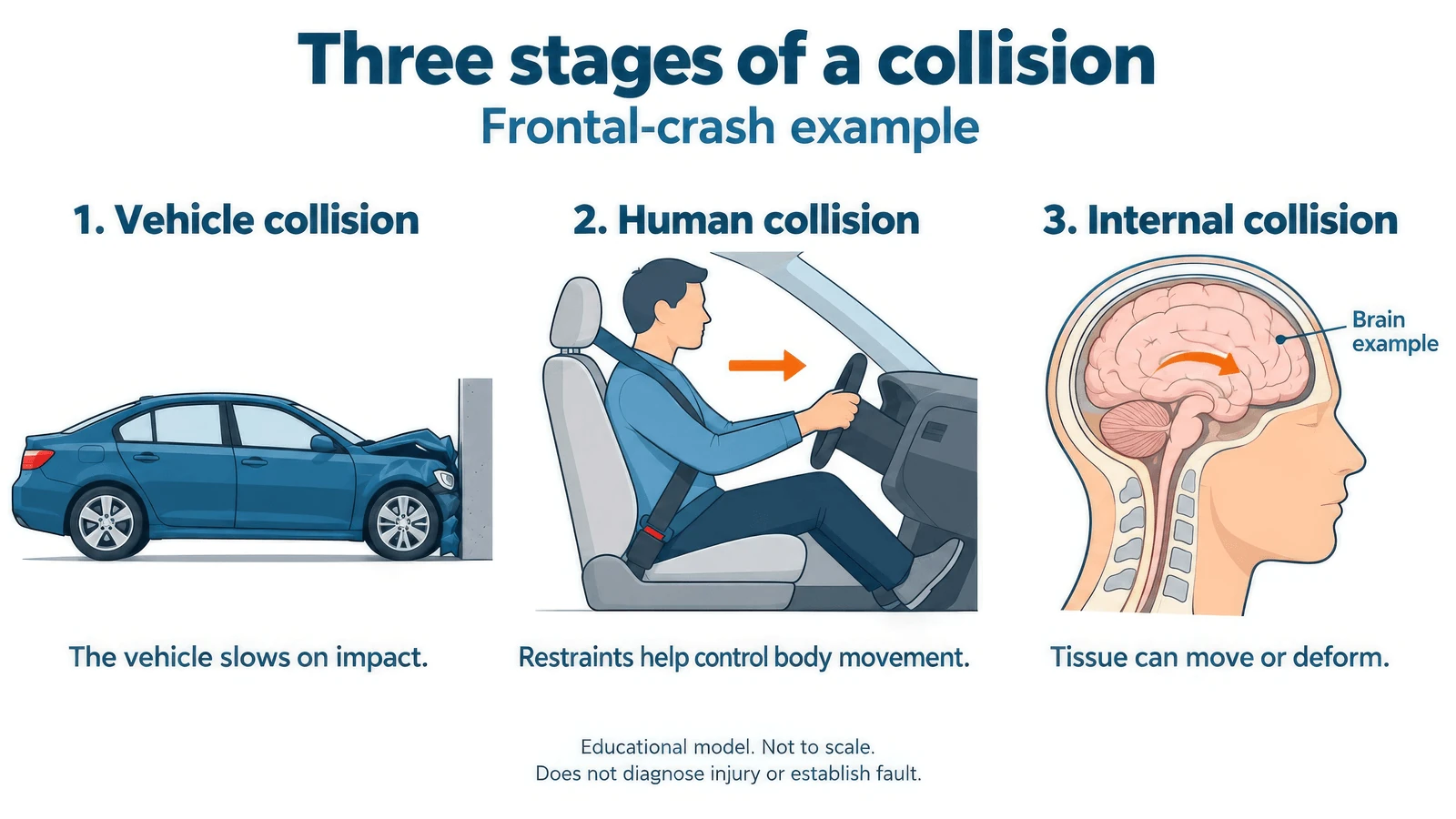
The three stages of a collision are the vehicle collision, the human collision, and the internal collision. They describe what happens to the car, its occupants, and the organs and tissues inside the body. Visible car damage alone cannot tell you whether someone was injured or how serious those injuries are.
Key Points
- The stages describe vehicle impact, occupant movement, and internal movement.
- Visible car damage alone does not determine a person’s injuries.
- Some symptoms appear later; emergency warning signs need immediate medical care.
- Medical records help document injuries and support a possible claim.
What Are the Three Stages of a Collision?
The National Child Passenger Safety Certification Training program’s training manual describes vehicle, human, and internal crashes to explain occupant protection. This is an educational model. It does not mean every crash causes three separate injuries, and it cannot diagnose an injury or establish fault.
In a frontal crash, inertia keeps your body moving as the vehicle slows. Restraints help control that movement, while organs and tissues can move or deform within the body. The direction and extent of movement depend on the impact and the restraints. These events happen rapidly, but their timing varies with the crash.
Stage One: The Vehicle Collision
The first stage occurs the instant a car collides with another vehicle, a fixed object, or a pedestrian. This vehicle collision stage typically lasts only a fraction of a second. In the training manual’s front-end example, it lasts approximately one-tenth of a second.
During this stage, parts of the vehicle may crumple. Crumple zones absorb some crash energy through deformation and help slow the passenger compartment more gradually. The reinforced cabin helps preserve space for occupants.
Variables that affect crash forces include:
- Speed: Using NASA’s kinetic-energy formula, the same vehicle traveling at 55 mph has about 3.36 times its kinetic energy at 30 mph. That calculation alone cannot predict injury severity.
- Angle: Side-impact (T-bone) and rear-end crashes transmit forces differently than head-on collisions.
- Vehicle size: As IIHS explains, people in a smaller, lighter vehicle experience greater forces when it collides with a heavier vehicle, all else being equal.
Crushed bumpers, bent frames, and shattered glass can help investigators understand the collision. Their appearance alone does not measure the forces on a particular occupant or replace a medical assessment.
Stage Two: The Human Collision
The human collision describes how occupants move relative to the vehicle and come into contact with restraints, interior surfaces, or other people. In a frontal crash, an unrestrained occupant may continue forward toward the steering wheel, dashboard, or windshield.
Seat belts spread forces across the chest and pelvis and increase the time over which the body slows. They also help prevent ejection. NHTSA estimates that lap-and-shoulder belts reduce fatal injury risk by 45% for front-seat passenger-car occupants and 60% for front-seat occupants of light trucks. Those figures describe risk reductions across groups, not a guarantee for any individual crash.
NHTSA’s airbag guidance explains that airbags supplement seat belts and reduce the chance that the head or upper body will strike the vehicle’s interior. Whether an airbag deploys depends on the crash and the system.
Without proper restraints, a driver or passenger can strike other occupants or be ejected. For example, an unbelted back-seat passenger can strike the front seat during a frontal crash and suffer facial injuries. Loose objects such as phones, laptops, tools, and groceries can also become projectiles.
A rear-end crash moves occupants differently. The seatback pushes the torso forward as the vehicle is struck from behind, while the head can lag behind the torso. The IIHS testing program examines how seats and head restraints manage this movement and the resulting stresses on the neck.
Stage Three: The Internal (Organ) Collision
The internal collision describes movement and deformation of organs and tissues during rapid changes in the body’s motion. Injury can involve stretching or compression as well as contact with surrounding structures. Organs do not all have to strike bone for an injury to occur.
The CDC’s concussion guidance explains that a hit to the body can make the head and brain move quickly back and forth. The brain may bounce or twist within the skull, stretching and damaging brain cells. A concussion is a type of traumatic brain injury and can occur without a direct blow to the head.
Blunt trauma can also injure organs such as the liver or spleen and cause internal bleeding. The American Association for the Surgery of Trauma describes splenic injuries after motor vehicle crashes, including tears and the possibility of delayed bleeding.
Medical professionals choose tests based on symptoms, examination findings, and the circumstances of the injury. The CDC notes that a CT scan is not needed to identify a concussion, although clinicians may use one when they are concerned about bleeding in the brain. A normal scan does not by itself rule out a concussion.
Injuries Associated With the Collision Stages
A single crash can involve several injury mechanisms at once. The examples below overlap; they do not establish a diagnosis or mean that an injury belongs to only one stage.
| Stage or mechanism | Possible injuries |
|---|---|
| Vehicle deformation or intrusion | Cuts from broken glass; fractures or other injuries if the passenger compartment is crushed |
| Occupant movement or contact | Whiplash, facial or rib fractures, bruising, and other soft-tissue injuries |
| Internal movement or deformation | Traumatic brain injury, organ tears, and internal bleeding |
Some injuries cause delayed symptoms, including headaches, fatigue, or neck pain. Report new or worsening symptoms to a medical professional rather than judging them by the amount of damage to the car.
Why Injuries May Not Be Obvious After a Car Crash
According to the CDC’s symptom guidance, some concussion symptoms appear immediately, while others emerge hours or days later. Symptoms may also be difficult for an injured person or family member to recognize.
Gather and colleagues’ 2026 trauma study reviewed 363 adults observed at one German trauma center after high-energy accidents despite no apparent injury requiring inpatient treatment. Researchers detected missed injuries in 3.9% of patients, including potentially life-threatening injuries in 0.6% of the full group. These figures describe that selected hospital population and should not be treated as rates for all car crash victims.
Seek prompt medical evaluation if you have symptoms or concerns after a crash. Follow discharge instructions, report new symptoms, and keep copies of medical records and test results.
When to seek emergency care
Call 911 or seek emergency care immediately for warning signs after a crash. The CDC’s danger signs include:
- A headache that keeps getting worse or repeated vomiting.
- Seizures, new weakness or numbness, or problems with coordination.
- Slurred speech, unusual behavior, confusion, or pupils of unequal size.
- Loss of consciousness or difficulty waking up.
MedlinePlus also advises emergency help for suspected internal bleeding. Warning signs can include abdominal pain or swelling, chest pain, shortness of breath, lightheadedness, or clammy skin after an injury. Get medical help before collecting evidence.
How the Three Stages of a Collision Affect Your Injury Claim
The three-stage model can help explain possible injury mechanisms. An injury claim still depends on the facts, medical evidence, applicable law, and insurance coverage. The model alone cannot establish fault, prove that a crash caused a particular injury, or determine compensation.
Vehicle and scene evidence
Document the accident scene with photos and witness information as soon as you can safely do so. Photograph the vehicles’ exteriors and interiors, skid marks, debris, and visible injuries. Save available dashcam footage. A lawyer or reconstruction specialist may also consider vehicle crush measurements and recorded vehicle data, when available.
For a commercial truck collision, relevant evidence may include driver logs, maintenance records, and data held by the trucking company. Ask a lawyer about preserving evidence before repairs or disposal affect what can be examined.
Medical records and losses
Tell your medical provider what happened, where you were seated, whether you wore a seat belt, and when symptoms began. Keep treatment notes, specialist reports, any imaging results, and photographs of bruises or seat belt marks. These records document what was reported, observed, and treated; they must be considered with the other evidence when assessing the cause of an injury.
Save medical bills, related receipts, and records of missed work. Notify your insurer as your policy requires. Which coverage may pay medical expenses, and which deadlines apply, depend on the policy and applicable law.
Preventing and Reducing Injuries in All Three Collision Stages
You cannot always avoid a car collision, but basic safety measures can reduce injury risk across all three stages. Crumple zones and reinforced cabins help manage crash energy and preserve occupant space. Restraints help control the body’s movement and reduce injury risk.
- Wear your seat belt correctly on every trip.
- Use a child restraint appropriate for the child’s age and size, installed according to its instructions and the vehicle manual.
- Adjust the seat and head restraint according to the vehicle manual.
- Secure loose objects inside the vehicle.
NHTSA explains that driver assistance systems can help prevent or reduce crashes: automatic emergency braking can slow a vehicle before impact, and lane-keeping assistance can help prevent unintended lane departures. These systems still require an attentive driver.
Drivers should keep a safe following distance and avoid distraction and impairment.
When to Call a Car Accident Lawyer After a Collision
After addressing urgent medical needs, consider contacting a lawyer if:
- You were hospitalized or have persistent symptoms.
- Fault is disputed or a settlement offer does not appear to address your documented losses.
- The crash involved a commercial truck or multiple vehicles.
- You are dealing with mounting medical costs and lost income.
Zinda Law Group’s car accident lawyers can review crash evidence and discuss a possible injury claim. Request a free case evaluation to ask about your legal options.

John (Jack) Zinda
Founder / CEO
Over 100 years of combined experience representing injured victims across the country.
Available 24 / 7|Free Consultation
Neil Solomon
Partner
Real results matter. We do not get paid unless we win your case.
Available 24 / 7|Free Consultation