













What an Erb’s palsy lawyer does
An Erb’s palsy lawyer establishes how a child’s nerve injury happened during the delivery process. The lawyer then files a medical malpractice claim where the birth records support one. The question is rarely whether the injury occurred. It is whether it was avoidable.
This page is for parents of a child diagnosed with Erb’s palsy. It covers the condition and what causes it. It also covers the realistic prospects for recovery, the compensation available, and the deadline that applies to a child.
Families who have never had the delivery explained to them in plain terms can have the medical records reviewed at no cost by Zinda Law Group. The number for a free consultation is (800) 863-5312.
What is Erb’s palsy
Erb’s palsy is a weakness or paralysis of the arm caused by damage to the upper nerves during birth. It is the most common form of brachial plexus birth palsy. Where the injury is permanent it affects the baby’s arm for life. A child’s birth injury of this kind is assessed over decades. Erb’s palsy may look mild in the first weeks and still leave a lasting deficit.

The brachial plexus is the network of nerves running from the spinal cord through the shoulder and into the arm. Erb’s palsy involves the upper ones, C5 and C6, sometimes reaching C7. Those two roots carry the signals that lift the arm and bend the elbow. Damage to those brachial plexus nerves is what produces the weakness.
Where the lower nerve roots are damaged instead, the condition is Klumpke’s palsy. The hand is affected and the shoulder is usually spared. A child with that injury has a weak grip. Damage across every root is total brachial plexus palsy, which is rarer and more serious than either.
In every form the damage sits in the nerves. What a child recovers depends on whether those nerves were stretched, scarred or torn away. The four grades of nerve damage, and the liability analysis that follows from them, are set out on the page covering brachial plexus injury claims.
Erb’s palsy is sometimes confused with cerebral palsy. The two are entirely different, and a child’s Erb’s palsy carries a very different prognosis. Cerebral palsy is caused by injury to the brain and usually affects more than one limb. A brachial plexus injury damages nerves outside the spinal cord and affects one arm.
Signs and symptoms
The signs appear in the first days of life and involve one arm only.

A limp arm The affected side hangs down while the other moves normally.
The waiter’s tip position The arm is rotated inward, the elbow straight, the forearm turned back and the wrist bent.
No Moro reflex on one side The startle reflex is absent or weak in the affected arm.
A weaker grip Less common here than in lower nerve injuries, because the hand is usually spared.
Reluctance to use it As a child grows, the affected limb may be visibly shorter or used less than the other.
Some children show no bruising at all, which is why Erb’s palsy may be identified at a routine check weeks later. A parent noticing that one of the baby’s arms is not moving is often the first record of the injury that anyone made.
What causes Erb’s palsy
A brachial plexus injury happens when the baby’s neck is stretched away from the shoulder during delivery.
Shoulder dystocia
The baby’s head delivers and the baby’s shoulder lodges behind the mother’s pelvis. This is the most common cause. It is an obstetric emergency with a defined response. That response is positional.
Excessive pulling
Excessive force applied to the baby’s head to free a stuck shoulder is the mechanism that damages the upper nerves. Correct management calls for repositioning the mother, applying pressure above the pubic bone, and rotating or delivering the posterior arm.
Breech birth
In a breech birth the arms can be pulled above the head as the body delivers. That stretches the brachial plexus nerves from the other direction. The resulting brachial plexus injury can reach every root.
Instrument delivery
Forceps and vacuum extraction apply force to the head, and a delivery that should have moved to cesarean instead carries a higher risk.
Conditions that should be recognized before delivery
A large estimated fetal weight, maternal diabetes, a prior shoulder dystocia and a prolonged labor are all documented risk factors for a difficult delivery. Health care providers are expected to identify them in advance and to plan for them. Where the chart records the factor but no plan, that absence is itself evidence.
An obstructed delivery through the birth canal is not by itself negligence, since obstruction happens. The response to it decides whether a claim exists.
Can a child fully recover
Most children do. A substantial minority do not. The difference is the severity of the nerve damage.
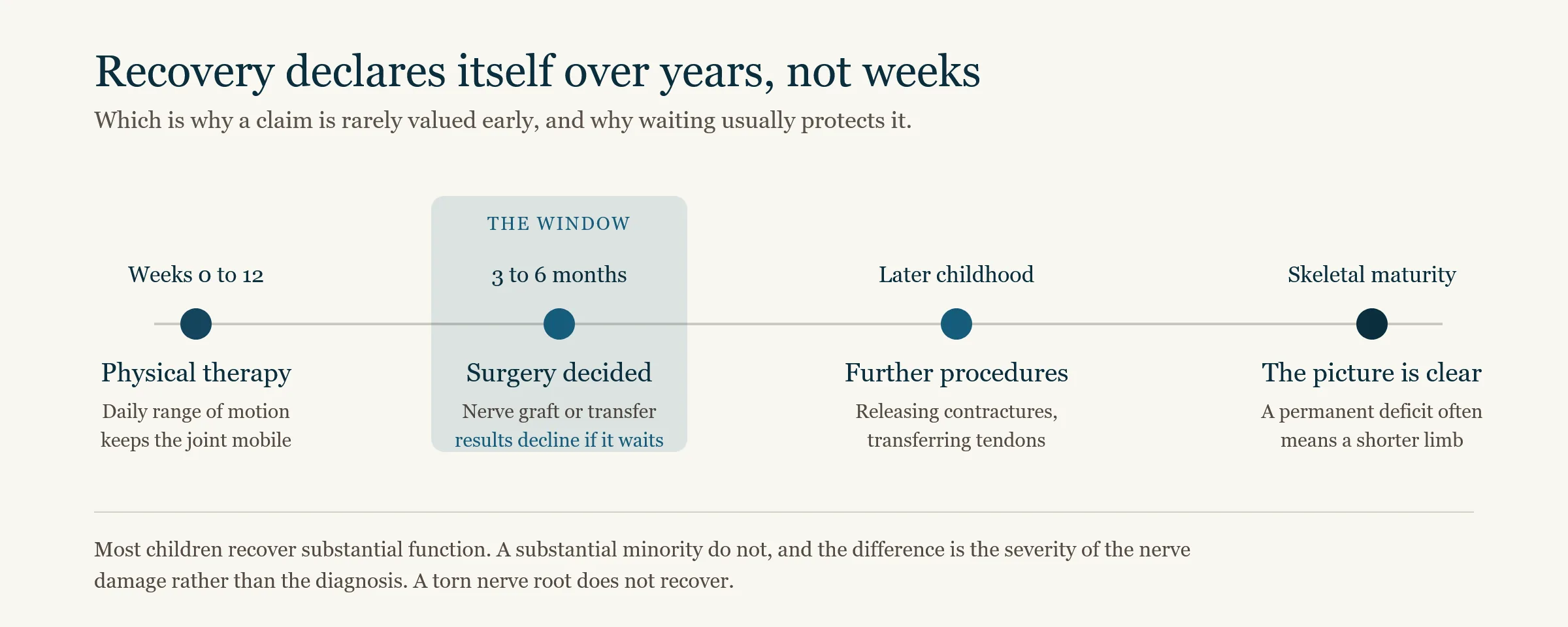
The first weeks Physical therapy begins early to keep the shoulder and elbow mobile while the nerves recover. Without it a joint can stiffen even when the nerve heals.
Three to six months If meaningful movement has not returned, surgeons consider nerve grafts or nerve transfers. This window matters, because results decline the longer the repair waits.
Later childhood Some children require surgery again to release contractures or transfer tendons. Assistive devices help with specific tasks.
Skeletal maturity A permanently affected arm often grows shorter than the other. This is when a child’s future functional level becomes clear, which is why a claim is rarely valued before it.
Severe cases can leave permanent paralysis. Where the brachial plexus nerves are torn away from the spinal cord, function does not return.
When Erb’s palsy is medical malpractice
Not every case is. Erb’s palsy may follow a well-managed delivery, and a claim needs more than a diagnosis.
Medical malpractice cases turn on two findings, and both are required. Erb’s palsy claims are no different in that respect from any other medical malpractice case. That the care fell below the accepted standard. That the failure caused the child’s injuries. Gathering evidence for both means reading the delivery record itself. The account a family was given at the time will not carry either finding.
The medical records show what was recognized and when. That is what makes them decisive. Fetal monitoring strips show distress and the hour it began. Nursing notes show who was called and when they arrived. The delivery summary names the maneuvers attempted and the order they were tried in. Medical experts read that sequence and say whether it met the standard. Their opinion is what medical malpractice lawsuits are built on.
Preparing the case therefore includes reviewing every page of the file, not the discharge summary a hospital offers first.
Medical negligence in an Erb’s palsy claim usually takes one of three forms.
- A documented risk factor that nobody acted on
- A response to shoulder dystocia that departed from accepted practice
- Traction applied to the baby’s head while the shoulder was fixed
Any one of the three can support a claim, and more than one is common. Medical malpractice cases built on all three are the strongest a family can bring.
Where the delivery was managed by a resident or a midwife, supervision becomes part of the question. More than one of the healthcare providers present may be held accountable.
What compensation is available
There is no average worth quoting. Published figures for Erb’s palsy settlements come from law firm marketing. No court record or public dataset backs them. A number drawn from those sources would not survive being checked.

What is knowable is what drives the compensation a family can recover. Each of the factors below is calculated. The records supply the inputs.
Severity A stretch that resolves in months values very differently from an avulsion causing permanent paralysis. Severity is the largest single factor in most Erb’s palsy cases.
Surgery Nerve transfers, grafts and later reconstructive procedures each carry cost and risk.
Therapy across a lifetime Physical therapy is often the largest single line item in an Erb’s palsy lawsuit.
Earning capacity A permanently weakened arm narrows the work a person can do, and an economist calculates that loss.
Medical bills and lost wages Both the child’s medical expenses and a parent’s lost income are recoverable, including wages given up for appointments. Medical expenses alone can run to six figures before a child starts school.
Future care Compensation covers the care a child will need after the claim closes, which in a permanent case means most of the care they will ever need.
Available insurance The responsible parties and their policy limits set a practical ceiling on compensation, whatever the claim is worth on paper.
Any lawyer offering a figure before reading the records is guessing. A family’s future should not rest on a guess made at a first meeting.
How long a family has to file
Deadlines for a birth injury are not the ordinary deadlines, because the injured person is a child.
Most states extend the limitation period for a minor, often substantially. Several set a separate and much shorter deadline for claims a parent brings in their own name. Claims against a public hospital can require formal notice within months.
Zinda Law Group takes legal action on these claims in Texas, Colorado, New Mexico, Arizona and Florida. The rules differ in each. It is worth checking early.
Choosing an Erb’s palsy attorney
An Erb’s palsy attorney is a specialized lawyer who concentrates on brachial plexus birth injuries. The distinction is not marketing. Birth injury work depends on hands on experience with obstetric records. That is a different skill from reading an accident report. A few questions separate an Erb’s palsy lawyer who does this regularly from a general practice taking the case on.
Which obstetric experts does the firm use, by name An Erb’s palsy attorney who has built these claims before can answer immediately without checking. Medical professionals willing to testify against a hospital are not easy to find, and a firm either has those relationships or does not.
Has the firm taken a birth injury case to trial Settlement value depends on whether the defense believes the case will actually be tried.
Who on the legal team reads the monitoring strips In a practice handling many Erb’s palsy cases, that is a named person.
Will the same palsy lawyer stay on the file These claims run for years. Continuity matters far more here than in a case that settles in months.
What happens if the case is declined A family should leave with the records they gathered and a clear explanation of why.
Erb’s palsy lawyers work on a contingency fee basis, so legal representation costs a family nothing unless the claim recovers. That is what makes it possible to act quickly on a case that would otherwise be unaffordable to investigate. An Erb’s palsy lawyer who asks for money up front is not working the way this field works.
Common Erb’s palsy questions families ask first
Three questions come up before anyone talks about filing.
Was this anyone’s fault? Sometimes. Erb’s palsy may follow a delivery that was handled correctly. The medical records are what separate the two, and no honest answer comes before someone reads them.
Is it too late? Usually not. The deadline for a child is longer than the deadline for an adult in most states, even where the medical negligence happened years ago.
What will this cost us? Nothing up front. These claims are taken on contingency, so a family pays no fee unless the claim recovers.
Any competent firm will answer all three at a first meeting. What an Erb’s palsy lawyer cannot do is value the claim before reading the file.
What has to be proved
The diagnosis alone proves nothing. An Erb’s palsy claim is proved by the delivery record, and four things have to come out of it.
That a risk was recognizable A large estimated fetal weight, maternal diabetes or a prior shoulder dystocia should appear in the prenatal chart. Where a factor is recorded and no plan follows it, that gap is the first finding.
That the response departed from accepted practice The maneuvers have a defined order. An Erb’s palsy lawyer reads the delivery summary for which ones were tried and in what sequence.
That traction caused the injury This is where most cases are won or lost. The defense is almost always that the forces of labor produced the injury on their own.
That the harm is lasting A child who recovers full movement in the first year has a very different claim from one who does not.
Each of those is answerable from documents a family can request. None of them is answerable from memory, which is why an experienced palsy lawyer asks for the file before saying anything else.
Questions a family should ask early
Waiting is common and understandable, and it is also how deadlines pass.
Can the records still be obtained Almost always yes. Hospitals retain obstetric records for years, and an Erb’s palsy lawyer can request them on a family’s behalf.
Does asking commit us to anything No. A records review is not a case, and most firms handling Erb’s palsy claims will say plainly when there is nothing there.
Will this cost anything to find out No. These claims run on contingency, so the review costs a family nothing.
What the legal process looks like
Records review The complete file is requested, including the strips, the orders and the entry times. This decides whether a case exists.
Expert evaluation An obstetrician reviews the delivery. A pediatric specialist assesses the child’s injuries and the prognosis, including how far the brachial plexus injury extends. Both opinions are needed before an Erb’s palsy lawsuit is filed.
Filing Several states require an expert affidavit with the complaint.
Discovery Medical professionals involved in the delivery give sworn testimony.
Resolution Most Erb’s palsy cases settle. Some are tried. The legal process runs months to years, largely because the injury has to declare itself before it can be valued.
Common questions
What is the average settlement for an Erb’s palsy lawsuit
No reliable average exists. Settlements are private, and the figures published online come from law firm marketing. Value depends on the severity of the nerve damage, the surgery required, the therapy projected across a child’s life, and the insurance available. A lawyer who has read the records can give a range. Nobody can give one before that.
Is Erb’s palsy considered a disability
It can be. A permanent injury that limits the use of an arm may qualify as a disability under federal law and may support a claim for school services. Cases resolving in the first year usually do not qualify. The test is lasting functional limitation.
Is it worth suing for medical negligence
That depends on whether the record supports a claim and on what the injury will cost. Where a child’s condition is permanent, the lifetime cost of care is usually far beyond what a family can absorb, and a claim is the only route to covering it. Where a child recovers fully, most lawyers will say so.
Can you fully recover from Erb’s palsy
Many children do, particularly where the nerves were stretched rather than torn. Recovery is usually apparent within the first year. Where movement has not returned by three to six months, surgery is considered. Outcomes after that vary widely. A torn nerve root does not recover, and no Erb’s palsy attorney should suggest otherwise.
Does my child’s Erb’s palsy still qualify if it was years ago
Possibly. Because the deadline for a minor is extended in most states, families who learn the cause years later often still have legal options. Delivery records are normally retrievable long after the fact.
Speak with an Erb’s palsy lawyer
If your child has Erb’s palsy and you have never been told plainly how it happened, the delivery record holds the answer and it can be read.
Zinda Law Group will review it at no cost. There is no fee unless the claim recovers.
Our Erb’s palsy lawyers handle these claims across five states. A family is told early where a case stands. Call (800) 863-5312 or use the online form to request a free consultation with an Erb’s palsy lawyer.