













What a shoulder dystocia lawsuit is
A shoulder dystocia lawsuit is a medical malpractice claim brought after a baby’s shoulder became stuck behind the mother’s pubic bone during delivery and the response to it caused a lasting injury. The emergency itself is rarely the claim. The claim is about the minutes that followed, once the baby’s head had already been delivered.
Shoulder dystocia has a defined response and every obstetric team is trained in it. The maneuvers free the baby’s shoulder by repositioning the mother and by rotating the baby inside the birth canal. None of them involves pulling harder on the baby’s head. Where the delivery record shows traction instead of maneuvers, there is usually a shoulder dystocia lawsuit to investigate.
This page is for parents of a child who suffered a birth injury during a difficult delivery. It covers what shoulder dystocia is and the risk factors a delivery team is expected to recognize in advance. It also covers the maneuver sequence, the injuries that follow when it fails, what a shoulder dystocia settlement is built from, and how long a family has to file.
Families who have never had the delivery explained to them plainly can have the medical records reviewed at no cost by Zinda Law Group. The number for a free consultation is (800) 863-5312.
What is shoulder dystocia
Shoulder dystocia occurs when the baby’s head emerges and one shoulder stays stuck behind the mother’s pubic bone. The head is out. The body cannot follow. Ordinary pushing does nothing at that point, because the obstruction is bone against bone rather than soft tissue.
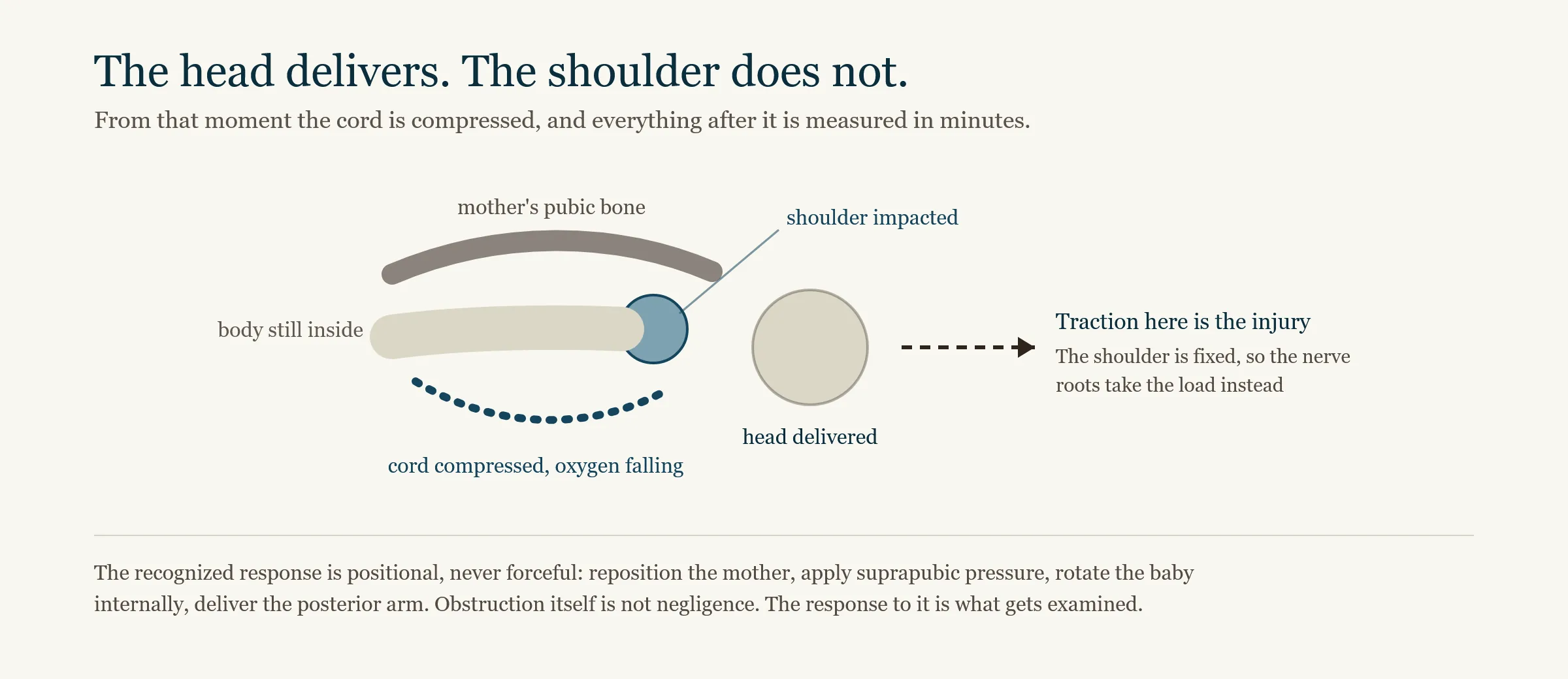
Physicians usually recognize shoulder dystocia by the turtle sign. The baby’s head delivers and then retracts back against the perineum as the shoulder catches. The next contraction pushes the head out again and it withdraws again.
This is a medical emergency and every delivery room treats it as one. The clock starts the moment the baby’s head emerges, because the chest cannot expand while the body is still inside the mother’s body. The umbilical cord is often compressed between the baby and the birth canal at the same time. Oxygen delivery falls from both directions at once.
Health care providers are not improvising when shoulder dystocia occurs. There is an agreed sequence. It is taught to every obstetrician and labor nurse. It is documented in the delivery note afterward.
Is shoulder dystocia considered high risk
It is. Shoulder dystocia is classified as an obstetric emergency, which is a higher category than a complication. Emergencies carry a required response.
Two things make shoulder dystocia dangerous. The first is time. The second is the temptation to pull.
Every minute a baby spends impacted raises the risk of oxygen deprivation and brain injury. That pressure is real and the delivery team feels it. Pulling on the child’s head relieves none of it and is how the nerves in the neck and shoulder are torn. The whole maneuver sequence exists to resolve the obstruction without traction, under time pressure, by people who are frightened.
Shoulder dystocia is also a birth trauma by any ordinary reading of the phrase. Mothers describe it as the moment the room changed. Families are often told afterward that everything went fine, and the delivery note tells a different story.
Shoulder dystocia risk factors that should be recognized before delivery
Shoulder dystocia cannot be predicted with certainty and no professional body claims otherwise. The risk factors are well documented and a delivery team is expected to know which ones a mother carries.
Recognizing them is only half of the duty. Acting on them is the other half. Where several of them stack up, accepted practice calls for a documented conversation about the mode of delivery. A cesarean section may be offered. A vaginal delivery may still be reasonable. What is not reasonable is a chart that records the risk factors and no plan at all.

Risk factors during pregnancy
Maternal diabetes Diabetes before pregnancy and gestational diabetes both change how the baby grows. Weight gathers unevenly across the shoulders and the chest. The distribution makes the shoulder catch, so maternal diabetes matters more here than raw size does.
Estimated fetal size A large estimated fetal weight is the finding most often recorded and most often ignored. Ultrasound estimates carry a wide margin of error near term. A large estimate still obliges a discussion.
Maternal obesity Maternal obesity raises the odds on its own and it frequently travels with gestational diabetes.
A prior shoulder dystocia Recurrence in a later pregnancy is common enough that obstetricians ask about it routinely. This is one of the strongest single risk factors on the list.
A post-term pregnancy Babies keep growing after the due date passes.
Risk factors during labor and delivery
Prolonged labor A second stage that stalls is a warning that the baby is not descending easily through the birth canal.
Induction and augmentation Induced contractions can push a baby into the mother’s pelvis faster than the pelvis accommodates.
Epidural anesthesia An epidural reduces the mother’s ability to shift position and to push effectively.
Instrument delivery Forceps and vacuum extraction pull the head through while the shoulders are still above the inlet. A shoulder dystocia birth injury is more likely once an instrument has been used.
A claim is often built on the gap between the two lists. The prenatal chart names gestational diabetes and a large estimated fetal weight. Neither was discussed with the mother. The same chart later records a difficult vaginal delivery that ended in a brachial plexus injury.
What is supposed to happen when shoulder dystocia occurs
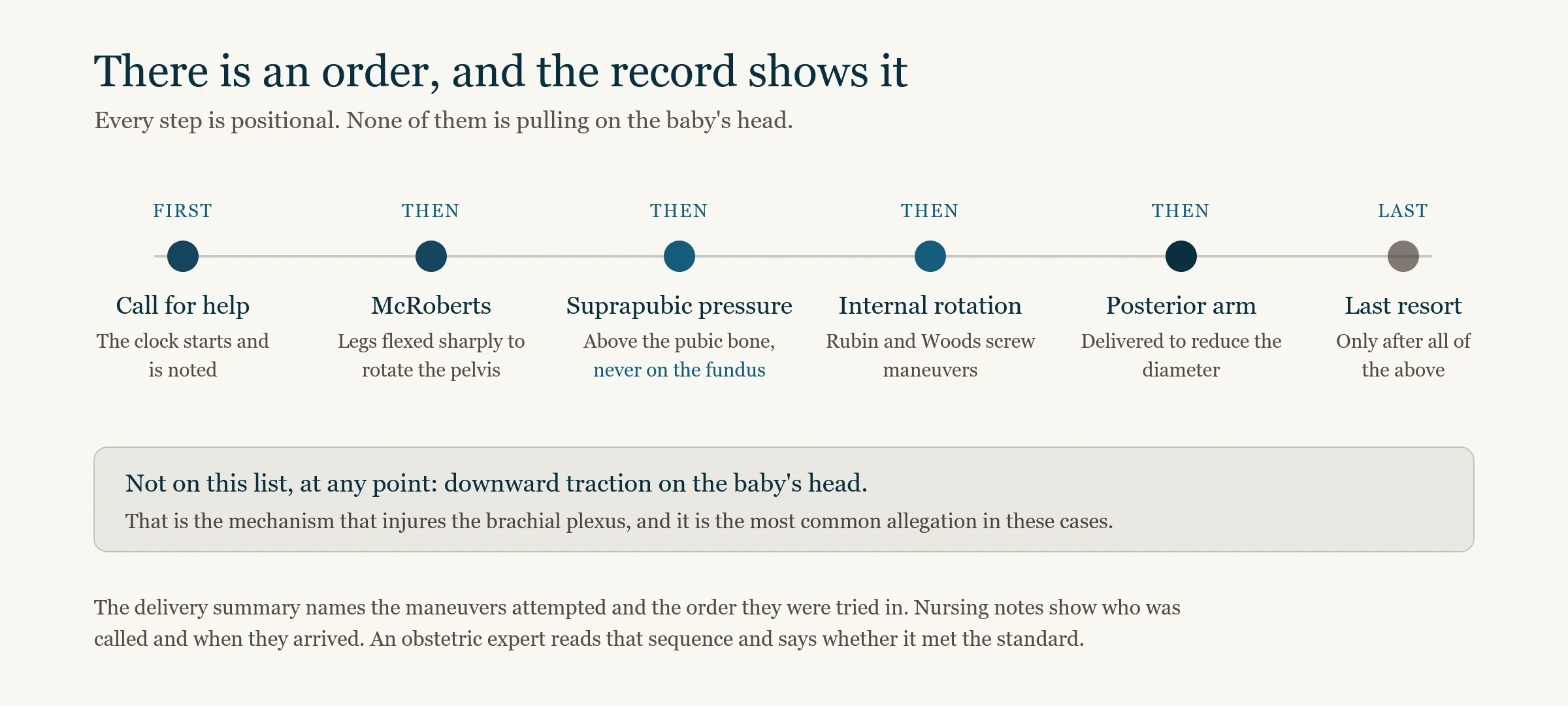
The response is a sequence and the order matters. Each step is less invasive than the one after it, so a team works down the list in order. Extra staff are called immediately and someone is assigned to record the time. The record is what later makes the sequence auditable in a shoulder dystocia lawsuit.
The McRoberts maneuver
The mother’s legs are sharply flexed back toward her chest. This rotates the pubic bone upward and flattens the lower spine, which frees the trapped shoulder without anyone touching the baby. It is first because it works often and carries almost no risk.
Suprapubic pressure
An assistant presses down and across, just above the pubic bone, to move the baby’s shoulder out of its wedged position and into the wider diagonal of the mother’s pelvis. Suprapubic pressure is usually applied together with the McRoberts maneuver.
It is not fundal pressure. Pressing on the upper part of the uterus drives the baby harder into the obstruction and makes the impaction worse. Fundal pressure during shoulder dystocia is a departure from accepted practice. It appears in delivery notes more often than it should.
The Rubin and Woods screw maneuvers
These are the internal rotations and they are frequently used together. In the Rubin maneuver the physician reaches inside and presses on the back of the baby’s shoulder to fold it forward across the chest. Narrowing the shoulders across is often enough on its own.
The Woods screw maneuver applies pressure to the front of the posterior shoulder and rotates the baby like a screw turning through the birth canal. One hand works each shoulder and the baby turns in a single direction. Rotating the wrong way, or persisting with a rotation that is not working, is a recognized way that shoulder dystocia related injuries are made worse.
Delivery of the posterior arm
The physician sweeps the baby’s rear arm across the chest and out. Removing an arm shortens the width that has to pass the pubic bone, which usually resolves the impaction. Delivery of the posterior arm is effective and it carries a real risk of fracturing that arm.
Rolling the mother and the last resort measures
The mother is moved onto her hands and knees. Gravity and the change in the shape of the mother’s body often release the shoulder without anything further.
Where everything above has failed, the remaining options are deliberate fracture of the collarbone, cutting the joint at the front of the pelvis, or pushing the head back in for an emergency cesarean section. These are rare and each carries serious risks of its own. Reaching them is not evidence of medical negligence by itself, and often the opposite. A birth injury that follows a correctly escalated sequence is usually not a claim at all.
Stay off the head
One instruction runs through the whole sequence. Nobody pulls on the baby’s head. That single rule is what most shoulder dystocia lawsuits turn on.
Every maneuver above works by changing the geometry of the pelvis or the position of the baby’s shoulders. Traction on the head does neither. It stretches the brachial plexus nerves running from the baby’s neck into the arm while the shoulder is held fixed. That stretch is the injury.
What goes wrong during a shoulder dystocia delivery
Most shoulder dystocia cases are resolved by the first two steps and the baby is delivered without lasting harm. Serious complications belong to the minority where the sequence breaks down. The shoulder dystocia cases that produce claims fail in one of a few recognizable ways.
Traction instead of maneuvers Excessive force is applied to the baby’s head because it is the instinctive response and because the head is the part the physician can reach. This is the most common allegation in a shoulder dystocia malpractice case.
Fundal pressure Someone pushes on the upper part of the uterus. The impaction tightens.
The sequence is skipped A team goes straight to an internal rotation without trying the McRoberts maneuver, or repeats one failed maneuver for minutes instead of moving on.
Nobody is watching the clock The delivery note records no times at all. Oxygen deprivation is a function of duration, so a record with no times leaves the duration unknowable.
The risk factors were never addressed The emergency may be handled correctly once it arrives. The question is whether this delivery should have been attempted through the birth canal at all.
The wrong people are in the room A junior resident or a midwife manages the emergency alone because the attending physician was not called or did not arrive.
Any one of these can support a birth injury lawsuit. More than one is common, and the delivery note usually shows them together. Preventable injuries in this area are the ones that follow a failure to plan, a failure to follow the sequence, or a failure to keep force off the head.
Injuries associated with shoulder dystocia
The injuries follow from two different mechanisms. Force applied to the baby breaks nerves and bone. Time spent impacted starves the brain of oxygen. Both start in the same place, with the baby’s shoulder held against bone inside the birth canal. A temporary or permanent injury to the arm is the most common result. The oxygen injuries are the rarer and the graver group.

Brachial plexus injuries
The brachial plexus is the bundle of nerves running from the spinal cord in the neck, through the shoulder, into the arm. Stretching the baby’s neck away from a fixed shoulder damages it. Brachial plexus injuries are the harms most closely associated with shoulder dystocia. They are what most of these claims are about.
Where the upper roots take the force, the result is usually Erb’s palsy. The arm hangs turned inward with the elbow straight. Most children recover substantial movement in the first year and some never do. The difference is the grade of nerve damage. Where a newborn suffered Erb’s palsy after an impacted shoulder, the delivery note is the document that explains it. Erb’s palsy and shoulder dystocia appear together so often that many families hear both words for the first time in the same conversation.
That injury is Erb’s palsy, and it is the most common result of an impacted shoulder. Damage to the lower roots affects the hand instead. Damage across every root leaves the whole arm weak. The four grades of nerve damage, the surgical windows and the liability analysis behind an Erb’s palsy claim are set out on the page covering brachial plexus birth injury claims.
A permanent injury to the brachial plexus nerves is assessed over decades. The child’s arm often grows shorter than the other one. The true functional level is not clear until the child stops growing. Physical therapy starts in the first weeks and frequently continues for years. Injuries of this kind are expensive to live with. The cost is spread across a lifetime.
Bone fractures
The collarbone and the upper arm bone are the two that break. A fracture may happen during a correctly performed maneuver and it may happen from traction on a fixed shoulder. Newborn fractures of this kind heal well and rarely carry a claim on their own. Their value in a case is evidentiary. A broken collarbone recorded beside a permanent birth injury tells an expert how much force reached the baby.
Oxygen deprivation and brain injury
While the baby is impacted the chest cannot expand and the umbilical cord is frequently compressed. Oxygen deprivation follows. Where it lasts long enough it produces a brain injury caused by lack of blood flow, which physicians call hypoxic ischemic encephalopathy.
The lasting result of that brain damage may be cerebral palsy, a seizure disorder, or a learning and developmental disability that only becomes visible at school age. Cerebral palsy from this mechanism affects movement and muscle control. Shoulder dystocia is one of the recognized routes to cerebral palsy. The timing recorded in the delivery note is what connects the two.
Serious complications of this kind are far less common than brachial plexus injuries and far more severe. Where the delivery note records no times, an expert reconstructs the interval from the fetal monitoring strip and the cord blood gases instead. Serious injuries to the brain are also the ones a family learns about last, because a developmental delay declares itself years after the delivery. Brain damage from shoulder dystocia is the reason these claims are sometimes filed long after everyone assumed the delivery was behind them.
Injuries to the mother from shoulder dystocia
The mother is injured too. A shoulder dystocia delivery can leave her with lasting harm of its own. Heavy bleeding after delivery, deep tearing into the rectum, separation of the pubic joint and in rare cases a tear of the uterus are all documented. A mother has her own claim for maternal injuries, separate from the child’s, and it usually carries its own shorter deadline.
When shoulder dystocia is medical malpractice
Not every case is. Shoulder dystocia happens in well-managed deliveries to careful physicians. A bad outcome is not medical malpractice on its own.
A medical malpractice lawsuit requires two findings and both are necessary. That the care fell below the accepted standard. That the substandard care caused the child’s birth injury. A shoulder dystocia birth injury that would have happened anyway is not compensable, however severe it is.
The standard of care here is unusually well defined, which is what makes these claims provable. Most areas of medicine leave room for reasonable disagreement about approach. The response to this emergency is a published sequence with an explicit instruction to stay off the head. Departing from it is visible on the page.
Medical negligence in shoulder dystocia cases usually takes one of four forms.
- Risk factors that were recorded and never acted on
- Excessive force applied to the baby’s head while the shoulder was impacted
- Fundal pressure, or a maneuver sequence that skipped steps
- A delay in calling for help or in moving to an emergency cesarean section
Medical negligence by a nurse counts as much as medical negligence by a physician. Fundal pressure is often applied by nursing staff. The hospital is answerable for its employees, and more than one of the health care providers present may be named.
The phrase preventable birth injuries carries the whole distinction. Shoulder dystocia itself is not preventable in any reliable sense. The harm that follows it often is, and that is the line a claim is drawn along.
Proving a shoulder dystocia claim
These claims are won and lost in the delivery note. A shoulder dystocia claim is a documents case before it is anything else. Everything follows from what that one document says.
The delivery note The note names the maneuvers attempted, the order they were tried in and the time each one took. A thorough note is a gift to both sides. A note reading only that the shoulder was delivered with gentle traction, after a delivery that produced a permanent nerve injury, is its own kind of evidence.
The fetal monitoring strip The strip shows fetal distress and the minute it began. It also fixes the interval between the head and the body, which is how oxygen deprivation is quantified.
The nursing notes These record who was called, when they arrived and what each person did. Nursing notes and physician notes disagree more often than either side expects.
The prenatal chart Estimated fetal weights, glucose testing, weight gain and any earlier difficult delivery all live here. The prenatal chart is where the risk factors were recorded, so it is where a failure to plan is proved.
The neonatal examination Which arm, which nerve roots, whether a bone was fractured, and the Apgar scores in the first minutes. The pattern of injury shows the direction the force came from.
Medical experts read that material and say whether the care met the standard. An obstetrician addresses the delivery. A pediatric neurologist or a specialist in brachial plexus injuries addresses the child’s injury and what it means for the rest of the child’s life. Their opinions are what a shoulder dystocia lawsuit is built on, and several states require an expert affidavit before the case can even be filed.
Getting the complete file matters more than families expect. Hospitals routinely produce a discharge summary and a partial record on the first request. The monitoring strips and the nursing notes are what the claim turns on. Those medical records have to be asked for by name.
What the defense will argue in a shoulder dystocia lawsuit
Knowing the defense in advance explains why the file is gathered the way it is.
That the injury happened before delivery Defense experts argue that the forces of labor itself, rather than the physician, damaged the brachial plexus. The pattern of injury and which arm was affected are the answer to this.
That the mother’s pelvis was the problem Cephalopelvic disproportion is a real diagnosis and a standard defense. Where it was recognized before delivery, the argument works against the defense.
That the maneuvers were performed and simply not written down This one is common. It asks a jury to prefer a physician’s memory of a shift years ago over the note written that night.
That the outcome was unavoidable Shoulder dystocia is genuinely unpredictable and the defense will say so. Unpredictable is not the same as unmanageable, and the claim is about the management. Where the risk factors were sitting on the chart all along, unavoidable is a harder argument to make.
An experienced shoulder dystocia lawyer builds the file to meet these arguments from the beginning. The sequence in the note, the times on the strip and the pattern of the child’s injury are what answer them.
What a shoulder dystocia settlement covers
There is no average shoulder dystocia settlement worth quoting. Every published average birth injury settlement figure traces to law firm marketing rather than to a court or a public dataset. The verdicts that circulate are the outliers that got reported. A number drawn from those sources would not survive being checked.

What is knowable is what a shoulder dystocia settlement is built from. An expert calculates each item below.
Medical expenses already incurred Emergency care at delivery, the neonatal stay, imaging, surgery and every appointment since. Medical bills in a serious case run high before the child starts school.
Future medical care Nerve surgery, orthopedic surgery, assistive equipment and the medical expenses of a lifetime. In a permanent case this is usually the largest number in the claim. Preventable birth injuries are expensive because the cost runs for a lifetime.
Physical therapy and occupational therapy These begin in the first weeks and often never fully stop.
Lost earning capacity A permanently weakened arm or a cognitive injury narrows the work the child will be able to do as an adult. An economist calculates that loss.
The parents’ losses Wages given up for appointments and surgeries are recoverable, and so are the medical expenses parents paid directly.
Pain and suffering Compensation for the child’s pain and for the loss of ordinary function and ordinary childhood.
Available insurance Policy limits and the number of responsible parties set a practical ceiling, whatever the claim is worth on paper. Some states also cap non-economic damages, and those caps differ enormously.
Two claims with identical injuries can settle very differently, because the strength of the delivery record differs. A successful shoulder dystocia lawsuit built on a detailed note showing traction is worth more than the same injury with a note that records nothing. A shoulder dystocia settlement reached before the child’s long-term function is known is worth less than one reached after.
Any lawyer who offers a figure before reading the file is guessing. A successful shoulder dystocia lawsuit starts with the record and not with a number.
How long a family has to file a shoulder dystocia lawsuit
Deadlines for a birth injury are not the ordinary personal injury deadlines, because the injured person is a child.
Most states extend the limitation period for a minor and several extend it substantially. Nearly all of them set a separate and much shorter deadline for the claim a parent brings in their own name. Claims against a public hospital or a military facility can require formal notice within months of the delivery.
Zinda Law Group takes legal action on birth injury cases in Texas, Colorado, New Mexico, Arizona and Florida. The rules differ in every one of them. Families who assume a child’s claim can wait until the injury declares itself sometimes find the parents’ claim has already expired.
A free consultation settles the question quickly. The deadline that applies to a shoulder dystocia lawsuit depends on the state and on who the defendant is. Where the medical negligence alleged involves a public facility, the notice period can be far shorter than the limitation period behind it.
Choosing a shoulder dystocia lawyer
A shoulder dystocia attorney reads obstetric records for a living. That is a different skill from reading an accident report. It is what separates a birth injury practice from a general personal injury firm taking one of these on.
A few questions sort one from the other.
Who reads the fetal monitoring strips In a practice that handles these regularly, the answer is a named person on the legal team rather than an outside service.
Which obstetric experts the firm uses A shoulder dystocia attorney who has built these claims before can answer without checking. Medical professionals willing to testify against a hospital are difficult to find.
Whether the firm has tried a birth injury case What a shoulder dystocia settlement is worth depends partly on whether the defense believes the case will be tried.
Who stays on the file These claims run for years, because the child’s injury has to declare itself before it can be valued. Continuity matters more here than in a case that resolves in months.
What happens if the case is declined A family should leave with the records they gathered and a plain explanation of why.
Birth injury lawyers work on a contingency fee basis. Legal representation costs the family nothing up front and the fee comes out of the recovery. An experienced medical malpractice attorney who asks for money before filing is not working the way this field works. A medical malpractice lawyer who takes the case is also taking the cost of the expert reviews, which in one of these cases is substantial. That arrangement is what lets birth injury lawyers investigate a shoulder dystocia claim a family could never afford to investigate alone.
What the legal process looks like in a shoulder dystocia case
The legal process is long and most of the length is medical.
Records review The complete file is requested by name, including the strips, the nursing notes and the prenatal chart. This is what decides whether a case exists.
Expert evaluation An obstetrician reviews the shoulder dystocia delivery itself. A pediatric specialist assesses the child’s injury and the prognosis.
Filing Several states require an expert affidavit alongside the complaint, and some require notice to the provider before that.
Discovery The physician, the nurses and the hospital give sworn testimony about a shift that happened years earlier.
Resolution Most birth injury cases settle and some are tried. Shoulder dystocia cases follow the same pattern. Where the injury is permanent, valuation often waits until the child is old enough for the long-term picture to be clear.
Common shoulder dystocia questions
Do most babies survive shoulder dystocia?
Yes. The large majority of babies delivered after shoulder dystocia are born alive and go home without a permanent injury. Death is rare and it is not the usual concern. The injuries that make a shoulder dystocia lawsuit worth investigating are the lasting ones. A brachial plexus injury to the arm is the most frequent of them.
Is shoulder dystocia considered a traumatic birth?
Yes. It is an obstetric emergency and the record usually describes it as birth trauma. Where the baby suffered a birth injury during it, the delivery note is what explains how. A mother who was never told what happened, and who cannot square the delivery she remembers with the summary she was given, is describing something that a review of the record can usually resolve.
What is the average settlement for a shoulder dystocia injury?
No reliable average exists. Settlements are private and the figures published online come from law firms. Value depends on how permanent the injury is, the surgery and therapy projected across a lifetime, the lost earning capacity, the strength of the delivery record and the insurance available. A lawyer who has read the file can give a range. Nobody can give one before that.
Can shoulder dystocia cause cerebral palsy?
It can. Where a baby experiencing shoulder dystocia is impacted long enough for oxygen deprivation to injure the brain, cerebral palsy is one of the possible results. This is much less common than a nerve injury and much more serious. The interval between the head and the body, taken from the delivery note and the monitoring strip, is what an expert uses to assess it.
Can shoulder dystocia be prevented?
Not reliably, and no responsible source claims it can. What can be managed is the risk. Recognizing the risk factors, discussing the mode of delivery with the mother, and responding to the emergency with the correct maneuvers are all within a delivery team’s control. Serious birth injuries in this area follow a failure in one of those three things far more often than they follow bad luck.
Can a hospital be sued for shoulder dystocia?
Yes, where the delivery was mishandled by its staff. Hospitals are answerable for their employees, which usually includes the nurses and often includes resident physicians. An attending obstetrician in private practice may be sued separately. Naming every responsible party matters, because the available insurance is what a family can actually recover against.
Speak with a shoulder dystocia lawyer
If your child was diagnosed with a nerve injury or a brain injury after a shoulder dystocia delivery, the delivery record holds the explanation and it can be read.
Zinda Law Group will review it at no cost. There is no fee unless the claim recovers.
Our birth injury lawyers handle shoulder dystocia cases across five states. Call (800) 863-5312 or use the online form to request a free consultation with a shoulder dystocia lawyer.