




A contrecoup injury is a bruise on the brain that forms on the side opposite the place where the head was struck. A bruise directly under the point of impact is called a coup injury, and one blow can cause both. This article explains the terms and what they can mean for a claim. It is not medical advice, so follow your own doctor’s guidance.

What Is a Contrecoup Injury?
Doctors use the word contusion for a bruise on the brain. The National Institute of Neurological Disorders and Stroke, or NINDS, describes contusions as bruising or swelling that happens when very small blood vessels bleed into brain tissue.
NINDS says a contusion can happen directly under the impact site, which is a coup injury, or, more often, on the opposite side of the brain from the impact, which is a contrecoup injury. Each is a kind of traumatic brain injury, often shortened to TBI.
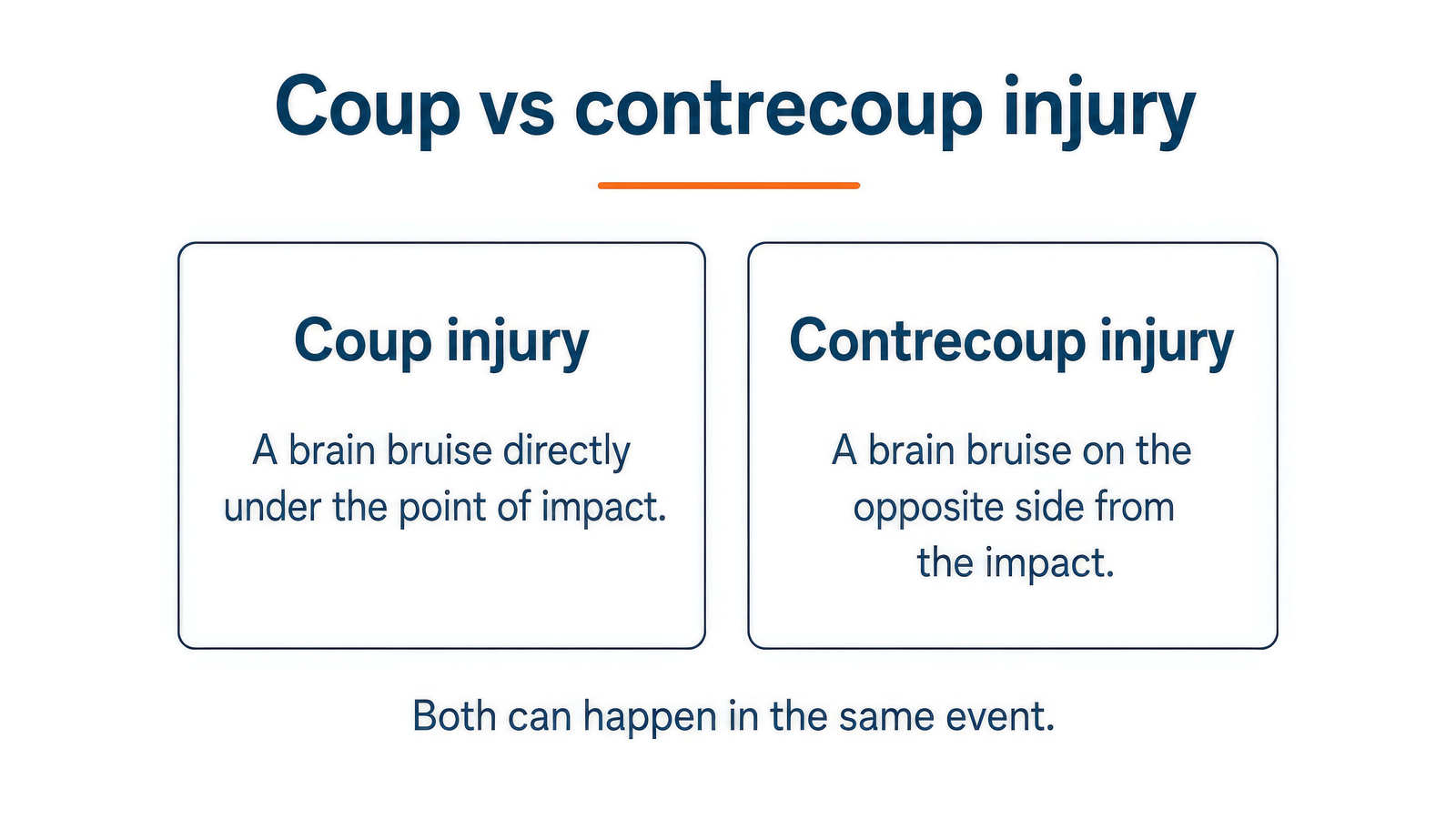
Johns Hopkins Medicine explains how one blow can cause both. A bruise forms at the site of impact, and as the brain jolts backward it can hit the skull on the opposite side and cause a second bruise. It calls that mechanism coup-contrecoup. People also search for it as a coup contrecoup injury or a coup contrecoup brain injury.
What Is the Difference Between Coup and Contrecoup?
The difference is where the bruise forms compared with where the head was struck.
| Question | Coup | Contrecoup |
|---|---|---|
| Where the bruise is | Under the point of impact | On the opposite side of the brain |
| How it forms | Trauma at the site of impact | The brain hits the opposite side of the skull |
| How often, per NINDS | Less often | More often |
The words come from French. Coup means blow, and contrecoup means counterblow.
How Does a Contrecoup Injury Happen?
According to NINDS, a closed head injury is caused by an outside force strong enough to move the brain within the skull. Contusions generally happen when the head abruptly decelerates, which causes the brain to bounce back and forth within the skull, as in a high-speed car crash.
Here is a hypothetical. A driver stopped at a light is hit from behind, and the back of the driver’s head strikes the headrest. In an event like that, a coup injury would be at the back of the brain, under the place the head hit, and a contrecoup injury would be at the front. Whether either one formed is a medical question.
NINDS lists these among the leading causes of TBI:
- Falls: citing the Centers for Disease Control and Prevention (CDC), NINDS calls falls the most common cause.
- Being struck by or against an object: including sports injuries.
- Vehicle-related injuries: involving motor vehicles, bicycles, and pedestrians.
What Symptoms Can Follow a Contrecoup Injury?
Symptoms depend on the person and the injury, and they do not always show up at once. NINDS notes that contusions can appear after a delay of hours to a day. The CDC says some symptoms of a mild TBI or concussion appear right away, while others may not appear for hours or days.
These agencies do not list symptoms for a contrecoup injury by itself, so the lists below are for traumatic brain injury. The CDC groups symptoms of a mild TBI or concussion this way:
- Physical: headaches, dizziness or balance problems, nausea, vision problems, and being bothered by light or noise
- Thinking and remembering: trouble concentrating, memory problems, and feeling slowed down or foggy
- Social or emotional: anxiety, irritability, and sadness
- Sleep: sleeping more or less than usual, or trouble falling asleep
Danger signs that need emergency care
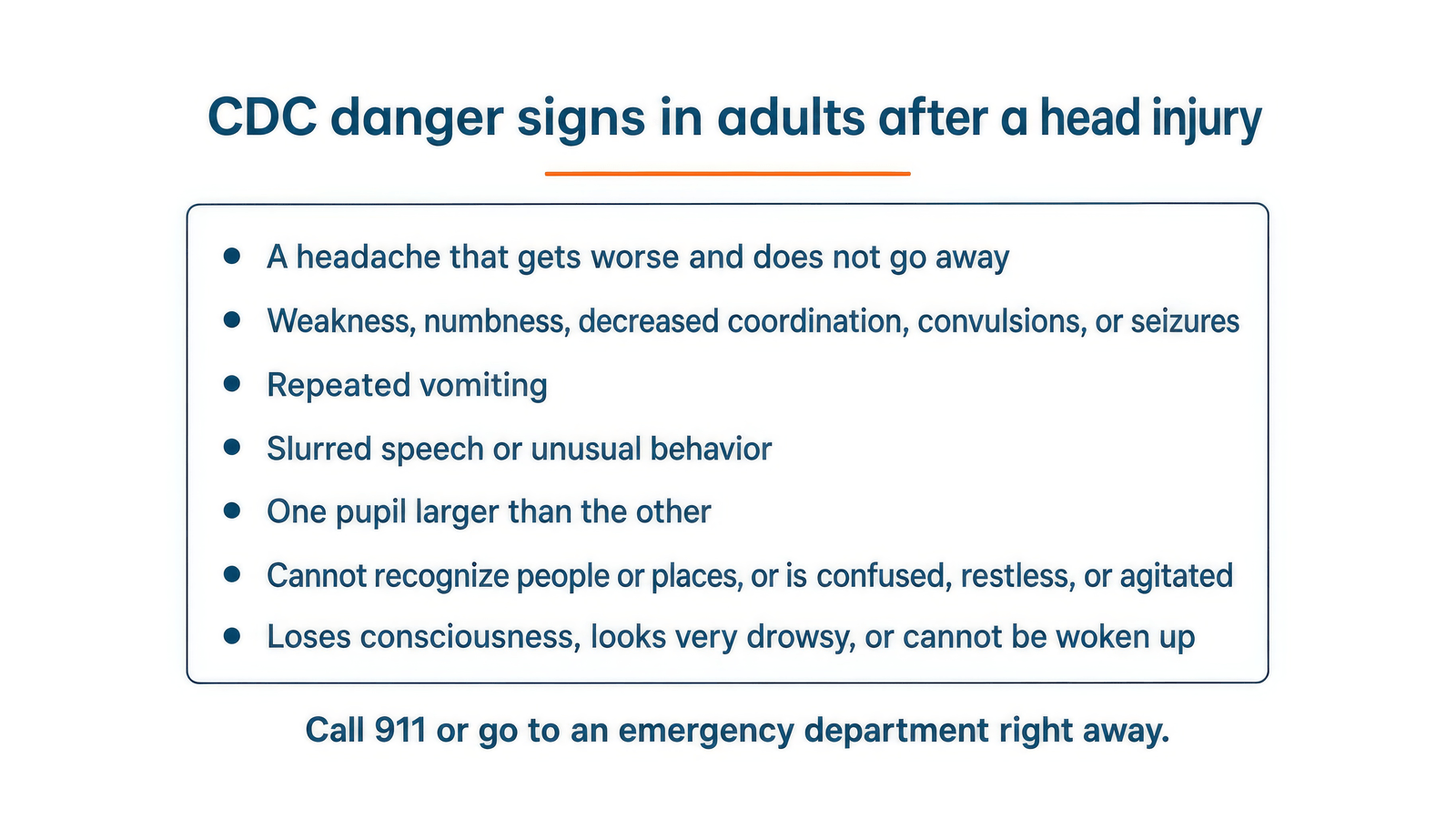
The CDC says that in rare cases a dangerous blood clot that crowds the brain against the skull can develop. It says to call 911 or go to an emergency department right away if an adult has any of these danger signs:
- A headache that gets worse and does not go away
- Weakness, numbness, decreased coordination, convulsions, or seizures
- Repeated vomiting
- Slurred speech or unusual behavior
- One pupil larger than the other
- Not recognizing people or places, or becoming confused, restless, or agitated
- Losing consciousness, looking very drowsy, or not being able to be woken up
For a child, the CDC adds two more signs: crying that will not stop and cannot be consoled, and refusing to nurse or eat.
How Do Doctors Find a Contrecoup Injury?
MedlinePlus says that if you have a head injury that may have caused a TBI, you need to get medical care as soon as possible. A provider will ask about your symptoms and the details of the injury.
NINDS explains that a neurological exam checks motor and sensory skills, coordination and balance, mental status, and changes in mood or behavior. Imaging may follow. NINDS says a CT scan can show a skull fracture and any brain bruising, bleeding, or swelling, and that an MRI is more sensitive and can pick up subtle changes a CT scan may miss.
Your doctor decides which tests you need and what the results mean.
Why Are These Injuries Sometimes Missed at First?
There are a few reasons. The bruise itself can take hours to appear, and symptoms can start days later. The CDC also warns that after a mild TBI or concussion a person may not recognize or admit they are having problems, and that problems may be overlooked by the person, their family members, or their health care provider.
NINDS says people with a mild TBI should make a follow-up visit with their health care provider and talk about new or ongoing symptoms, even ones that seem unrelated to the injury. Write down new symptoms with the date, and keep every follow-up visit.
What Does a Contrecoup Injury Mean for an Injury Claim?
The diagnosis does not decide a claim, but it shapes the evidence. A claim generally has to show that someone else’s carelessness caused the event, that the event caused the injury, and how the injury changed your life. A personal injury lawyer can gather:
- How it happened: crash or incident reports, photos, and witness accounts
- Medical proof: emergency records, CT and MRI reports, and notes from follow-up care
- Daily impact: missed work, changes at home, and what family members have noticed
Our guides on proving brain injury damages and steps after a brain injury go further. Filing deadlines vary by state, so ask about yours early.
FAQs About Contrecoup Injuries
Can you have a contrecoup injury without hitting your head?
NINDS does not answer that directly. It says a forceful bump, blow, or jolt to the head or body can cause a traumatic brain injury. Whether a bruise formed, and where, is for your doctor to say.
Is a contrecoup injury the same as a concussion?
No, they are different terms. MedlinePlus describes a concussion as a type of mild TBI. A contrecoup injury is a bruise on the brain, which NINDS calls a contusion. Ask your doctor to explain the words in your records. Our concussion injury page covers that diagnosis.
Should I keep copies of my scans and records?
Yes. Ask for the radiology reports as well as the images, and keep discharge papers and visit summaries together. These records help your doctors follow your recovery, and they can be important proof of the injury if you bring a claim.
Talk With Zinda Law Group
You do not need to understand every medical term before you contact us. Zinda Law Group offers a free consultation to explain your options. If we do not win, you will not be responsible for attorney’s fees, court costs, or litigation expenses. If you do win, these expenses and unpaid medical bills will be taken from your share of the recovery.
If you or a family member has a brain injury after a crash or fall, you can reach us through the case evaluation form.

John (Jack) Zinda
Founder / CEO
Over 100 years of combined experience representing injured victims across the country.
Available 24 / 7|Free Consultation
Neil Solomon
Partner
Real results matter. We do not get paid unless we win your case.
Available 24 / 7|Free Consultation