


The difference in interstate vs intrastate trucking is where the freight is going. Interstate trucking carries cargo across state lines, or as one leg of a trip that crosses them, under federal rules. Intrastate trucking stays inside one state under that state’s rules. A truck accident lawyer checks which one applied because it can change the rules, insurance, and evidence in your case.
What Is the Difference Between Interstate and Intrastate Trucking?
The Federal Motor Carrier Safety Administration (FMCSA) defines both terms in 49 CFR 390.5. Interstate commerce is trade or transportation between a place in a state and a place outside it, between two places in a state through another state, or between two places in a state as part of a trip that starts or ends outside the state. Intrastate commerce is any transportation within a state that does not fit that description.
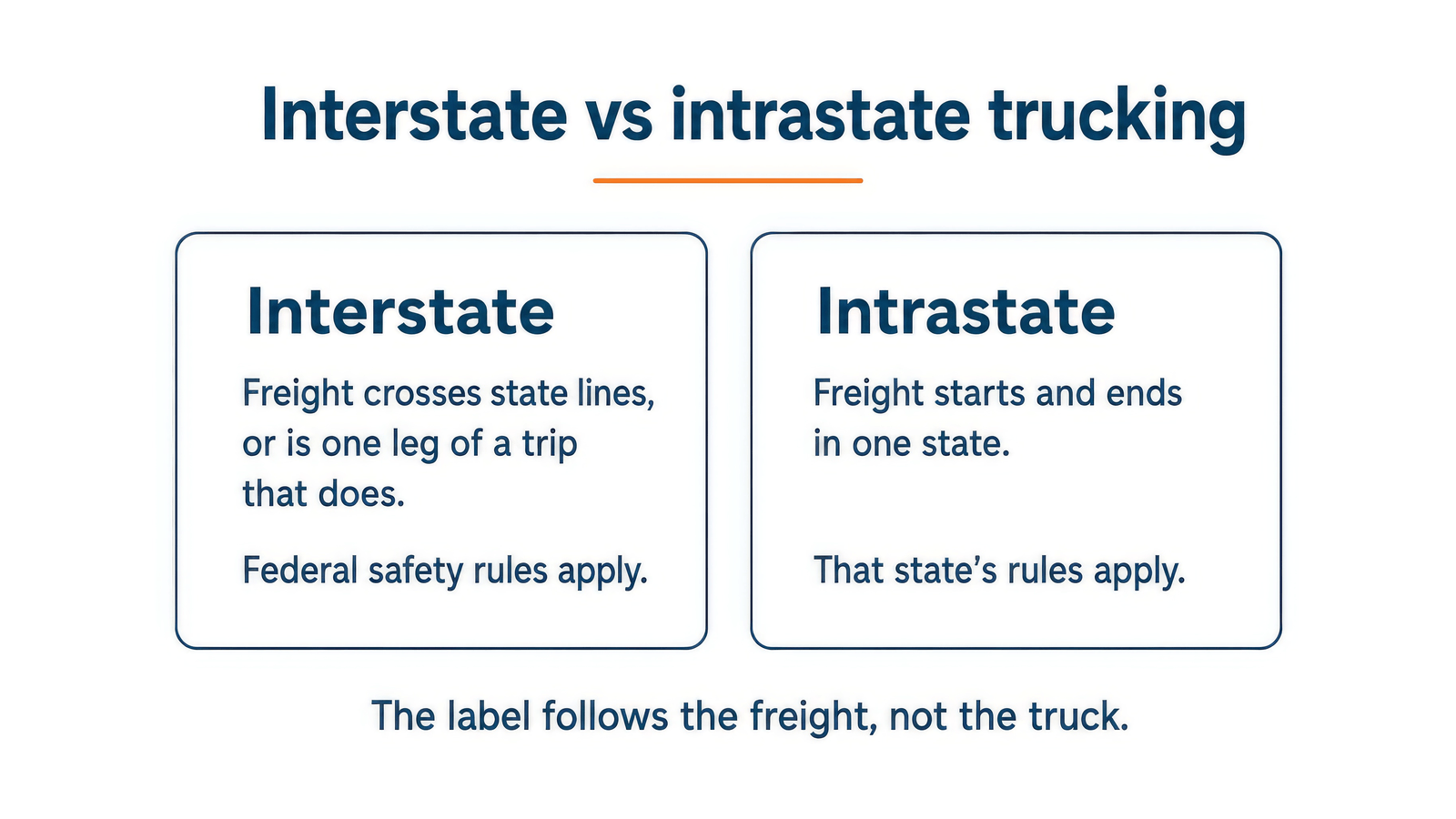
The label describes the trip, not the company. Many carriers run both kinds of loads, and the same truck can haul an interstate load in the morning and an intrastate load in the afternoon.
| Question | Interstate trucking | Intrastate trucking |
|---|---|---|
| Where the freight goes | Across state lines, or within one state as part of a trip that crosses them | Starts and ends in one state, and is not part of a longer trip |
| Main regulator | FMCSA, a federal agency | The state, which often adopts most federal rules |
| Safety rules | 49 CFR Parts 390 to 399 | State rules. Texas adopts most federal rules |
| Insurance minimums | 49 CFR Part 387 | State law. Texas sets its own minimums |
| Registration | USDOT number from FMCSA | State registration, and in many states a USDOT number too |
Can a Truck Be in Interstate Commerce Without Leaving the State?
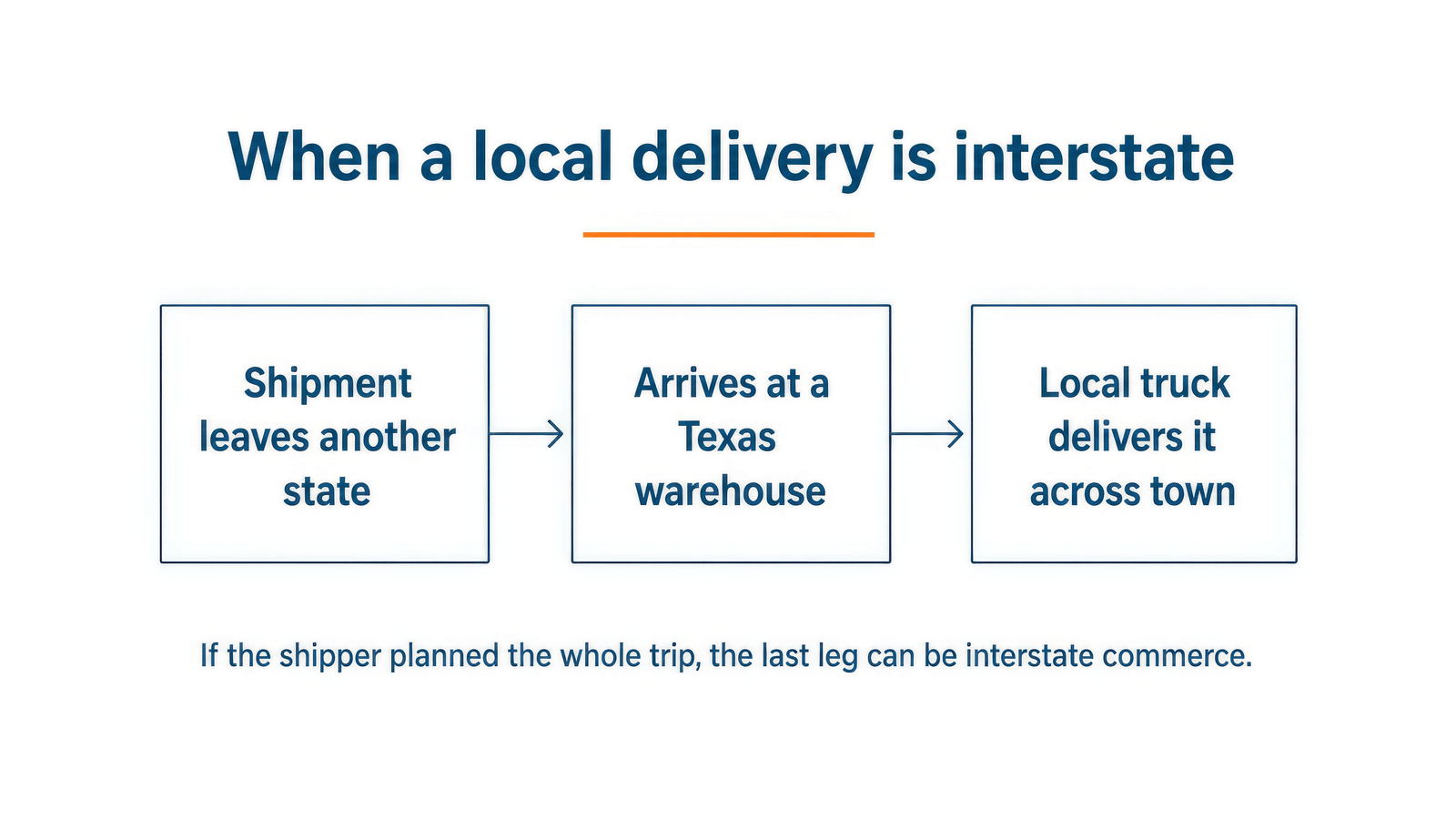
Yes. What matters is the journey of the cargo, not the route of one truck. In its interstate commerce guidance, FMCSA says the question turns on the essential character of the movement, shown by the shipper’s fixed and persistent intent at the time of shipment. When that intent is interstate, the federal rules can apply even if the route stays inside one state.
Here is a hypothetical. A truck picks up pallets at a Dallas warehouse and delivers them across town. The pallets arrived from another state a few days earlier and were always headed to that final address. That local delivery can count as interstate commerce, depending on the shipping documents and what the shipper intended.
Which Safety Rules Apply to Each Kind of Trip?
Both kinds of trucking have safety rules. The difference is which rulebook applies and which agency enforces it.
Federal rules for interstate trips
Interstate trips fall under the Federal Motor Carrier Safety Regulations in 49 CFR Parts 390 to 399. These cover the subjects that most often matter after a crash:
- Driver qualification, including medical certification and driving history
- Hours of service, which limit driving and on-duty time
- Vehicle inspection, repair, and maintenance
The federal definition of a commercial motor vehicle in section 390.5 generally starts at a weight rating of 10,001 pounds.
How Texas treats in-state trips
Texas adopts most of the federal regulations for in-state trucking through 37 Texas Administrative Code 4.11, enforced by the Texas Department of Public Safety. The rule does not reach every truck. Among other categories, it applies those regulations to an in-state vehicle with a weight or weight rating over 26,000 pounds.
That gap matters. A mid-size delivery truck may be covered by the federal regulations on an interstate trip and fall outside the Texas rule on a purely in-state one.
How Do Insurance Minimums Differ?
Federal law sets the minimum for for-hire interstate carriers. Under 49 CFR 387.9, a for-hire carrier hauling nonhazardous property in interstate commerce, in a vehicle rated at 10,001 pounds or more, must carry at least $750,000 in liability coverage. The same section sets $1,000,000 or $5,000,000 for certain hazardous cargo.
In-state carriers answer to state law. Texas sets its own minimums by vehicle and cargo type under 43 Texas Administrative Code 218.16. The Texas Department of Motor Vehicles lists a $500,000 minimum for most carriers running vehicles over 26,000 pounds, which is lower than the federal figure. Our guide to Texas trucking insurance requirements explains the state rules.
A minimum is only a floor. Many carriers buy more coverage, and an excess policy, a broker, or a shipper may add other sources of recovery. A Texas truck accident lawyer can look for every policy that may apply.
What Records Show Which Rules Applied?
You are not expected to know at the scene whether the trip was interstate or intrastate. That answer comes from documents, and a lawyer usually requests these first:
- Bills of lading and shipping orders: where the freight started and where it was going
- The carrier’s USDOT registration: how the company describes its own operations to FMCSA
- Electronic logging device data and driver logs: where the truck traveled and for how long
- Driver qualification and maintenance files: what the carrier checked before the trip
FMCSA says a USDOT number is required for companies that operate commercial vehicles in interstate commerce. It also lists Texas among the states that require one for in-state carriers, so the number alone does not settle the question.
Some of these records do not have to be kept for long. Under 49 CFR 395.8, a carrier must keep driver duty status records for at least six months, so early preservation requests matter. Our overview of FMCSA records covers what the agency publishes, and our page on interstate trucking accidents explains how these claims proceed.
FAQs About Interstate vs Intrastate Trucking
Does interstate trucking move my case to federal court?
Not by itself. Where a case is filed depends on several things, including where the crash happened, where the people and companies involved are based, and the amount in dispute. A lawyer can explain which courts are available for your facts.
Do I need the truck’s USDOT number to start a claim?
No. It helps if you have it, and it is often printed on the side of the cab, so a photo from the scene may capture it. If you do not have it, a lawyer can usually identify the carrier from the crash report, the license plate, or the company name on the truck. Other details worth noting at the scene are covered in our article on steps after a truck wreck.
Do other states treat in-state trucking the same way as Texas?
No. Each state decides how much of the federal rulebook to adopt for trucks that stay inside its borders, and each sets its own insurance minimums. If your crash happened outside Texas, ask a lawyer licensed in that state which rules apply.
Talk With Zinda Law Group
You do not need to work out which rules applied before you call. Zinda Law Group offers a free consultation to explain your options. If we do not win, you will not be responsible for attorney’s fees, court costs, or litigation expenses. If you do win, these expenses and unpaid medical bills will be taken from your share of the recovery.
If you were hurt in a crash with a commercial truck, you can reach us through the case evaluation form.

John (Jack) Zinda
Founder / CEO
Over 100 years of combined experience representing injured victims across the country.
Available 24 / 7|Free Consultation
Neil Solomon
Partner
Real results matter. We do not get paid unless we win your case.
Available 24 / 7|Free Consultation