



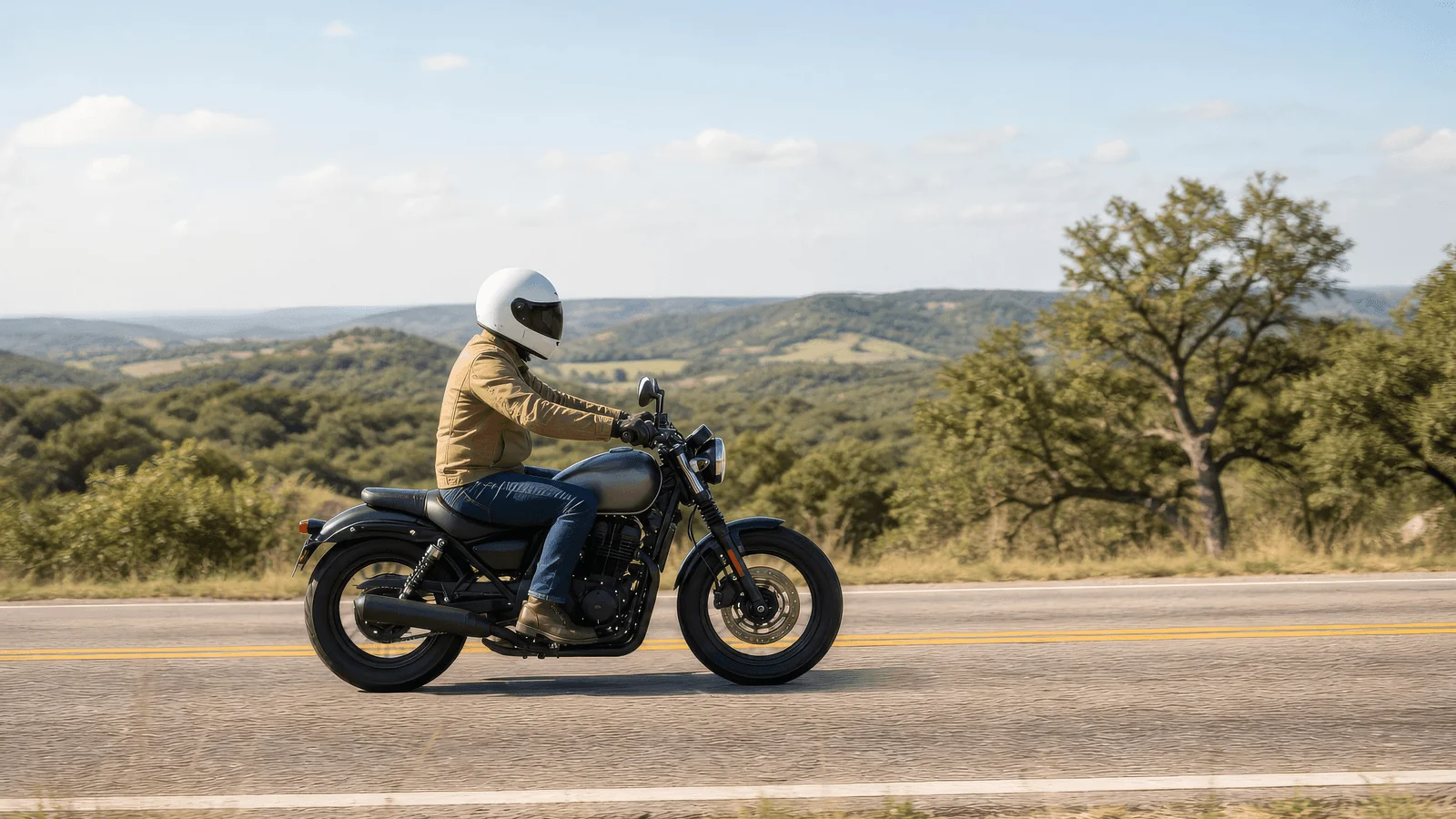
Is lane splitting legal in Texas? No. Since September 1, 2023, a state statute has said a motorcycle operator may not ride between lanes of traffic moving in the same direction or pass a motor vehicle while in the same lane. This guide is for Texas motorcycle riders, drivers, and anyone hurt in a motorcycle accident. It covers what the law says, how lane splitting differs from lane filtering and lane sharing, and how lane position can affect an injury claim.
What Does Texas Law Say About Lane Splitting?
Texas Transportation Code Section 545.0605 bars a motorcycle operator from riding between lanes of traffic moving in the same direction and from passing a motor vehicle while in the same lane. House Bill 4122 added the section, the governor signed the bill on June 12, 2023, and the new law took effect that September 1.
The statute never uses the words “lane splitting.” It describes the conduct instead. Under it, the operator of a motorcycle:
- Is entitled to full use of a lane
- May ride two abreast in a single lane with another motorcycle
- May not ride more than two abreast in a single lane with other motorcycles
- May not operate the motorcycle between lanes of traffic moving in the same direction
- May not pass a motor vehicle while in the same lane as the vehicle being passed
The three limits do not apply to “a police officer in the performance of the officer’s official duties.” You may still see lane splitting described online as a gray area under Texas motorcycle laws. The wording of this statute now answers the question.
What Is the Difference Between Lane Splitting, Lane Filtering, and Lane Sharing?
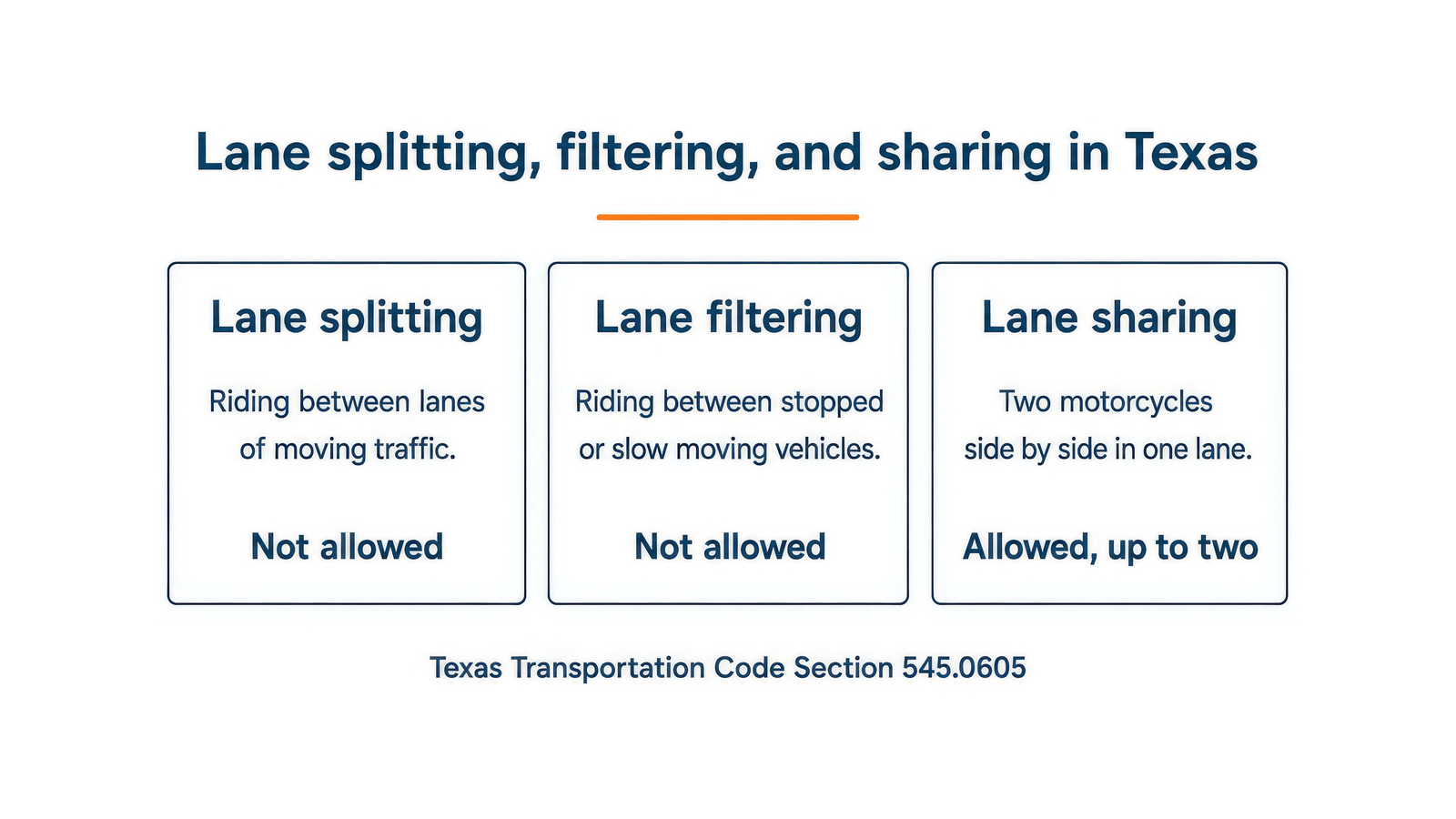
These are riders’ terms, not the statute’s, and people use them in slightly different ways. This article uses them as follows.
| Term | Meaning | Texas law |
|---|---|---|
| Lane splitting | Between lanes of moving traffic | Not allowed |
| Lane filtering | Between stopped or slow vehicles | Not allowed |
| Lane sharing | Two riders side by side in one lane | Allowed, up to two |
Lane sharing has its own limit. Motorcyclists may ride side by side, but three or more motorcycles abreast in a single lane is not allowed.
Can Motorcycles Split Lanes in Texas When Traffic Is Stopped?
No, as we read the statute. Riders ask whether lane filtering is legal in Texas because moving up between stopped cars at a red light feels different from passing other vehicles in moving traffic. The statute does not treat them differently.
The statute does not use the word filtering. It has no exception for stopped traffic, heavy traffic, traffic congestion, or slow-moving vehicles, and it does not set a speed below which riding between lanes is allowed.
We read the ban on riding “between lanes of traffic moving in the same direction” as covering lanes that run the same way, even when the cars in them are stopped. A rider who moves up beside a car inside that car’s lane is also passing “a motor vehicle while in the same lane.” That is our reading, and this article cites no court decision on the point. So our answer to “can motorcycles split lanes in Texas” is the same at a stoplight as in moving traffic.
What Is the Penalty for Lane Splitting in Texas?
Lane splitting is a traffic violation. Under Section 542.301, a person who does something the rules of the road prohibit commits an offense, and unless another rule says otherwise that offense is a misdemeanor. Under Section 542.401, the general penalty is a fine of $1 to $200.
Reckless driving is a separate offense. Section 545.401 defines it as driving a vehicle in willful or wanton disregard for the safety of persons or property. Whether a particular ride meets that test depends on the facts, so lane splitting is not automatically reckless driving.
How Can Lane Splitting Affect a Texas Motorcycle Accident Claim?
A ticket or a statutory violation does not by itself decide an injury claim. Texas uses proportionate responsibility under Civil Practice and Remedies Code Chapter 33, and each person involved in a crash can be assigned a percentage of responsibility.
- More than 50 percent: under Section 33.001, a claimant whose percentage of responsibility is greater than 50 percent may not recover damages.
- 50 percent or less: under Section 33.012, the damages are reduced by the claimant’s percentage of responsibility.
An insurance company can point to lane splitting as evidence that the rider shares the fault. The other driver’s conduct is weighed too.
Here is a hypothetical. A rider is moving between two lanes of slow traffic. A driver who has not checked a mirror changes lanes without signaling and strikes the rider. The rider’s lane position could count against the rider. The unsafe lane change could count against the driver. How the percentages come out depends on the evidence.
What Do Texas Drivers Owe Motorcycle Riders?
The same statute protects riders. A motor vehicle may not be driven in a manner that deprives a motorcycle of the full use of a lane. A separate rule, Section 545.060, says an operator on a road with marked lanes may not move from a lane unless that movement can be made safely.
So a driver who drifts into a rider’s lane, or changes lanes into a motorcycle, can be responsible for a crash even when the rider was nowhere near the line. Our guide to common crash causes covers more examples, and Texas helmet laws explains another rule that can come up after a wreck.
What Should You Do After a Motorcycle Accident in Texas?
Your health comes first. These steps can also protect a claim:
- Get to a safe place and call 911.
- Get medical care, even if you feel fine.
- Photograph the vehicles, the lanes, and the scene if it is safe.
- Get names and contact details for the other driver and witnesses.
- Do not argue about fault at the scene.
Our guide on steps after a crash goes through each one.
FAQs About Lane Splitting in Texas
Can a motorcycle use the shoulder to get around stopped traffic?
Only in limited situations. Section 545.058 lets an operator drive on an improved right shoulder when that is necessary and can be done safely, and only for listed purposes. Those include passing a vehicle that is slowing or stopped on the main traveled part of the highway and avoiding a collision. Whether a pass on the shoulder was necessary and safe is judged on the facts. The statute does not give riders a general right to ride the shoulder.
Should I tell the insurance company I was riding between lanes?
Be truthful. What you say about lane position can be used when responsibility for the crash is divided, so you may want a lawyer to explain proportionate responsibility before you give a recorded statement. You can also ask the insurance company to wait until you have had medical care.
Does it matter that other states have different rules?
Not for riding on a Texas road. Other states set their own rules, but how you may ride in Texas is set by the Texas Transportation Code. This article covers Texas only. If you ride across state lines, check the law where you are riding before you split lanes.
Talk With Zinda Law Group
Zinda Law Group represents injured motorcycle riders and their families across Texas. Our motorcycle accident lawyers can review the crash report, the lane positions, and the other driver’s conduct, and our San Antonio motorcycle lawyers help riders hurt in that area.
If we do not win, you will not be responsible for attorney’s fees, court costs, or litigation expenses. If you do win, these expenses and unpaid medical bills will be taken from your share of the recovery.
If you were hurt in a motorcycle crash, you can request a free case evaluation online.
Founder and CEO
John C. (Jack) Zinda
Jack founded Zinda Law Group and focuses his practice on catastrophic personal injury, 18-wheeler accidents and wrongful death.