





Start with your state’s requirements, then compare available PIP limits against the medical costs your health insurance may leave unpaid and the income you could lose while recovering. There is no single dollar amount that works for every driver in every state. Your savings and the premium you can afford also affect the choice.
Key points
- PIP needs depend on your state, health coverage, income, and savings.
- Compare deductibles, medical limits, and lost-wage benefits before choosing coverage.
- State minimums may leave medical bills and lost income unpaid.
- Exhausting PIP does not automatically qualify you for pain-and-suffering damages.
The legal minimum may leave you with out-of-pocket costs after a serious injury. Depending on the state and insurer, coverage options may start at $2,500 and extend beyond $100,000. Limits such as $10,000, $15,000, $50,000, and $250,000 are available in different states, with eligibility restrictions for some options. Ask your agent which limits you can buy and how much each would cost.
What Personal Injury Protection (PIP) Covers
Personal injury protection, often called PIP, helps pay for medical treatment and certain related expenses after a crash, regardless of fault, subject to the policy’s terms. Some states include PIP in a no-fault insurance system, but not every state offers or requires it.
Depending on state law and your auto insurance policy, PIP may cover:
- Hospital and doctor bills, imaging, and emergency medical costs
- Rehabilitation and ongoing medical treatment
- A portion of lost wages if you cannot work
- Substitute services such as childcare or household help
- Funeral expenses
- Your injuries as a pedestrian struck by a vehicle
PIP fits alongside liability insurance, collision, comprehensive, and uninsured or underinsured motorist coverage. It covers eligible injuries to you and certain passengers or household members. Florida and New York both have no-fault PIP requirements, but their benefit rules differ. Check your declarations page, policy, and state’s requirements to confirm who and what is covered. Our overview of the nine types of insurance claims shows where PIP sits among those other coverages.
How PIP Differs From Bodily Injury Liability, MedPay, and Health Insurance
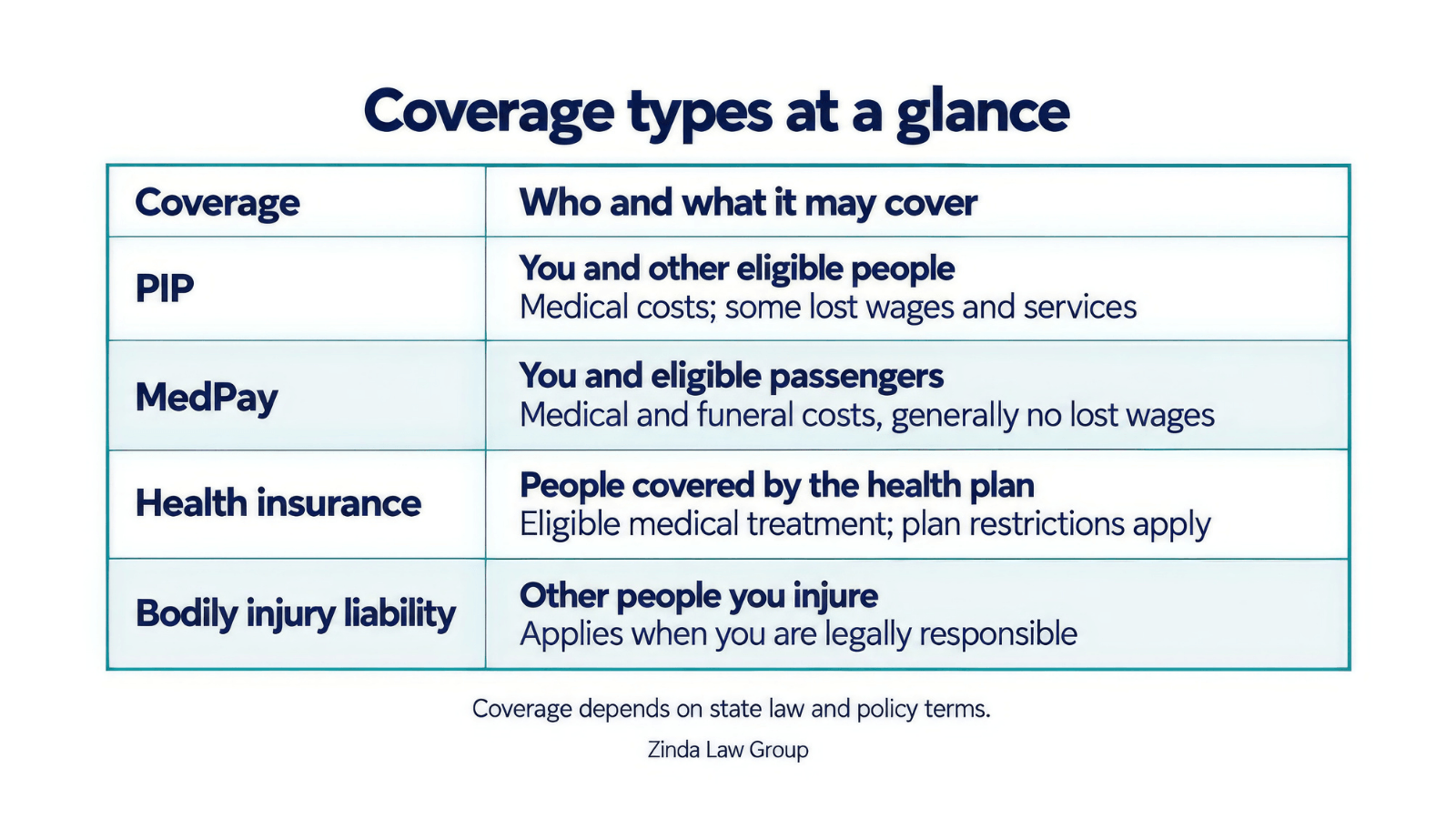
These coverages pay for different people and expenses:
- Bodily injury liability coverage pays for other people’s medical expenses, lost income, and related costs when you are legally responsible for an accident, up to your policy limits. It does not pay for your own injuries. It is required in almost every state.
- PIP helps pay for injuries to you and certain people in your vehicle or household, regardless of fault. In states that do not require PIP, medical payments coverage may still be available.
- Medical payments coverage, or MedPay, typically pays medical and funeral expenses. It generally does not cover lost wages or substitute services.
- Health insurance may cover crash-related medical costs, subject to deductibles, copays, network limits, prior authorization requirements, and limits on rehabilitation or nursing care.
In many states, PIP pays first for car accident injuries. Health insurance may then pay covered expenses after PIP is exhausted. The order varies by state and policy, so ask your auto and health insurers how your coverages interact. New Jersey, for example, allows eligible policyholders to select their health insurer as the primary payer.
Key Factors That Help You Decide How Much PIP Coverage to Carry
Review these factors before renewing your auto policy. State minimums may leave medical bills and lost wages unpaid after a serious accident.
Health insurance scope
If your health plan has a high deductible, for example $2,000–$7,500, limited out-of-network benefits, or caps on rehabilitation, higher PIP limits may help with eligible costs. Check your health plan’s out-of-pocket maximum and whether it covers car accident injuries. If you lack health coverage, review your options for medical treatment after a car accident without insurance.
Income and lost wages
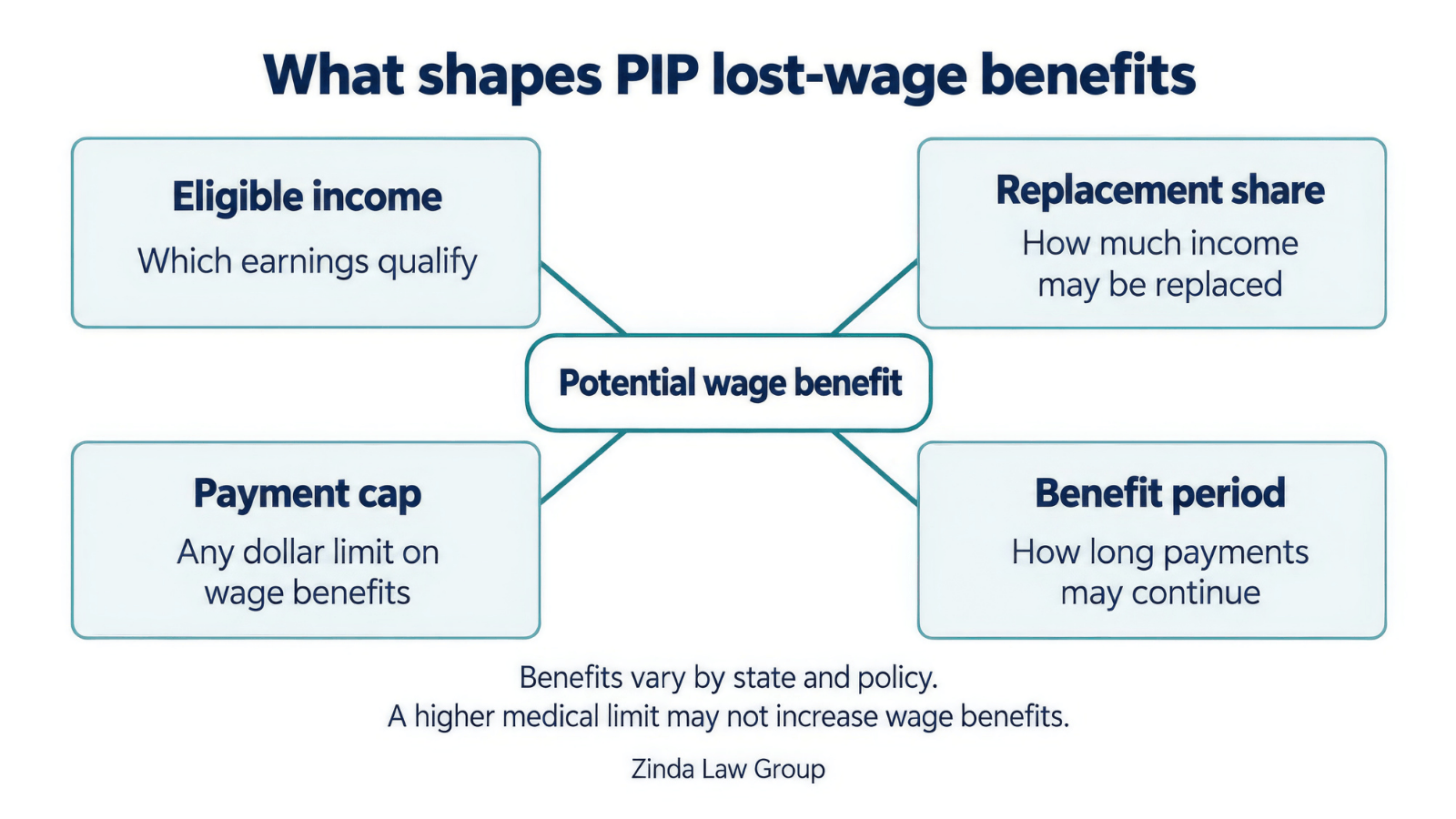
Total 3–6 months of your net income as a planning exercise. If you earn $5,000 a month, that is $15,000–$30,000 of lost income at risk. PIP may cover part of your lost wages and childcare expenses, but that calculation does not establish what your policy will pay. Check the wage-replacement percentage, dollar caps, and benefit duration.
Family and passengers
If family members, children, or carpoolers ride with you regularly, check who qualifies for benefits and what limit applies to each covered person. Our guide explains whether PIP covers passengers.
Savings and ability to absorb costs
If you cannot easily cover several thousand dollars in unexpected medical bills or lost wages, consider whether higher PIP limits would cover expenses you could not otherwise pay.
Vehicle use
Long commutes and frequent highway driving mean more time on the road. If you do rideshare work, confirm which policy covers you while working; the Texas Department of Insurance notes that a personal auto policy may exclude that use.
Annual review
Review your policy limits annually, especially after marriage, having children, or losing health insurance benefits.
Ask your agent for quotes at the available limits. For each option, compare the premium, any PIP deductible, the medical benefit limit, and the wage-loss caps. A higher medical limit may not increase every other benefit.
Liberty Mutual estimates that PIP typically accounts for 15–20% of an auto policy’s cost. Treat that as a general estimate from one insurer. Your price depends on your state, driving history, limits, and deductible; use actual quotes to compare your options.
Understanding State Requirements and PIP Coverage Limits
PIP requirements, exemptions, and rejection options vary by state. WalletHub’s state summary lists 12 states with PIP requirements, but that count does not determine whether a particular driver must carry coverage.
Requiring PIP does not by itself establish restrictions on injury lawsuits. In states where PIP is unavailable, MedPay or health insurance may cover your own medical bills. If another driver caused the crash, that driver’s bodily injury liability coverage may also apply.
Here are the state examples:
| State | PIP requirement or coverage option |
|---|---|
| Oregon | According to Liberty Mutual’s Oregon example, a $15,000-per-person minimum. |
| Massachusetts | According to Massachusetts law, $8,000 per person, subject to applicable deductibles and coordination with other coverage. |
| New Jersey | According to New Jersey Department of Banking and Insurance, the Basic Policy provides $15,000 per person, per accident. Standard Policy options range from $15,000 to $250,000 or more. Both provide up to $250,000 for certain qualifying severe injuries, even when a lower limit was selected. |
| Florida | According to Florida statute, $10,000 in required PIP benefits. Medical reimbursement generally covers 80% of eligible expenses, initial care must occur within 14 days, and medical benefits can be limited to $2,500 without a qualifying emergency medical condition. |
Michigan offers $250,000, unlimited, and other PIP medical options. Its $50,000 option and medical-coverage opt-out have eligibility requirements. These are medical coverage choices, not a promise of unlimited benefits in every category.
Do not assume your state’s legal minimum will cover a serious injury or long-term rehabilitation. Confirm the benefits and limits of the policy you are considering.
What Can Happen When Your PIP Benefits Run Out
Imagine a driver with $10,000 in PIP coverage who suffers a broken leg and concussion in a car accident. In this example, PIP pays eligible costs for the initial ER visit, ambulance, and imaging, but further surgery and physical therapy push expenses beyond the policy limit.
Once PIP is exhausted, health insurance may pay covered costs, subject to its own deductibles, network limits, and coverage restrictions. Remaining expenses fall on the injured person unless another source of payment applies. Depending on the available coverage, unpaid costs may include ongoing therapy, mileage to appointments, home modifications, long-term attendant or nursing care, and continuing lost income.
Other Sources of Compensation
An injury claim or lawsuit against an at-fault driver may seek losses not fully paid by PIP or health insurance. However, exhausting PIP does not automatically create a right to pain-and-suffering damages. Some states impose injury thresholds or lawsuit-choice rules. New Jersey’s lawsuit options, for example, distinguish economic losses from pain-and-suffering claims.
If another driver caused the crash and had no insurance or too little coverage, your uninsured or underinsured motorist coverage may cover eligible losses, subject to its terms.
States and policies set deadlines for reporting claims, providing medical documentation, and challenging denials. Missing a deadline can jeopardize benefits. Zinda Law Group can help clients understand how PIP, health insurance, and claims against an at-fault driver’s insurer interact when there are coverage gaps or denied benefits. When an insurance adjuster disputes a bill or delays a benefit, an insurance claims lawyer can review the file.
When to Talk to a Personal Injury Lawyer About PIP and Coverage Gaps
Consider contacting a personal injury attorney if you are dealing with:
- Serious or permanent injury from an accident
- Disputed fault among the drivers involved
- PIP denials or premature benefit cutoffs
- Complex coordination between PIP, health insurance, and other coverages
- Questions about whether the other driver’s bodily injury liability limits are sufficient to cover your claim
A lawyer can investigate fault, identify available PIP, MedPay, liability, and uninsured or underinsured motorist coverage, document medical needs, and pursue compensation for losses PIP does not cover.
Zinda Law Group is a nationwide personal injury law firm. We offer free case evaluations and work on a contingency-fee basis, meaning there are no attorney’s fees unless we recover compensation.
If you were hurt in a crash and are unsure how your coverages apply, contact Zinda Law Group for a free case evaluation.

John (Jack) Zinda
Founder / CEO
Over 100 years of combined experience representing injured victims across the country.
Available 24 / 7|Free Consultation
Neil Solomon
Partner
Real results matter. We do not get paid unless we win your case.
Available 24 / 7|Free Consultation