













What a brachial plexus injury lawyer does
A brachial palsy lawyer investigates whether a newborn’s nerve injury was caused by how the delivery was managed, and brings a medical malpractice claim when the record shows it was. The work is medical before it is legal. It starts with the fetal monitoring strips, the delivery notes and the timing of every decision made in the room.
This page is written for parents of a child diagnosed with a brachial plexus birth injury, including Erb’s palsy, Klumpke’s palsy and total plexus injuries. It covers what the brachial plexus is, how these injuries happen, which delivery decisions turn an injury into a claim, what compensation covers, and how long a family has to file.
If your child was diagnosed with a brachial plexus birth injury and no clear explanation has followed, Zinda Law Group can review the delivery records at no cost, and the number for a free consultation is (800) 863-5312.
What is the brachial plexus
The brachial plexus is a bundle of nerves running from the spinal cord at the base of the neck, through the shoulder, and down into the arm and hand. It carries every signal that moves the shoulder, elbow, wrist and fingers, and every sensation that travels back.
Five nerve roots form it. They leave the spinal cord between the fifth cervical vertebra and the first thoracic vertebra, which physicians write as C5 through T1. Each root feeds a different part of the arm. That is why the pattern of a child’s weakness tells a physician which brachial plexus nerves were damaged.

That anatomy matters to a claim. A child whose shoulder and upper arm are affected has an upper plexus injury. A child whose hand and fingers are affected has a lower plexus injury. The location of the damage is evidence about the direction and the amount of force applied during delivery.
Types of brachial plexus injuries
The named conditions describe which brachial plexus nerves were injured, not how badly.
Erb’s palsy
Erb’s palsy is the most common of the brachial plexus birth injuries. It involves the upper roots, C5 and C6, and sometimes C7. The arm hangs at the side, turned inward, with the forearm rotated back and the wrist bent. Physicians sometimes call this the waiter’s tip position. It is also known as Erb-Duchenne palsy.
Most children with Erb’s palsy recover substantial function within the first year. Some do not. The difference is usually the grade of nerve damage.
Because Erb’s palsy accounts for most brachial plexus birth injuries, it is also the condition behind most of these claims. Zinda Law Group maintains a separate page on Erb’s palsy claims covering prognosis, treatment and settlement in detail.
Klumpke’s palsy
Klumpke’s palsy involves the lower roots, C8 and T1. It affects the hand and the fingers rather than the shoulder. A child may have a clawed hand, and in some cases a drooping eyelid on the same side, because the nerves controlling the eye travel alongside the lower plexus.
Total brachial plexus palsy
When every root from C5 to T1 is damaged, the whole arm is affected. This is the least common and the most serious presentation. The arm may be completely flaccid, and sensation may be absent from the shoulder to the fingertips.
Klumpke’s palsy and total plexus palsy are less common than Erb’s palsy, and other brachial plexus injuries fall between these patterns depending on which roots took the force.
How badly the nerves were damaged
Two children can carry the same diagnosis and face entirely different futures, because the diagnosis names the location while the grade names the severity. There are four grades, running from an injury that resolves on its own to one that never will.

NeurapraxiaA stretched nerve, bruised but intact. Function usually returns within a few months.
NeuromaScar tissue forming as a stretched nerve heals, blocking some signals. Recovery is partial.
RuptureA tear in the nerve outside the spinal cord. It does not heal on its own and may require surgery.
AvulsionThe nerve root torn away from the spinal cord itself. It cannot be reattached, and it is the injury most associated with permanent paralysis.
Grade drives the value of a claim more than diagnosis does, because grade drives the lifetime cost of a child’s care.
What parents notice first
A brachial plexus birth injury is usually visible in the first days of life. The signs a parent notices are the same ones a pediatrician looks for.
An arm that hangs limply at the side. No movement in the shoulder or elbow on one side while the other arm moves normally. A weak or absent grip. An arm held with the forearm turned back. An absent startle reflex on the affected side.
Some injuries sustained during delivery are noted in the nursery. Others are not recorded at all. A parent raises them at a later visit. Either way, what a child suffered in the delivery room is documented in the record before anyone connects it to a claim.
How these injuries happen during birth
A brachial plexus injury occurs when the baby’s neck is stretched away from the shoulder far enough to damage the nerves. In an uncomplicated delivery, that does not happen. It happens when something obstructs the birth and the response to the obstruction goes wrong.
Shoulder dystocia
Shoulder dystocia is the emergency behind most of these cases. The baby’s head delivers and then the baby’s shoulder catches behind the mother’s pubic bone. The clock starts immediately, because the umbilical cord is now compressed inside the birth canal.
Obstetric training covers a defined sequence of maneuvers for this. The response is supposed to be positional. Change the mother’s position, apply pressure above the pubic bone, rotate the baby internally, deliver the posterior arm.
Traction on the head
What is not supposed to happen is downward traction on the baby’s head to pull the shoulder free. That is the mechanism that injures the brachial plexus. When too much force is applied to the baby’s neck while the shoulder is fixed, the nerve roots take the load.
Excessive traction during a shoulder dystocia is the most common allegation in these cases. It appears in the delivery record more often than families expect.
Instrument deliveries
Forceps and vacuum extraction raise the risk, because both apply force to the baby’s head. Used correctly they are safe and often necessary. Used on a delivery that should have gone to cesarean, or continued after a failed attempt, they become part of the claim.
Risk that should have been recognized
Several conditions raise the risk of shoulder dystocia enough that medical professionals are expected to plan for it. A large estimated fetal weight, maternal diabetes, a prior shoulder dystocia, and a prolonged second stage of labor are all on that list.
When those factors sit in the chart and no plan appears anywhere in it, that gap is itself evidence of medical negligence.
Treatment and what recovery looks like
Appropriate treatment begins within weeks of birth. The first phase is the same regardless of grade.
Physical therapy Daily range-of-motion work keeps the joint mobile while the nerve recovers. Without it a shoulder can contract even when the nerve heals. The child is then limited by the joint.
Occupational therapy As a child grows, occupational therapy addresses grip, feeding, dressing and the ordinary tasks a weak arm makes difficult.
Surgery When there is no meaningful recovery by three to six months, surgeons consider nerve grafting or nerve transfer. Later procedures may release contractures or transfer tendons to restore specific movements.
A child’s condition at one year is the usual marker for long-term prognosis. Children left with a permanent deficit often face a shorter, weaker arm, limited overhead reach, and chronic pain in adulthood. That is why a child’s medical care is projected across a lifetime.
Related birth injuries
A difficult delivery can produce more than one injury, and brachial plexus damage sometimes appears alongside other birth injuries.
Prolonged shoulder dystocia compresses the cord, and oxygen deprivation can cause brain damage independent of the nerve injury. Where that happens, a child may be diagnosed with both a plexus injury and cerebral palsy. The two are commonly confused because both involve motor impairment, but cerebral palsy is a brain injury while a plexus injury damages the brachial plexus nerves outside the spinal cord.
Where both injuries occur together, the claim covers both, and the cerebral palsy component usually dominates the value. A child’s birth injury is assessed as a whole.
How Erb’s palsy claims fit into a plexus case
Erb’s palsy is the diagnosis most families arrive with, because it is the most common of the brachial plexus birth injuries. The claim behind it is the same claim. The analysis does not change with which roots were damaged.
That is why Erb’s palsy cases and other brachial plexus injury cases are built identically. The delivery record is read for recognized risk, for the response when the baby’s shoulder became stuck, and for traction on the head. What differs is the medical proof of severity, because Erb’s palsy affecting C5 and C6 produces a different functional picture from an injury reaching the hand.
Erb’s palsy lawyers therefore spend most of their time on two questions. Whether the delivery met the standard, and what a child’s condition will look like at skeletal maturity. An Erb’s palsy lawsuit filed before the second question can be answered is usually filed too early.
Some Erb’s palsy cases resolve while a child is still an infant. Most do not, because the value of a claim moves with the prognosis, and establishing a prognosis takes time. Where a child suffered a severe injury, waiting usually protects the claim.
When a brachial plexus birth injury becomes a claim
Not every brachial plexus injury is malpractice. Some occur despite a correctly managed delivery. The law does not treat a bad outcome as proof of a bad decision.
A medical malpractice claim requires showing that the care fell below the accepted standard, and that the failure caused the child’s injury. In practice, four questions decide it.
- Was the risk of shoulder dystocia recognizable before delivery, and was it addressed
- When the shoulder became stuck, was the recognized sequence of maneuvers followed
- Was traction applied to the baby’s head, and how much
- Was a cesarean offered or performed when the circumstances called for one
Each is answerable from the medical records, which is why the records are the first thing an experienced brachial plexus injury attorney requests.
What the delivery record shows
The record holds more than the narrative. It holds the times. The times are what turn an account into evidence.
Fetal heart tracings show distress and when it began. Nursing notes show who was called and when they arrived. The delivery summary names the maneuvers attempted and their order. Anesthesia records show whether an operating room was prepared.
A delivery managed correctly usually looks correct in the record. One that was not usually shows gaps. Those gaps are visible to an obstetric expert reviewing the file. Medical errors that nobody documented as errors are still legible in the sequence and the timing.
Who can be held liable
Liability in a brachial plexus injury lawsuit is rarely limited to one person.
The delivering obstetrician is the usual defendant. Nurses may share responsibility where warning signs were not escalated. The hospital may be liable for the conduct of its employees, for inadequate staffing, or for failing to enforce its own protocols. Where a midwife or a resident managed the delivery, supervision becomes an issue.
Identifying every responsible party among the health care providers involved matters because it determines the insurance available to a family. A serious medical malpractice case frequently exceeds a single policy. Holding negligent healthcare providers accountable is also how a hospital’s protocols get changed.
What compensation covers
Families seek compensation built from a child’s projected needs across a lifetime, not from the medical expenses already incurred.

Medical care already provided Hospitalization, imaging, specialist consultations and early therapy.
Future medical expenses Nerve graft or tendon transfer surgery, follow-up procedures, and the specialist care continuing into adulthood.
Physical therapy and occupational therapy These often run for years and are among the largest line items in a serious claim.
Assistive equipment and home modification Splints, adaptive tools, and changes to a home that let a child manage independently.
Lost earning capacity A permanent arm injury narrows the work a person can do. An economist calculates that loss.
Pain, suffering and loss of enjoyment The non-economic harm of growing up with a limb that does not work as it should.
The parents’ losses A parent who leaves work to manage a child’s care may recover compensation for that income.
Injury victims in these cases are infants, so the money is normally structured to be available when the costs actually arrive.
How long a family has to file
Every state sets a deadline, and birth injury cases follow different rules from ordinary claims because the injured person is a child.
Most states extend the deadline for a minor, sometimes substantially. Several impose a separate and much shorter deadline on claims brought by parents in their own name. Some require formal notice before a birth injury lawsuit can be filed against a public hospital, occasionally within months.
Zinda Law Group handles these claims in Texas, Colorado, New Mexico, Arizona and Florida. The deadlines differ in each. The safe assumption is that the deadline is closer than it appears.
What to look for in a brachial plexus injury lawyer
Families dealing with a birth injury are usually hiring a law firm for the first time. A few questions separate a practice that handles these cases from one that merely accepts them.
Which obstetric experts does the firm work with by name An Erb’s palsy attorney who cannot answer that without checking has not built these cases before.
Has the firm tried a birth injury case to verdict Settlement value depends on whether the other side believes the case will be tried.
Who reads the fetal monitoring strips In a practice handling these routinely, that is a named person on the legal team.
Will the same lawyer stay on the file Erb’s palsy birth injuries produce claims that run for years, and continuity matters more here than in a case resolving in months.
What happens if the case is declined A family should leave with the records they gathered and a clear explanation.
An Erb’s palsy attorney is a specialized lawyer who concentrates on brachial plexus birth injuries. The questions above test for that focus.
Lawyers who handle these claims read delivery records for a living. An experienced Erb’s palsy lawyer will want the complete file before saying anything about value, because the file is the only place the answer is. Some law firms will tell a family what a case is worth at the first meeting, before anyone has read it. Nobody can know that yet.
The distinction matters because medical malpractice is its own field. A general practice can file a medical malpractice case, but a brachial plexus injury attorney knows which maneuver belongs in which order and can tell when the record departs from it. Recognizing a medical mistake in an obstetric record is a trained skill.
Comprehensive legal support in these cases means more than filing. It means finding the treating specialists, projecting the cost of a child’s medical care, and building the record a court needs.
What the legal process looks like
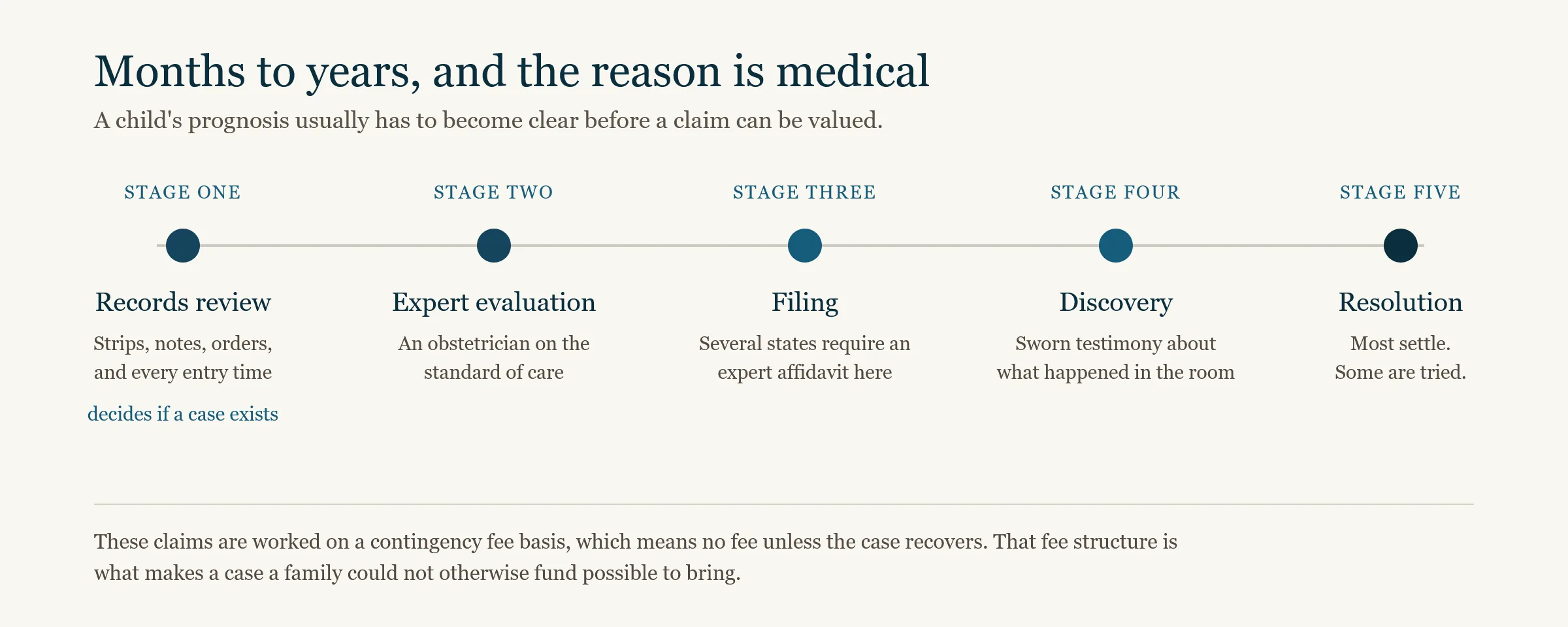
Records review The complete file is requested, which means the strips, the nursing notes, the orders and the time each was entered. This stage decides whether a case exists.
Expert evaluation An obstetrician reviews the delivery for standard of care. A pediatric neurologist or hand surgeon assesses the injury and the prognosis.
Filing The complaint is filed against the identified defendants. Several states require an expert affidavit at this point.
Discovery Both sides exchange medical records. The medical professionals involved give sworn testimony about what happened in the room.
Resolution Most of these cases settle. Some are tried. The legal process runs months to years. A child’s prognosis often has to become clear before value can be established.
Erb’s palsy lawyers and brachial plexus injury lawyers work on a contingency fee basis. That means no fee unless the case recovers. An Erb’s palsy lawsuit is expensive to build, and that fee structure is what makes it possible for a family to bring one. Zinda Law Group offers a free consultation and a free case review to any family considering a claim.
Common questions
Can you sue for a brachial plexus injury
Yes, where the injury was caused by negligent care during delivery. A brachial plexus injury lawsuit requires proof that a medical provider failed to meet the accepted standard of care and that the failure caused the injury. The injury alone is not enough. The delivery records are what establish the link.
Is a brachial plexus injury considered a disability
It can be. A permanent brachial plexus injury limiting the use of an arm may qualify as a disability under federal law and may support a claim for special education services. Milder injuries resolving within the first year usually do not. The determination turns on lasting functional limitation.
How much is nerve damage worth in a lawsuit
There is no standard figure. Value depends on the grade of nerve damage, the surgery required, the therapy projected across a lifetime, and the effect on future earning capacity. Erb’s palsy settlements vary enormously for that reason. Any lawyer quoting a number before reading the records is guessing.
Why are birth injury cases hard to prove
Because the question is not whether the child was injured but whether the injury was avoidable, and that turns on decisions made in minutes under pressure. The defense in nearly every case is that the injury came from the forces of labor itself rather than from anything the delivering physician did. Overcoming that argument requires obstetric experts and a detailed reading of the record.
Does a brachial plexus injury always mean malpractice
No. These injuries can occur in a properly managed delivery. A claim requires more than a diagnosis. What distinguishes a claim is evidence that a recognizable risk was missed, that the response to shoulder dystocia departed from accepted practice, or that traction was applied to the baby’s head.
What if my child’s Erb’s palsy was diagnosed years ago
It may still be actionable. Because the deadline for a minor is extended in most states, families discovering the cause of a child’s Erb’s palsy years later often retain legal options. The records from the delivery are normally still retrievable. A medical mistake made at birth is provable long after the fact.
Speak with a brachial plexus injury lawyer
If your child sustained a brachial plexus birth injury and you want the delivery records reviewed, Zinda Law Group can help you understand whether the care met the standard.
Families in these cases seek justice for a child who will carry the injury for life, and pursuing maximum compensation is how a family covers the lifetime of care a child deserves. What happened in the delivery room is answerable. The record is where the answer sits.
There is no cost to have the file read, and no fee unless the case recovers. Call (800) 863-5312 for a free case evaluation, or request one online.