




Yes, you can sue a doctor when the care you received fell below the accepted standard of care and that failure caused an injury with real losses. A medical malpractice lawyer can review whether the facts support a claim under the law of the state where you received treatment.

What Is Medical Malpractice, and How Is It Different From a Bad Outcome?
Medical malpractice is a form of medical negligence. It occurs when a health care provider fails to follow the accepted standard of care and that failure injures a patient. The standard of care means what a reasonably careful doctor with similar training would have done in the same situation, given the information available at the time. We have medical malpractice explained in more depth in a separate guide if you want the fuller picture.
An infection after surgery, for instance, can occur despite appropriate care. The infection alone does not establish that the surgeon did anything wrong. Texas law reinforces this distinction: Section 74.303(e)(2) requires juries to be told that negligence cannot rest solely on a bad result.
The Four Elements You Must Prove in a Medical Malpractice Lawsuit
A medical malpractice claim generally requires evidence of all four elements.
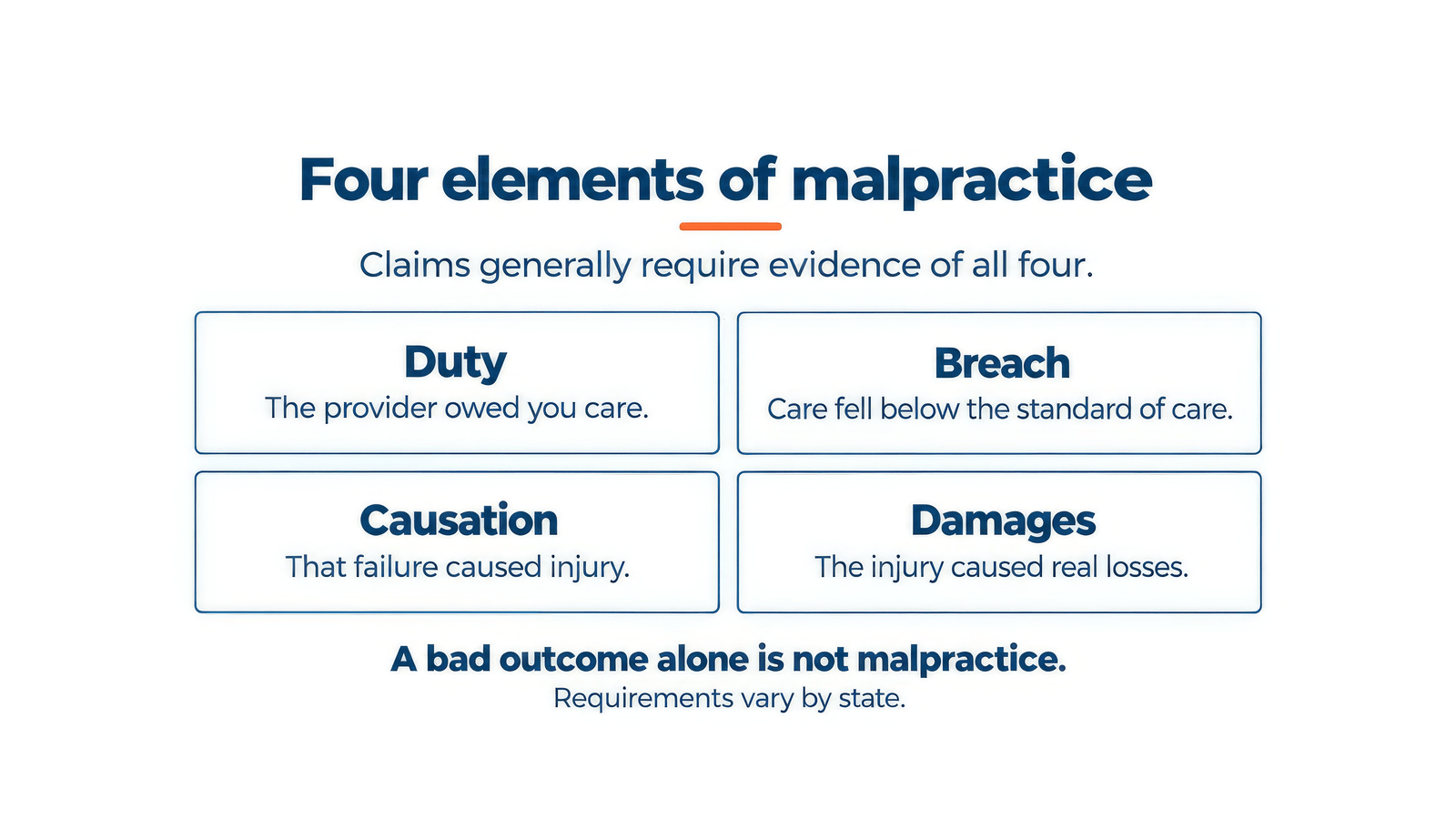
Duty: did the doctor owe you care?
A doctor-patient relationship creates a legal duty of care. A doctor who examines and treats you at a clinic generally owes you that duty.
That duty extends beyond your primary care physician. Surgeons, hospitalists, ER doctors, nurses, and other health care providers may owe duties through their role in your treatment. Informal advice, like a relative who is a physician giving casual comments at a family gathering, often does not create the same legal duty.
Breach: did the doctor fall below the standard of care?
Breach of duty involves failing to provide the accepted standard of care. A hypothetical example is failing to order a CT scan when a patient has clear stroke symptoms and a reasonably careful doctor would have ordered one immediately. Poor follow-up or premature discharge may also support a claim if the care fell below the applicable standard.
Many malpractice claims require qualified medical experts to explain the standard of care and how the provider departed from it. Requirements and exceptions vary by state and by the issues in the case.
Causation: did the breach actually cause your injury?
You must connect the breach to your injury. That generally means showing that the injury was more likely than not caused by substandard care, rather than solely by your underlying disease or an unavoidable complication.
Consider this hypothetical: a doctor negligently fails to diagnose appendicitis, and the resulting delay allows the appendix to rupture, causing sepsis and permanent organ damage. Compare that with a situation where cancer progresses despite appropriate treatment. In the second scenario, the outcome was not caused by a failure in care.
Damages: what losses did you suffer?
Damages are the losses caused by the injury, such as added medical bills, lost wages, the cost of ongoing care, or pain and suffering. Medical records, bills, and other evidence help establish those losses.
Minor, quickly resolved injuries may not justify the time and expense of a full malpractice lawsuit, even if the care was questionable. A lawyer can assess the likely recovery against the cost of pursuing the claim.
Common Examples of Doctor Negligence That May Justify a Lawsuit
These hypothetical examples may support a claim if the required elements are established:
- Misdiagnosis or delayed diagnosis. A patient reports chest pain and has abnormal EKG findings, but the doctor dismisses the symptoms, missing a heart attack.
- Surgical errors. A surgeon performs a procedure on the left knee instead of the right.
- Medication errors. A pharmacist fills a prescription with a drug the patient is allergic to, despite the allergy being documented in the chart.
- Birth injuries. Excessive force during delivery injures a newborn, or failure to monitor fetal distress leads to oxygen deprivation and brain damage.
- Anesthesia errors. A provider administers too much anesthesia or fails to review the patient’s medical history for contraindications.
- Lack of informed consent. A surgeon fails to disclose a material risk that would have affected the patient’s decision, and that risk causes injury. This may support a claim even if the surgery itself was performed correctly.
Who Can You Sue Besides the Doctor?
Hospitals, surgical centers, clinics, urgent care facilities, nurses, anesthetists, radiology groups, and corporate health care systems may also be liable, depending on their role in the injury.
A hospital may be responsible for negligence by a nurse it employs. If that nurse gives the wrong dose of medication while working and the patient suffers harm, the hospital may be a defendant alongside the nurse.
Responsibility for independent contractors, such as traveling anesthesiologists or consulting radiologists, depends on state law and the working relationship. A lawyer can review staffing arrangements, employment contracts, and insurance coverage to identify potentially responsible parties.
What Evidence Do You Need for a Medical Malpractice Claim?
Useful records include:
- Complete medical records, hospital charts, and operative reports
- Medication lists and pharmacy records
- Lab work and imaging results
- Discharge instructions and follow-up records
- Bills and insurance correspondence
Photographs of injuries, a dated journal of pain and limitations, and family members’ observations can help document the injury’s effects. Keep the records you already have while a lawyer helps identify what else is needed.

Texas Rules for Medical Malpractice Claims
Texas health care liability claims are governed by Chapter 74 of the Civil Practice and Remedies Code.
Filing deadlines
Section 74.251 generally requires filing within two years of the breach or the completion of the treatment or hospitalization at issue. Which starting date applies depends on the facts. The statute gives minors under 12 until their 14th birthday to file and sets a 10-year statute of repose measured from the act or omission.
A statute of repose is an outer time limit. Do not assume that discovering an injury later automatically extends the deadline.
Presuit notice
Section 74.051 requires written notice to each prospective defendant by certified mail, return receipt requested, at least 60 days before filing suit. The notice must include the medical-authorization form required by Section 74.052.
Expert report
Under Section 74.351, a claimant generally must serve an expert report and the expert’s curriculum vitae on each defendant or that defendant’s attorney within 120 days after that defendant files an original answer.
If a required report is not served on time, the statute calls for dismissal with prejudice, reasonable attorney’s fees, and court costs on the defendant’s motion, subject to limited exceptions. Dismissal with prejudice means the claim cannot be refiled.
Damage caps
Section 74.301 limits noneconomic damages, such as pain and suffering, to:
- $250,000 per claimant against all physicians and non-institutional providers combined
- $250,000 per claimant against each health care institution
- $500,000 per claimant across all health care institutions
Section 74.301 does not cap economic damages such as medical bills and lost wages. A separate cap in Section 74.303 applies to all damages in wrongful death or survival health care claims, except expenses for necessary medical, hospital, and custodial care. That cap is adjusted for inflation.
A Texas malpractice attorney can evaluate which deadlines, procedural requirements, and damage limits apply to your claim.
Colorado, New Mexico, Arizona, and Florida
Each state has its own statutes of limitations and procedures. These brief notes show why the state of treatment matters:
- Colorado: Section 13-80-102.5 of the Colorado Revised Statutes generally combines a two-year filing period after the claim accrues with a three-year outer limit after the act or omission, subject to exceptions.
- New Mexico: For providers qualified under the Medical Malpractice Act, Section 41-5-13 generally sets a three-year deadline from the act of malpractice. The Court of Appeals explains that this rule runs from the act rather than discovery; provider status and exceptions need individual review.
- Arizona: Article 2, Section 31 of the Arizona Constitution generally prohibits legislative limits on damages for personal injury or death. This does not eliminate filing deadlines.
- Florida: Section 766.106 of the Florida Statutes requires presuit notice and a screening period before a medical negligence lawsuit can proceed.
Speak with a medical malpractice lawyer licensed in the state where the treatment occurred instead of relying on a general internet timeline.
How to Sue a Doctor: First Steps
If you are still at risk from the injury or a serious condition, seek appropriate medical attention first.
Once your immediate needs are addressed:
- Contact a medical malpractice lawyer promptly to discuss deadlines and any required steps before filing; do not wait for a complete set of records.
- Request copies of your medical records and imaging.
- Write down a timeline with dates, providers’ names, symptoms, and what you were told.
- Preserve medication bottles, implant cards, discharge paperwork, appointment reminders, bills, and insurance letters.
- Avoid posting detailed accusations or medical information on social media.
A lawyer can assess whether the evidence supports a claim, identify the proper defendants, and explain the filing requirements. Gathering records does not itself extend a deadline.
How a Medical Malpractice Attorney Evaluates Your Potential Case
A medical malpractice attorney’s first step is usually to listen to your account and review any documents you already have, such as operative reports or lab results. The lawyer can then request records from the facilities involved, including providers in other states if you were transferred or referred.
The firm may arrange independent medical review to evaluate the care and its connection to your injuries. The attorney will also consider the available damages, insurance coverage, and likely cost of pursuing the case.
What Compensation Might Be Available in a Doctor Negligence Case?
No attorney can promise a specific outcome. Compensation depends on the harm caused by the malpractice and the damages available under state law. It may include:
- Past and future medical expenses, including additional treatment, long-term care, and assistive devices
- Lost income and reduced earning capacity
- Pain and suffering, emotional distress, and loss of enjoyment of life
- Funeral expenses and eligible family losses in wrongful death cases
The value of a claim depends on the evidence of liability, state law, available sources of recovery, and the severity and permanence of the injuries.
FAQs About Suing a Doctor for Medical Malpractice
What if the doctor has no medical malpractice insurance?
You may still sue if the legal requirements for a malpractice claim are met. A doctor’s lack of insurance does not by itself bar a lawsuit, but it can make collecting compensation more difficult. A lawyer can assess whether another provider or institution is legally responsible and whether there are assets or other sources of recovery.
Can I sue a doctor if I signed a consent form?
Often, yes. A consent form shows that you agreed to a procedure and were told about certain risks. It does not give a provider permission to perform that procedure carelessly. If the care fell below the standard of care and caused an injury, signing the form does not by itself prevent a claim.
Can I sue a doctor on behalf of a family member?
In many situations, yes. A parent or legal guardian can generally bring a claim for an injured child, and after a death, state law decides which family members or estate representatives may file. Who qualifies and how long they have depends on the state where the treatment occurred.
Costs and a Free Consultation With Zinda Law Group
Many people worry they cannot afford a medical malpractice lawyer, especially while facing large medical bills and missed work. Here is how fees work at Zinda Law Group: if we do not win, you will not be responsible for attorney’s fees, court costs, or litigation expenses. If you do win, these expenses and unpaid medical bills will be taken from your share of the recovery.
Zinda offers a free consultation to review the basic facts, answer questions about medical malpractice claims, and explain your options. If your treatment occurred in Texas, Colorado, New Mexico, Arizona, or Florida, you can contact Zinda through the case evaluation form.

John (Jack) Zinda
Founder / CEO
Over 100 years of combined experience representing injured victims across the country.
Available 24 / 7|Free Consultation
Neil Solomon
Partner
Real results matter. We do not get paid unless we win your case.
Available 24 / 7|Free Consultation