




Can you sue someone for emotional distress in Texas? Yes, but generally not as a claim by itself. It is typically one of the damages in a claim for an injury that another person caused. A personal injury lawyer can tell you which of three routes fits what happened to you.

What Counts as Emotional Distress Under Texas Law?
Emotional distress is the mental harm that follows an injury or a traumatic event: anxiety, grief, depression, fear, and lost sleep. Texas courts usually call it mental anguish.
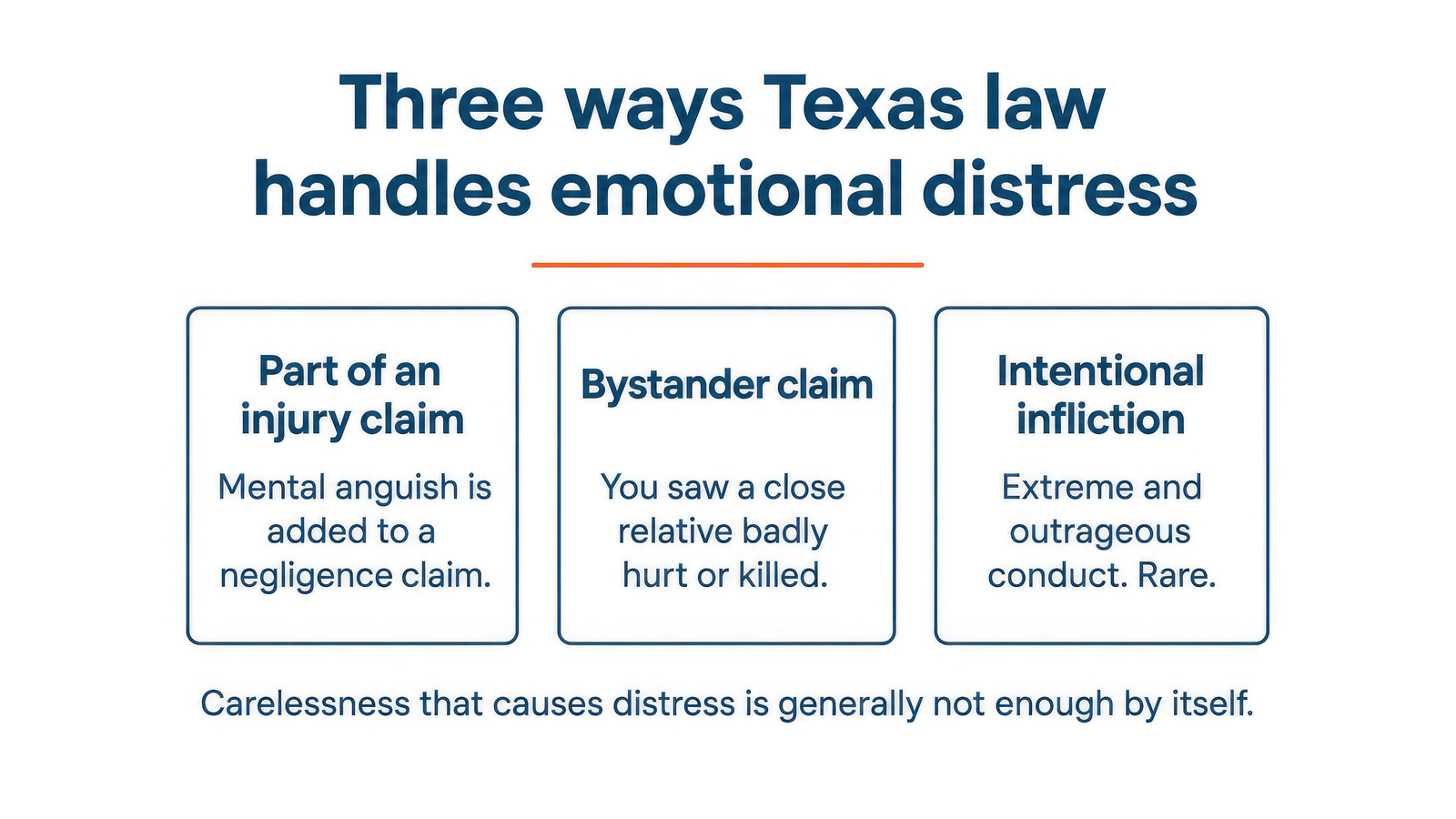
Texas law treats it as a kind of noneconomic damages. Section 41.001 of the Civil Practice and Remedies Code defines noneconomic damages to include “mental or emotional pain or anguish,” along with physical pain and suffering and loss of enjoyment of life. Economic damages, such as medical bills and lost income, are counted separately.
Can You Sue for Emotional Distress Alone?
Usually not. The Texas Supreme Court has said there is no general duty to avoid negligently inflicting mental anguish on others. Carelessness that causes distress, without more, is generally not enough for an emotional distress lawsuit.
The same opinion explains that mental anguish damages can be recovered when some other legal duty is breached and the evidence is strong enough. In practice, that leaves three main routes in an injury setting.
| Route | When it applies | Main limit |
|---|---|---|
| Mental anguish in an injury claim | A careless act injured you | You must show how your life changed |
| Bystander claim | You saw a close relative badly hurt or killed | You must have been near and seen it happen |
| Intentional infliction | Extreme conduct caused severe distress | Rare, and only when no other claim fits |
Workplace harassment, defamation, and family law disputes can involve emotional distress too, but they follow different rules and are outside this article.
When Is Emotional Distress Part of an Injury Claim?
This is the route for a person who was physically hurt. If someone’s negligence physically injured you in a crash, a fall, a dog attack, or a similar event, your claim can include the mental anguish that came with the injury. You prove the negligence claim first, and mental anguish is one of the losses you ask to be paid for.
Here is a hypothetical. A driver is rear-ended on the freeway and suffers a back injury. Months later, the driver still has panic attacks when merging and has stopped driving to work. The fear and the changes to daily life can be part of the damages in that driver’s claim.
The Texas Supreme Court has also noted that mental anguish may be recoverable in some cases without serious bodily injury, such as those involving intent or malice, certain special relationships, or events of a shocking and disturbing nature. A Texas personal injury lawyer can tell you whether your facts fit.
Can a Bystander Sue After Seeing a Family Member Hurt?
Sometimes. Texas allows a bystander to recover for mental anguish when a close relative is seriously hurt or killed and three things are true. In a recent opinion, the Texas Supreme Court restated the three bystander factors:
- You were near the scene, not some distance away.
- Your shock came from seeing or hearing the event as it happened, not from learning about it afterward.
- You and the injured person were closely related.
Here is a hypothetical. A parent standing at a crosswalk watches a driver run a red light and seriously injure the parent’s child. The parent was not touched but develops flashbacks and cannot sleep. That parent may have a bystander claim, separate from the child’s own claim.
A relative who gets a phone call and arrives later will generally not qualify as a bystander. If the family member died, that relative may still have a wrongful death claim. Our FAQ on bystander recovery claims explains how these differ from wrongful death claims.
What Is Intentional Infliction of Emotional Distress?
It is a separate claim for conduct that is far worse than carelessness. According to the Texas Supreme Court, a person bringing it must prove four elements:
- The defendant acted intentionally or recklessly.
- The conduct was extreme and outrageous.
- The conduct caused emotional distress.
- The distress was severe.
The bar is high. The court describes extreme and outrageous conduct as going “beyond all possible bounds of decency,” and says that mere insults, indignities, threats, and annoyances, or conduct that is only rude, do not qualify.
The court also calls this a gap-filler claim. It is meant for the rare case where no other legal claim covers what the person did. If another claim fits, that claim is generally the one to bring.
What Evidence Supports an Emotional Distress Claim?
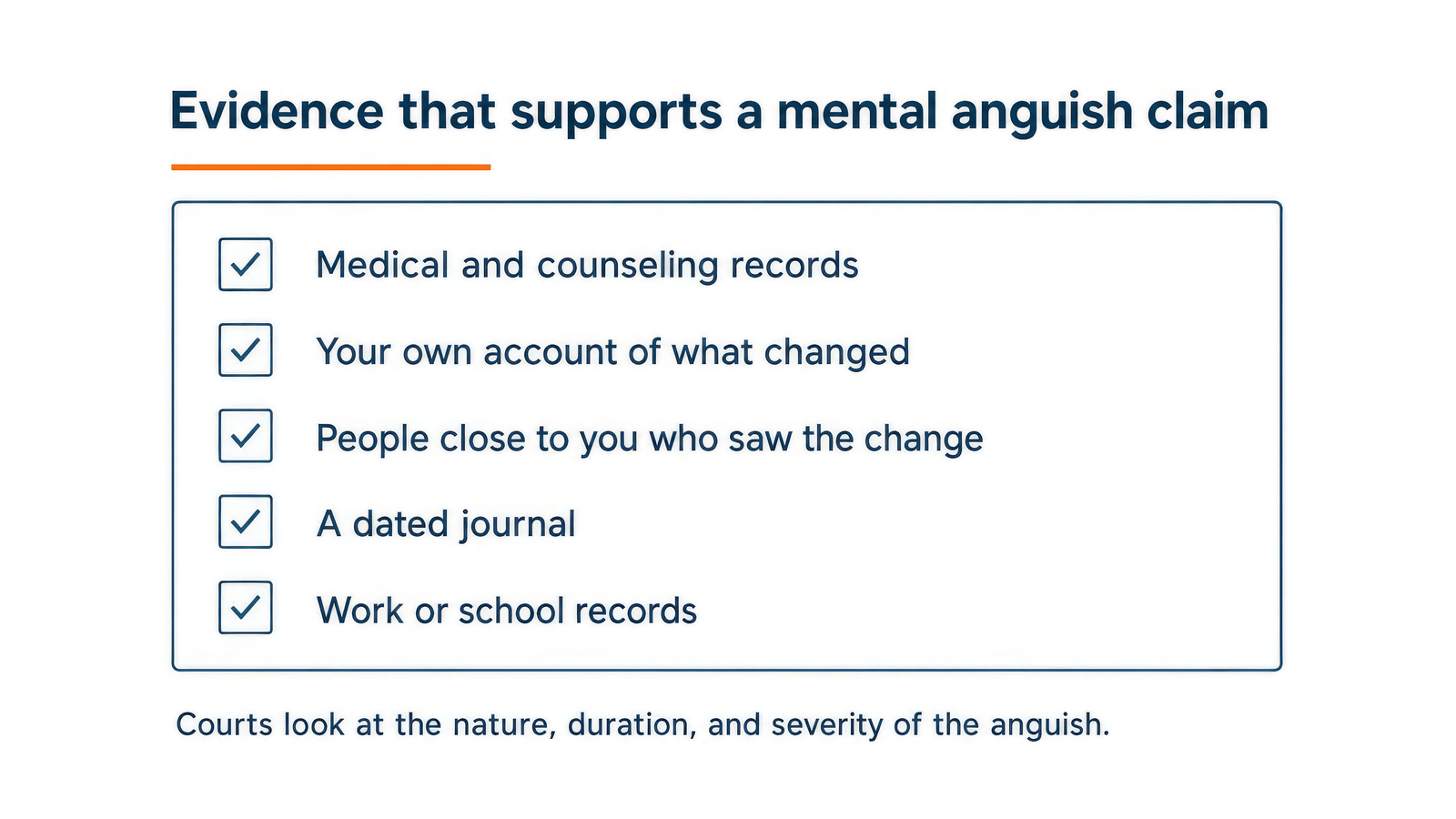
Texas courts look for specifics. The Texas Supreme Court has said a person seeking mental anguish damages must generally offer direct evidence of the nature, duration, and severity of the anguish, showing a substantial disruption in daily routine. A general statement that you were distressed is generally not enough without detail.
These kinds of evidence generally help:
- Medical and counseling records: visits, diagnoses, and treatment tied to the event
- Your own account: what changed, when it started, and how long it has lasted
- People close to you: family, friends, or coworkers who saw the change
- A journal: dated notes on sleep, mood, and missed activities
- Work or school records: missed days and reduced duties
A diagnosis can strengthen a claim, but the overall picture of how your life changed matters too. Getting care also helps you, apart from any claim.
How Does Emotional Distress Relate to Pain and Suffering?
They sit in the same category. Physical pain and suffering and mental anguish are both noneconomic damages under Section 41.001, and a jury can award money for both when the evidence supports it.
Chapter 41 does not give a formula or a multiplier for these damages. The amount depends on the evidence. Some kinds of cases also have their own limits. In claims against health care providers, for example, Section 74.301 limits noneconomic damages. Our article on pain and suffering payments covers how insurers approach these losses.
How Long Do You Have to File in Texas?
Generally two years. Under Section 16.003 of the Civil Practice and Remedies Code, a personal injury suit must be filed no later than two years after the day the claim accrues. Missing the deadline can end the claim.
Exceptions can change the time. For example, Section 16.001 does not count the time before an injured person turns 18. Other kinds of claims have their own rules. Have a lawyer calculate the date from your facts.
Do Other States Handle Emotional Distress the Same Way?
No. This article covers Texas law. Other states differ on suing for emotional distress without a physical injury, who counts as a bystander, how long you have to file, and whether damages are limited. If the event happened outside Texas, speak with a lawyer licensed in that state.
FAQs About Emotional Distress Claims in Texas
Do I need a physical injury to recover for emotional distress?
Not always. A serious physical injury is one recognized basis for mental anguish damages, and the other bases are narrow. A bystander who meets the three factors can recover without being physically hurt, and intentional infliction does not require a physical injury. Whether an exception fits depends on the facts.
Will seeing a counselor hurt my claim?
It does not have to. Treatment records can be clear proof of what you have been through and how long it has lasted. Texas Rules of Evidence 509 and 510 have an exception to the privilege for records that are relevant to a condition a party relies on as part of a claim. If you claim mental anguish, the other side may be allowed to ask for some of those records, so talk with your lawyer about what can be requested.
Can I recover for my own grief after a family member’s death?
Possibly, through a wrongful death claim. The Texas Supreme Court lists wrongful death suits among the cases where mental anguish can be recovered. In Texas, that claim belongs to the surviving spouse, children, and parents. A Texas wrongful death lawyer can explain who may file and what must be shown.
Talk With Zinda Law Group
You do not need to know which kind of claim you have before you call. Zinda Law Group offers a free consultation to explain your options. If we do not win, you will not be responsible for attorney’s fees, court costs, or litigation expenses. If you do win, these expenses and unpaid medical bills will be taken from your share of the recovery.
If an injury has left you struggling, you can reach us through the case evaluation form.

John (Jack) Zinda
Founder / CEO
Over 100 years of combined experience representing injured victims across the country.
Available 24 / 7|Free Consultation
Neil Solomon
Partner
Real results matter. We do not get paid unless we win your case.
Available 24 / 7|Free Consultation