




In Texas, a wrongful death claim pays surviving family members for what they lost, and a survival action pays the estate for what the person who died went through before death. A wrongful death lawyer usually brings both in the same case because they arise from the same event.

What Is the Difference Between a Survival Action and a Wrongful Death Claim?
The difference is whose loss is being paid for. A wrongful death claim compensates the family for their own losses after the death. A survival action compensates the estate for the injury claim the person could have brought if they had lived.
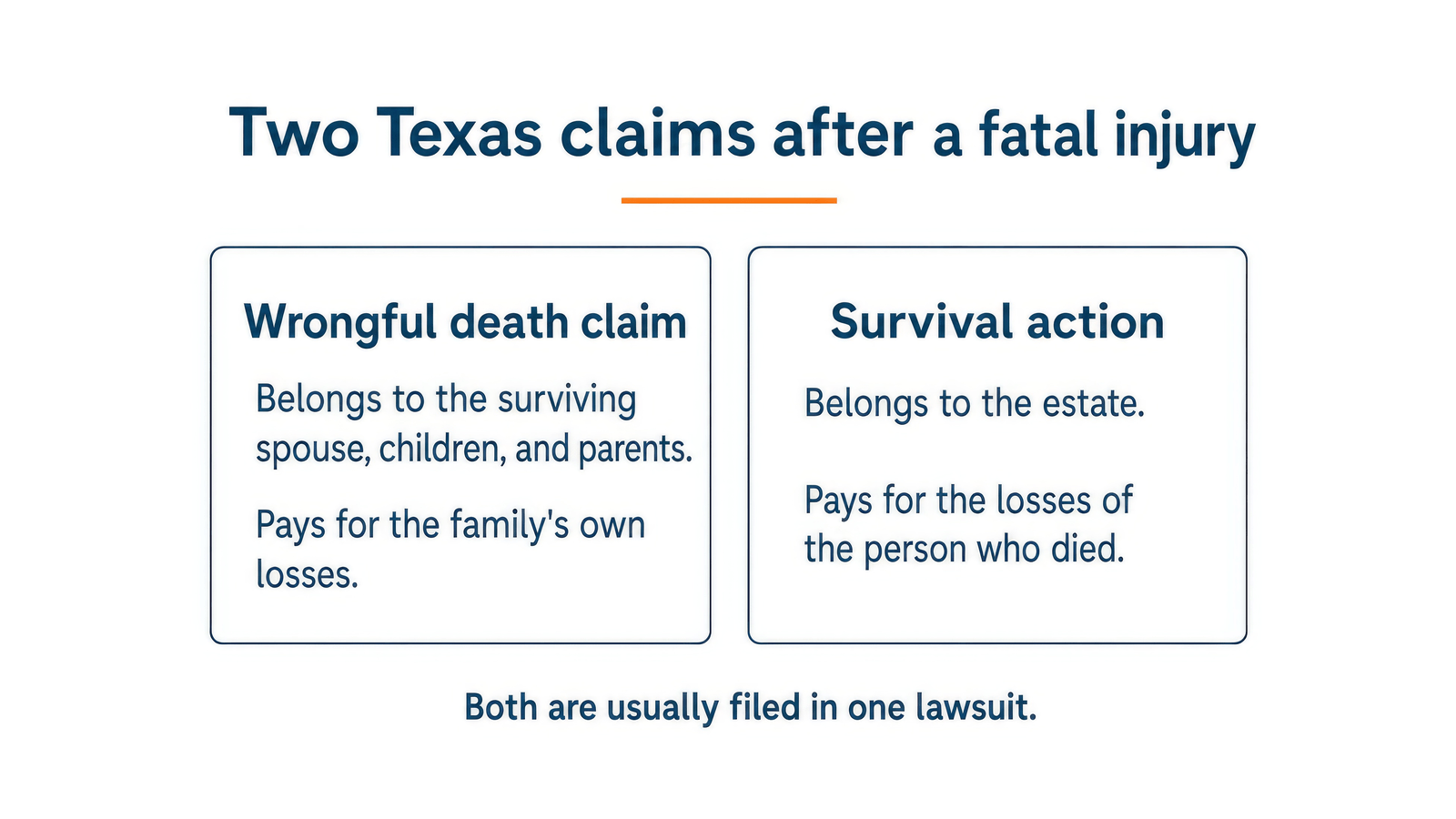
Both claims come from Chapter 71 of the Texas Civil Practice and Remedies Code. They can be filed together, but the damages stay separate so that no loss is paid twice.
| Question | Wrongful death claim | Survival action |
|---|---|---|
| Who brings it | Surviving spouse, children, and parents (Section 71.004) | Heirs, legal representatives, or the estate (Section 71.021) |
| Whose losses | The family’s own losses caused by the death | The losses of the person who died, from the injury until death |
| Where the money goes | To the eligible family members, in shares set by the jury | To the estate, then to heirs under the will or Texas law |
| Typical damages | Lost financial support, lost companionship, the family’s mental anguish | Pain and mental anguish before death, medical bills, funeral costs |
| General deadline | Two years from the death (Section 16.003(b)) | Two years from the injury, paused for up to 12 months after the death (Sections 16.003(a) and 16.062) |
Who Can File a Wrongful Death Claim in Texas?
Only the surviving spouse, children, and parents of the person who died can file a Texas wrongful death claim. Section 71.004 says the action is for their exclusive benefit, and one or more of them may bring it for the benefit of all.
What the three-month rule means
If none of those family members has started the case within three calendar months after the death, Section 71.004 requires the executor or administrator of the estate to bring it. The exception is when all of the eligible family members ask that it not be filed.
What a wrongful death claim pays for
A wrongful death claim pays for the family’s own losses. Depending on the facts, those can include:
- Financial support and household services the person would have provided
- Companionship, guidance, and care the family has lost
- The mental anguish of the surviving spouse, children, and parents
- Inheritance the family would likely have received
The jury divides the award among the family members who are entitled to it, under Section 71.010. Section 71.011 adds that wrongful death damages are not subject to the debts of the person who died.
When the death was caused by a willful act or omission or by gross negligence, Section 71.009 also allows exemplary damages, which are meant to punish.
Who Brings a Survival Action, and What Does It Cover?
A survival action is brought for the estate, usually by the executor or administrator, and it covers what the person who died could have recovered. Section 71.021 says a personal injury claim does not end when the injured person dies. It survives in favor of the heirs, legal representatives, and estate.
What a survival action pays for
A survival action generally covers losses between the injury and the death, such as:
- Physical pain and mental anguish the person experienced before death
- Medical bills for treating the fatal injury
- Income lost between the injury and the death
- Funeral and burial costs
These damages matter most when the person lived for hours, days, or longer after the injury. Medical records and witness accounts are often the main evidence of what they went through.
Where the money goes
Money recovered in a survival action belongs to the estate. Valid debts of the estate can be paid from it, and the rest passes to heirs under the will or, without a will, under Texas inheritance law. This is why a relative who cannot file a wrongful death claim may still receive money through the estate. Our guide to suing for a deceased person explains how that works.
How Long Do You Have to File Each Claim in Texas?
Each claim generally has a two-year deadline under Chapter 16 of the Civil Practice and Remedies Code, but the clocks do not always start on the same day.
- Wrongful death: Section 16.003(b) gives two years, and the claim accrues on the date of death.
- Survival action: This is the injured person’s own claim, so the two years under Section 16.003(a) generally run from the injury. Section 16.062 pauses that clock for up to 12 months after the death. If an executor or administrator qualifies sooner, the clock starts running again at that point.
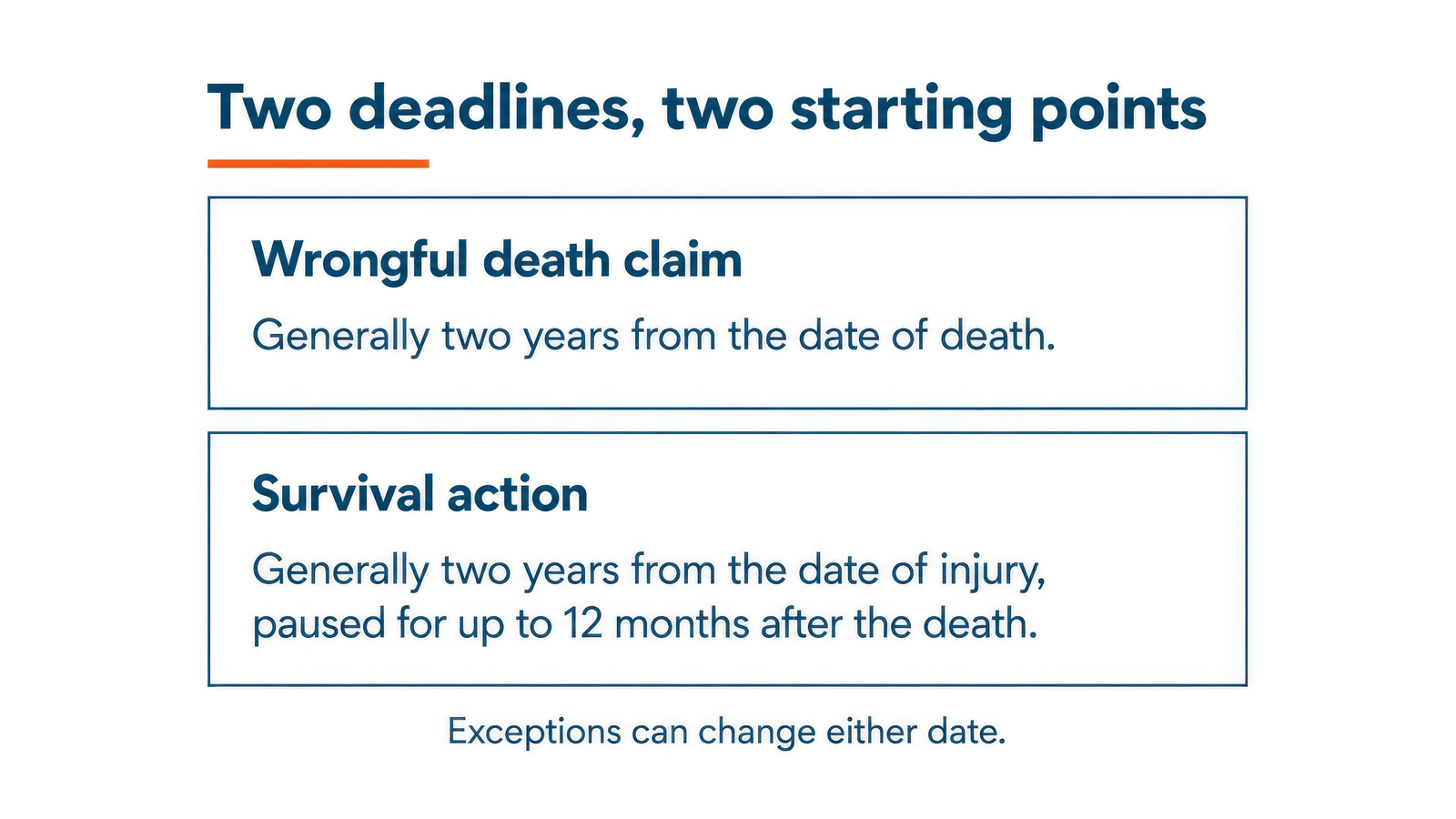
When the injury and the death happened on different days, the survival deadline can arrive before the wrongful death deadline. Exceptions can change either date, so have a lawyer calculate both from your facts.
How Do the Two Claims Work Together?
Both claims are usually filed in one lawsuit, with the family members and the estate’s representative as plaintiffs. Much of the same evidence proves fault for both. The damages are then decided separately for each claim.
Bringing both can matter financially. The family’s losses and the estate’s losses are different losses, and leaving one claim out can leave part of the harm uncompensated. A Texas wrongful death attorney can work with the executor so the two claims are filed on time and kept distinct.
Do New Mexico, Colorado, Arizona, and Florida Handle These Claims the Same Way?
No. This article covers Texas law, and other states use different rules even when they use the same words. States differ on who may file, whether a personal representative must bring the case for everyone, what damages are available, and how the money is divided.
If the death happened in another state, the rules for New Mexico, Colorado, Arizona, or Florida may apply instead. Speak with a lawyer licensed in the state where the claim will be filed.
FAQs About Survival Actions and Wrongful Death in Texas
Can a sibling file a wrongful death claim in Texas?
No. Section 71.004 limits a Texas wrongful death claim to the surviving spouse, children, and parents, so brothers, sisters, and grandparents cannot file one. A sibling may still receive money from a survival action if the sibling inherits from the estate under the will or under Texas inheritance law.
Who is the personal representative of the estate?
The personal representative is the person with legal authority to act for the estate. That is usually the executor named in the will or, when there is no will, an administrator appointed by the probate court. This person generally brings the survival action and, under the three-month rule, may have to bring the wrongful death claim.
Does a criminal case affect these claims?
No. Wrongful death and survival claims are civil claims for money, and they are separate from any criminal case the state brings. Section 71.006 says a wrongful death action is not precluded because there may be a criminal proceeding. A family can file them whether or not criminal charges are filed, and whatever the result of a criminal trial. The civil deadlines generally keep running while a criminal case is pending.
What if the death was caused by medical care?
Different rules apply. Claims against doctors, hospitals, and other health care providers fall under Chapter 74 of the Civil Practice and Remedies Code, which has its own filing deadline in Section 74.251 and a separate limit on damages in wrongful death and survival cases in Section 74.303. Ask a lawyer about these rules early.
Talk With Zinda Law Group
You do not need to sort out which claim applies before you call. Zinda Law Group offers a free consultation to explain your options. If we do not win, you will not be responsible for attorney’s fees, court costs, or litigation expenses. If you do win, these expenses and unpaid medical bills will be taken from your share of the recovery.
If you lost a family member or have been named executor, you can reach us through the case evaluation form.

John (Jack) Zinda
Founder / CEO
Over 100 years of combined experience representing injured victims across the country.
Available 24 / 7|Free Consultation
Neil Solomon
Partner
Real results matter. We do not get paid unless we win your case.
Available 24 / 7|Free Consultation