













What a Pitocin malpractice claim involves
A birth injury attorney working one of these claims establishes whether the drug was given at a dose or a rate the delivery record cannot justify. The lawyer then brings a medical malpractice claim where that error injured the mother or the baby. Pitocin itself is rarely the issue. The dosing and the monitoring decisions around it are.
This page is for parents of a baby injured during an induced labor or an augmented one. It covers what Pitocin is and why it is given, how the drug is supposed to be administered, what excessive contractions do to a baby’s oxygen supply, and what the fetal monitoring strip recorded while it was happening.
If your labor was induced with Pitocin and no one has explained plainly what went wrong, Zinda Law Group will review the delivery records at no cost. The number for a free consultation is (800) 863-5312.
What Pitocin is and why it is given
Pitocin is a synthetic version of oxytocin. Oxytocin is the natural hormone that makes the uterine muscles contract, and the body produces more of this hormone as childbirth approaches. The drug is a manufactured version of oxytocin, given through an IV so a doctor can start a labor that has not begun or strengthen one that has stalled.

The reasons a doctor decides to induce labor are usually sound. A pregnancy well past its due date, ruptured membranes with no labor starting, high blood pressure in the mother and a stalled labor process are all recognized reasons to induce labor. The same drug is given after delivery to help the uterus clamp down and control bleeding.
Pitocin induces contractions. It does not open the cervix or the birth canal, which matters when a labor induction begins before the body is ready for one.
Labor induction is common and most patients come through it without complications. Nothing about the use of Pitocin is negligent by itself. It is a powerful drug with a narrow margin between the dose that helps and the dose that harms. The risk climbs with every increase in the rate. The harm in these birth injury cases comes from how the drug was dosed and how it was watched.
How Pitocin is supposed to be administered
Hospital protocols for administering Pitocin are written down and they are specific. They exist because this drug carries a known risk, and the protocol is how a hospital controls it. A claim usually begins by reading the hospital’s own protocol next to the delivery record.
A low starting rate The drug goes in through an IV pump and the starting rate is deliberately low.
Increases in small increments The rate goes up slowly. Enough time has to pass between increases for the doctor and the nurse to see what the last one did to the mother and to the baby.
A defined endpoint The increases stop once contractions are coming every two or three minutes or the maximum rate the protocol allows is reached.
Continuous monitoring The baby’s heart rate and the contraction pattern are recorded on the same strip for as long as the drug runs.
Written rules for stopping Every protocol names the findings that require the drug to be turned down or shut off.

The last of those matters more than the rest in litigation. Pitocin clears the body quickly once the infusion stops. The ability to end the exposure sits in the room the whole time, which is why a delivery team that let a bad tracing run has to account for the delay. A labor and delivery nurse does not need a doctor’s order to stop the drug, because hospital protocols give the nurse at the bedside that authority directly.
Tachysystole and uterine hyperstimulation
Tachysystole means uterine contractions coming too close together, counted over ten-minute windows on the strip. Uterine hyperstimulation is that same pattern together with a fetal heart rate that has started to react to it. Both are known complications of too much Pitocin. The equipment records them as they happen.
A baby takes on no oxygen while the uterus is squeezing. The damage comes from what happens between the contractions. The exchange happens in the rest interval. Blood reaches the placenta while the uterine muscles are relaxed, and a contraction closes those vessels. When excessive contractions crowd together the rest interval shrinks and uterine blood flow never fully recovers.
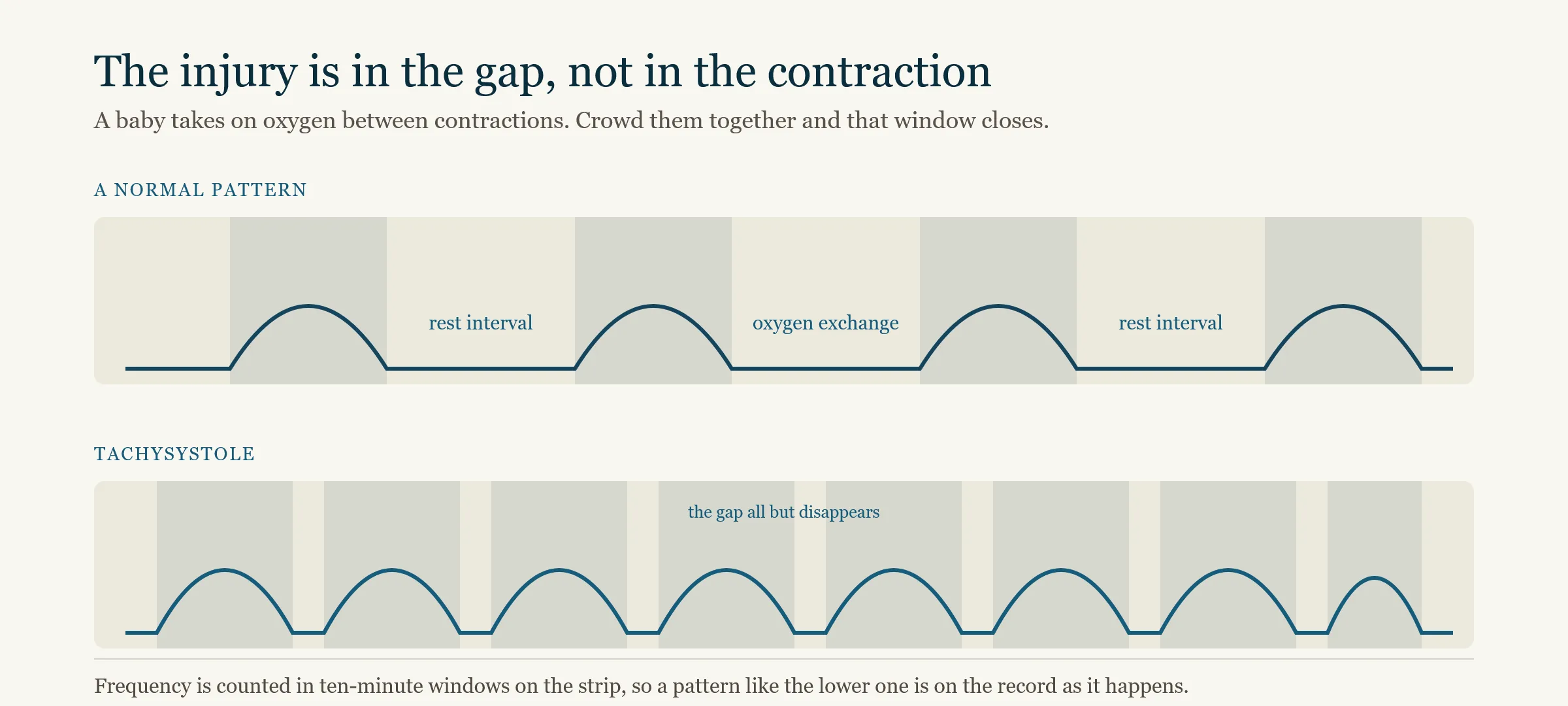
A healthy baby carries reserve and tolerates a period of this. That reserve is finite. Prolonged contractions spend it faster, and an overly strong pattern does the same. A baby can lose oxygen steadily while each individual contraction still looks ordinary on the tracing.
Excessive Pitocin carries a separate risk to the mother. A uterus driven harder than it can tolerate can tear. A ruptured uterus is an emergency for the mother and the baby at once. The danger is higher for a woman in labor after a previous C-section. Excessive doses have also been linked to placental abruption, where the placenta separates from the wall of the mother’s uterus before the baby is delivered.
What the fetal monitoring strip shows
The fetal monitoring strip is the document these cases turn on. It records the baby’s heart rate and the contraction pattern against the same clock. What the doctors and nurses knew and the hour they knew it are both printed on it.
Contractions too frequent Frequency is counted in ten-minute windows and the tracing shows it without interpretation.
Late decelerations The heart rate dips after the peak of a contraction and comes back slowly. Recurrent late decelerations are the classic sign that the placenta is not delivering enough oxygen.
Recurrent variable decelerations Sharp drops linked to cord compression. Repeated ones through an induced labor are a warning sign.
A rising baseline with flattening variability A baby’s heart rate that climbs and then goes smooth is a baby running out of reserve.
A tracing that was never acted on Fetal distress on the strip calls for the Pitocin to be reduced or stopped. Documented fetal distress with no change in the infusion is where most Pitocin malpractice claims begin.
Strips are kept and they are retrievable years later. A family who never saw one is not out of options.
Injuries linked to Pitocin errors
Complications from a Pitocin error fall into two groups. The risks that matter most to a baby are neurological, and sustained oxygen deprivation during an induced labor can cause hypoxic ischemic encephalopathy. That is a brain injury with its own diagnostic criteria and its own body of case law. It is covered on the page for HIE claims.
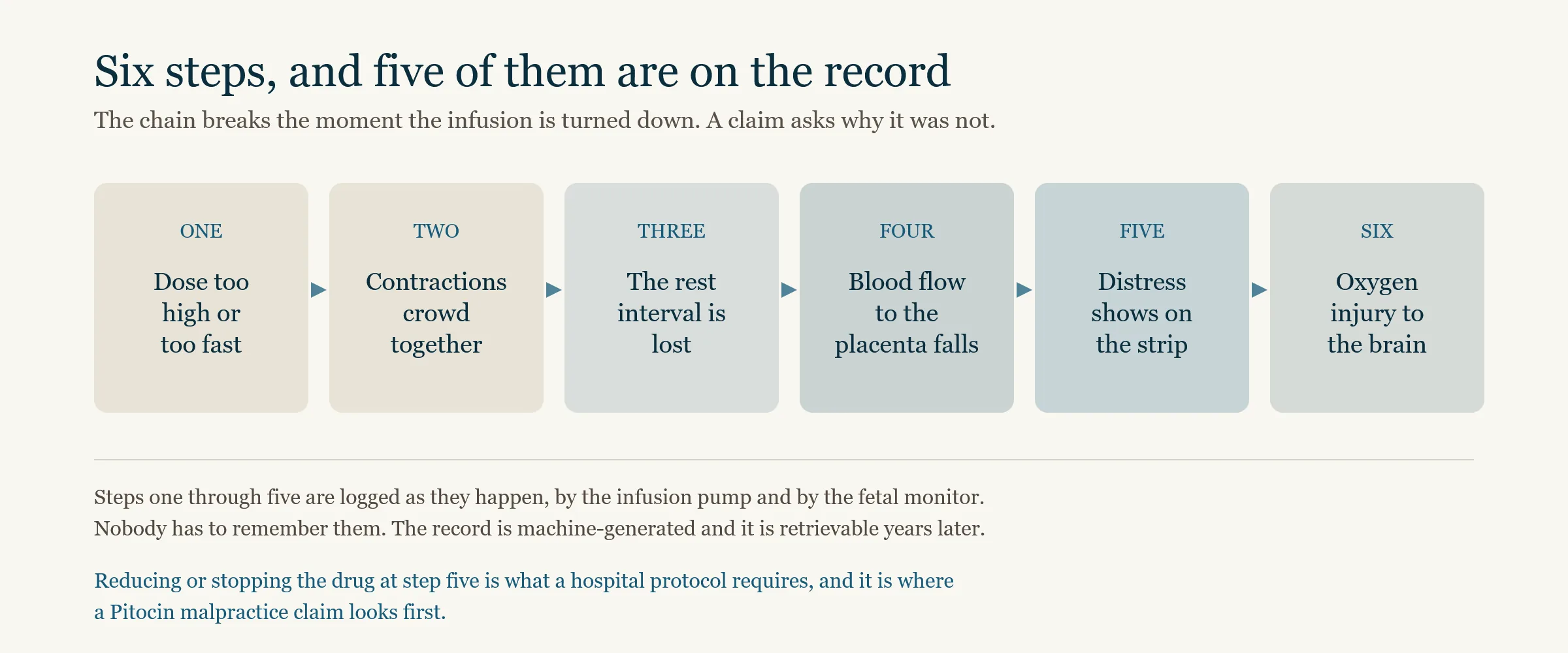
Cerebral palsy is the long-term diagnosis many of these children carry. It has many causes and an induction is only one route to it. Where the record shows a hyper-stimulated uterus, a deteriorating tracing and no response, medical experts can answer whether the cerebral palsy came out of that sequence.
Brain injuries from a birth range from deficits that resolve to permanent damage that shapes an entire life. Seizures in the first days are often the earliest sign that a baby suffered an oxygen injury.
Contractions driven beyond what the birth canal will allow can also force a baby against an obstruction. Nerve damage to the shoulder and arm can follow at birth, and that is covered on the page for brachial plexus birth injuries.
The second group is injuries to the mother. Those complications include uterine rupture, hemorrhage and an emergency C-section that was avoidable. Where a mother was harmed as well as her baby, both can be claimants in the same birth injury lawsuit.
When a Pitocin error becomes medical malpractice
Not every difficult induction is a case. Medical malpractice requires two findings and both are needed. That the care fell below the accepted standard. That the failure caused the injury.
A protocol is written down, which is what makes a departure from one provable. Pitocin errors show up in the record in a small number of recognizable shapes.
- A labor induction the chart records no indication for
- Raising the dose faster than the hospital’s own protocol allows
- Continuing the infusion through a tracing that called for stopping it
- Failing to move to a cesarean section once the baby was clearly not tolerating labor
- Failing to recognize a Pitocin overdose and its effect on the labor
The use of Pitocin without a documented indication is the simplest of these to prove. Any one of them can support a claim, and more than one appears in most of these files.
Medical negligence has to be established through expert testimony in nearly every state. Medical experts read the strip, the orders and the nursing notes as one sequence and say whether that sequence met the standard. Their opinions are what medical malpractice claims are built on.
Who is held responsible
The doctor who decided to induce labor owns the plan behind it. The nurse who administers Pitocin at the bedside owns the rate changes and the monitoring. Both can be defendants and often both are.
Chain of command is part of the standard here. A nurse who sees a tracing the doctor is ignoring is expected to escalate above that physician. A healthcare team that never escalated leaves a record of not escalating. The hospital is usually named as well, because it employs most of the healthcare providers in the room and it wrote the protocol that was departed from.
What a Pitocin malpractice claim can recover
There is no average settlement worth quoting on this page. Published Pitocin figures trace back to law firm case-result pages rather than to a court record or a public dataset. A number taken from those sources would not survive being checked.
What is knowable is what a birth injury lawsuit is valued on. Injured patients and their families recover compensation across the categories below.
Medical expenses Neonatal intensive care, imaging, surgery and the treatment that follows.
Future care The care a child will need after the claim closes, which in a permanent case is most of the care they will ever need.
Therapy and equipment Physical, occupational and speech therapy, plus mobility and communication equipment replaced as a child grows.
Lost earning capacity An economist calculates what the injury takes out of a working life.
The parents’ own losses Lost wages and the mother’s separate claim where she was injured too.
Birth injury cases are rarely valued early, because the harm has to declare itself before anyone can price it. Any law firm quoting a figure before reading the records is guessing.
How long a family has to file
The deadline for a birth injury is not the ordinary deadline, because the injured person is a child.
Most states extend the limitation period for a minor, often by years. Several set a separate and much shorter deadline for the claim the mother brings in her own name. A claim against a public hospital can require formal notice within months of the delivery.
Zinda Law Group takes these claims in Texas, Colorado, New Mexico, Arizona and Florida. The rules differ in each one. Checking early costs nothing and assuming there is time has ended cases.
Common questions
Is it easy to sue a labor and delivery hospital?
It is not easy and it is done regularly. Hospitals defend these claims hard, because the sums are large and the reputational stakes are real. A patient bringing one is up against a defense team that does this for a living. What makes a Pitocin case workable is that the evidence is machine-generated. The strip and the infusion record were created at the time by equipment rather than written afterward by the people being sued.
Which element of malpractice is hardest to prove?
Causation, in nearly every birth injury case. Showing medical negligence is often straightforward once the protocol and the strip sit side by side. Proving that this failure and nothing else caused the baby’s brain injury is the contested part. It is where the medical experts on both sides spend their time.
Does Pitocin cause cerebral palsy?
Pitocin is a synthetic version of a hormone the body already makes, and by itself it does not cause cerebral palsy. A Pitocin overdose can produce the excessive uterine contractions that reduce a baby’s oxygen, and the risk rises with the dose and with how long a bad tracing was left alone. Prolonged oxygen deprivation can cause the brain damage that later presents as cerebral palsy. Whether that chain happened in a particular delivery is answered from the monitoring records.
Is it worth suing for medical malpractice?
That depends on what the record supports and on what the injury will cost. No honest law office will quote odds of winning. The outcome turns on the strength of the specific record. Where a child’s condition is permanent, the lifetime cost of care runs far beyond what a family can absorb. A medical negligence claim is usually the only route to covering it. Where the baby recovered fully, most lawyers will say so.
Speak with a birth injury attorney about a Pitocin claim
If your baby was injured during an induced labor, the monitoring records hold the answer and they can be read.
Zinda Law Group will review them at no cost. A law office that handles birth injury claims regularly will read the strips before saying anything about value.
Our birth injury lawyers handle Pitocin errors on a contingency fee, so there is no fee unless the claim recovers. Call (800) 863-5312 or use the online form to request a free consultation.