













An HIE lawyer represents families whose child was diagnosed with hypoxic-ischemic encephalopathy, a brain injury caused by oxygen deprivation around the time of birth. This page explains how hypoxic-ischemic encephalopathy (HIE) happens during labor and delivery, and when it amounts to medical negligence. It also covers what a birth injury claim has to prove, what compensation covers, and how long a family has to file.
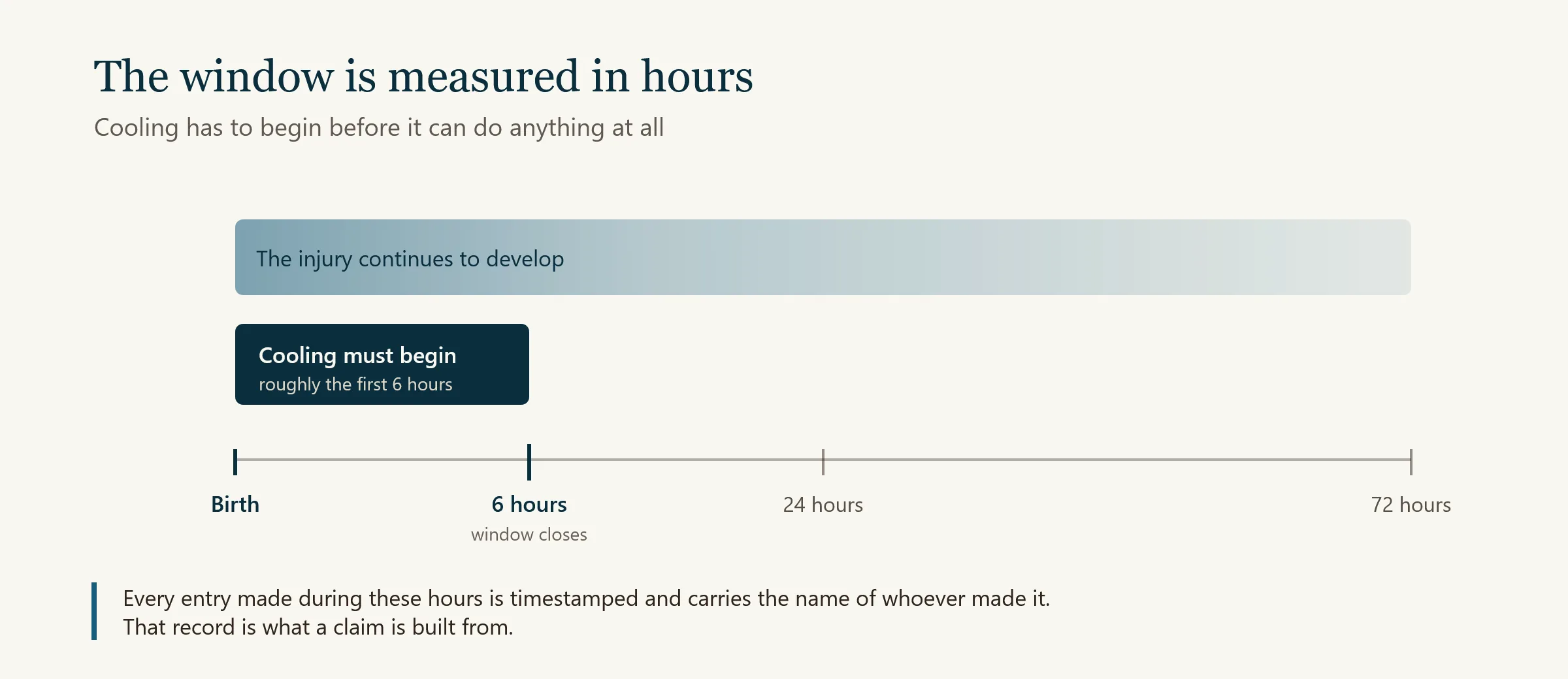
If your child received an HIE diagnosis, the medical records made in the first hours after birth will usually show whether the injury could have been prevented. Those records already exist. Every entry carries a timestamp and the name of whoever made it.
Zinda Law Group offers a free case evaluation with an experienced HIE lawyer. A hypoxic-ischemic encephalopathy lawyer can tell you whether the records are worth requesting, and what your legal options look like from there. You pay nothing unless we recover compensation for you. Call (800) 863-5312.
What an HIE lawyer does
An HIE lawyer reads the birth file before saying anything about the case, which means the fetal monitoring strips, the nursing notes, and the neonatal chart from the first days of life.
The work is narrower than most families expect. It is to establish when the baby’s oxygen supply became compromised, and how long the gap ran before anyone acted on it.
Most law firms do not take these cases. Birth injury litigation needs medical experts in obstetrics and neonatology, and the cost of building a single claim runs well into six figures before a hospital responds to anything. Birth injury lawyers who do this work carry those costs themselves until the case resolves.
How hypoxic-ischemic encephalopathy (HIE) happens
Hypoxic-ischemic encephalopathy is the brain damage that follows a loss of oxygen around birth. When blood flow to an infant’s brain drops far enough, brain cells begin to die. The injury keeps developing for hours and sometimes days after delivery. That is why treatment is urgent, and why what gets written down in those hours matters so much later.
Some oxygen deprivation during the birthing process could not have been prevented by anyone. A placental abruption can happen without warning. An umbilical cord can compress in seconds. Umbilical cord complications sit among the causes healthcare professionals genuinely cannot foresee. Other causes are decisions. A birth injury lawsuit examines decisions.
HIE differs from other birth injuries in how fast the window to treat closes. A fractured collarbone can be set the following week. Brain cells cannot wait that long.
The fetal monitoring record
Continuous monitoring produces a strip, a time-stamped record of what the baby’s heart was doing. Fetal distress shows up there first.
Staff watch it so they can monitor fetal distress as it develops. A pattern on that strip means something specific to the people trained to read it. Late decelerations. Reduced variability. A heart rate that will not recover between contractions.
When a strip runs for forty minutes without a response, the chart shows a choice. That is the difference between a tragedy and medical negligence. Most HIE lawsuits turn on that distinction.
Decisions the chart captures
A cesarean ordered on time and performed an hour later is a different case from a cesarean never ordered at all. Both appear in the chart, and both can be measured against the hospital’s own protocols and the times its own staff entered.
Medication given to strengthen contractions can push the uterus to contract faster than the placenta refills between them, so each contraction begins from a lower oxygen reserve than the one before it. The strip shows this happening in real time. That is why dosing decisions end up at the center of so many medical malpractice claims.
Fetal distress that is charted but never escalated is the other pattern these medical errors follow. The entry sits in the chart. What is missing is any record of it moving up the chain.
Symptoms medical professionals look for at birth
Medical professionals grade hypoxic-ischemic encephalopathy as mild, moderate or severe. The grade comes from what the baby does. No single test result sets it. HIE symptoms show up in the first minutes and hours after a child suffered the injury.
- Low Apgar scores that do not improve in the first minutes
- A baby who does not cry or breathe without help
- Poor muscle tone or absent reflexes
- Seizures within the first day of life
- Blood gas results showing the baby is acidotic at delivery
A baby who suffered HIE during a difficult delivery may show signs of birth trauma alongside it. Mild cases often resolve. Moderate and severe cases carry a higher risk of lasting harm, which can include cerebral palsy, epilepsy, developmental delay and problems with vision or hearing that only surface as a child grows.
Magnetic resonance imaging in the first week, usually just called an MRI, shows the pattern of injury across the infant’s brain, and that pattern points toward the timing of the damage. That timing is the single most contested fact in most claims. An EEG records seizure activity that is not always visible from the outside. Cord blood gas results taken at delivery sit alongside both, and together these narrow the window in which oxygen supply was lost.
What cooling tells you
Many babies with moderate or severe HIE receive therapeutic hypothermia, which families usually hear described as cooling. It slows the injury while the brain is most vulnerable. It has to begin within roughly six hours of birth to do anything at all.
Cerebral palsy is the diagnosis most often attached to severe HIE in later years, though it is not the only one. If your child was cooled, somebody recognized a brain injury early. A hypoxic-ischemic encephalopathy (HIE) claim then asks whether the events that made cooling necessary should have been prevented in the first place.
Some infants also need respiratory support during those days, which appears in the neonatal chart alongside the cooling record and the medication log.
When hypoxic-ischemic encephalopathy (HIE) is medical negligence
Not every case of hypoxic-ischemic encephalopathy involves a mistake. A knowledgeable attorney will say so early. No family should spend a year finding that out on their own.
Medical negligence means the care fell below what a competent clinician would have provided and that the gap caused the injury. Both halves have to hold. Causation is where birth injury cases are won and lost.
The defense in almost every HIE case is that the injury happened before labor began, or that it was unavoidable once labor started. Meeting that argument takes imaging, the cord blood gas, and medical professionals in the relevant specialty who will testify to what the timing shows.
Who can be held responsible
Birth injury lawyers get asked who the defendant is before anything else. Families assume a claim means suing the doctor who delivered the baby. It often does not, or does not only. Responsibility can rest with the labor and delivery nurses who watched the monitor, with an anesthesiologist, or with a midwife.
Where a hospital ran a unit too thin to respond, the hospital itself is the defendant. Medical malpractice claims of this kind frequently name the medical group that employed the clinician as well, because that is where the coverage sits.
What an HIE claim has to prove
Four things. The relevant medical records carry most of them.
- A duty of care existed between the clinician and the mother or child
- The care provided fell below the accepted standard
- That failure caused the brain injury
- The injury produced losses the law can compensate
The third one is the fight. Hospitals rarely dispute that a child has hypoxic-ischemic encephalopathy. They rarely dispute the severity. What they dispute is when the oxygen deprivation began, and whether anything available at the time would have changed the outcome.
What compensation covers in an HIE case
A birth injury claim seeks the maximum compensation available for what the injury will cost across a lifetime. That number gets built from evidence.
Lifetime and ongoing medical care
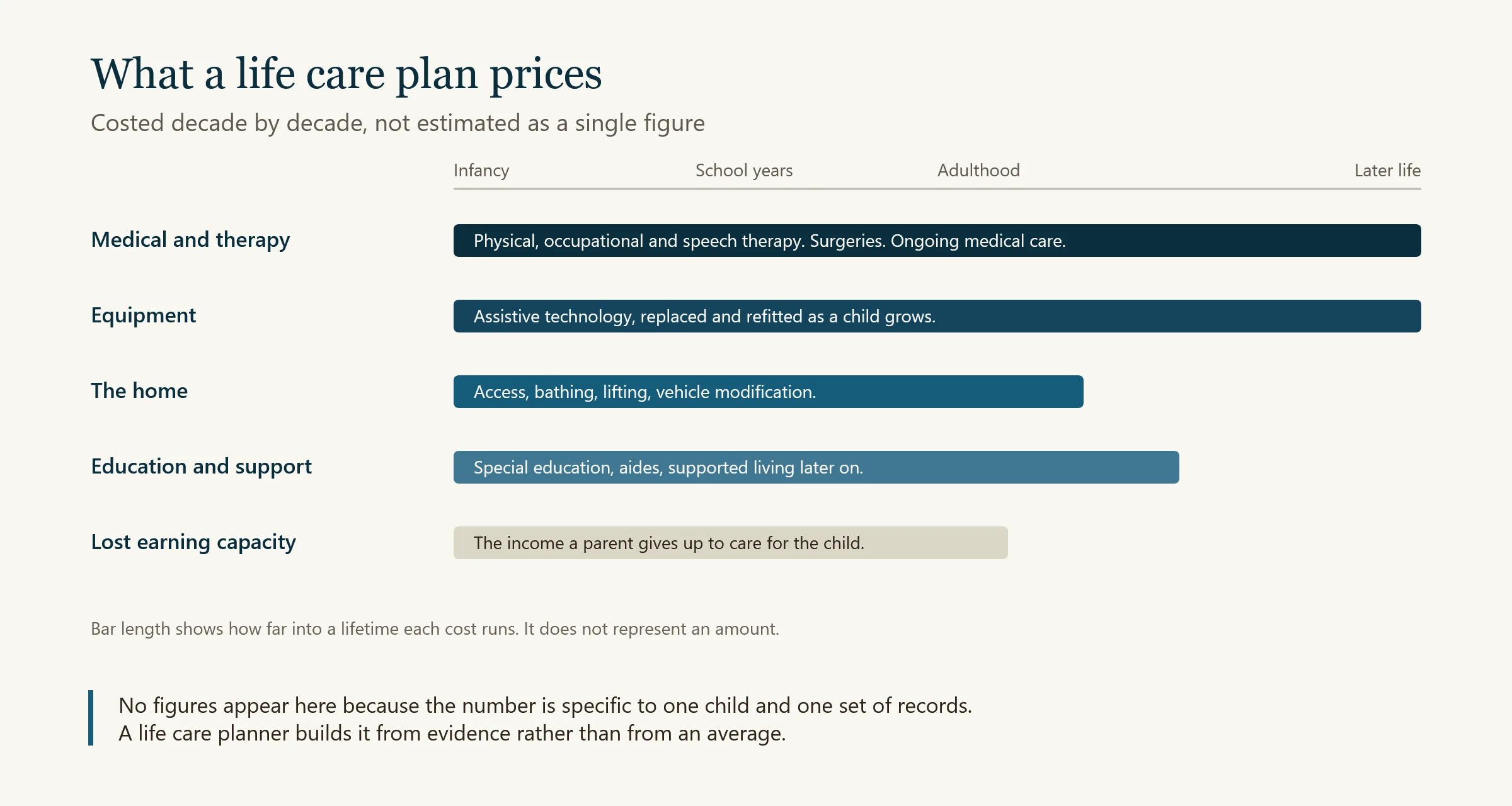
A life care planner prices what the child will need decade by decade, which covers equipment, surgeries, and the ongoing medical treatment that continues long after a family can no longer provide the care themselves.
Physical therapy and occupational therapy run on their own schedules, and speech therapy is often added once a child is older. Therapy costs compound quietly across a lifetime. The medical expenses a family absorbs in the first two years are the beginning of that number.
Assistive technology and changes to the home are priced the same way. So is a parent’s lost earning capacity, meaning the income given up once caring for the child becomes the work.
Non-economic damages cover what arrives with no invoice attached: pain, the loss of an ordinary childhood, and the effect on a family that did not choose any of it. Families seek compensation for the emotional toll as well.
What a claim is really pricing is the child’s future. The child’s injury sets the level of care needed for as long as they live. No other injury case carries that horizon. Some states cap these damages in medical malpractice cases, and a cap on one side of the file is a reason to build the other side properly.
How long families affected by HIE have to file
Every state sets a deadline for filing a medical malpractice claim, and every state treats a claim brought on behalf of an injured child differently from a claim brought by an adult. The difference is usually large. It is not the same in any two states.
The legal aspects of that deadline are worth asking about early. Monitoring strips, staffing records and incident reports are easier to obtain while producing them is still routine, and medical errors are easier to establish while the people involved still remember the shift. Waiting rarely helps a claim and often costs it outright.
Families dealing with a new diagnosis usually have no reason to think about deadlines at all. If you are unsure where your family stands, ask. Filing claims on behalf of a child follows a different clock from an adult’s, which is the part families most often get wrong. That clock runs whether or not the legal process has started. A five minute conversation with a hypoxic-ischemic encephalopathy lawyer is enough to tell you whether the deadline is a problem.
How to choose a law firm for an HIE case
Families dealing with a birth injury are usually hiring a lawyer for the first time. A few questions separate the law firms that handle these cases from the ones that merely accept them.
The first is which medical experts the practice works with by name. Most law firms cannot answer that without checking. The second is how many birth injury cases it has taken to trial rather than settled quietly, since insurers price that difference. It is also worth asking who is actually going to read the fetal monitoring strips. If a firm cannot name the experts it works with, or cannot say when it last tried a birth injury case, that is an answer in itself.
A proven track record in car accident work says nothing about a firm’s ability to litigate against a hospital’s insurer. Legal expertise in birth injury is specific. Law firms without it usually refer the case out to someone who has it, and the good ones say so at the first meeting.
Medical malpractice rules also differ by state, and a practice that works in one state is not automatically equipped for another.
Some law firms will tell a family what a case is worth at the first meeting, before anyone has read the file. Nobody can know that yet.
How our birth injury lawyers build an HIE claim
The first step is requesting the complete file rather than the discharge summary, which means the strips, the nursing notes, the orders, and the time each one was entered.
Independent specialists then review what comes back. Their reading decides whether there is a case, and not the legal team’s enthusiasm for one. Losing a case at the review stage is better than carrying one that was never there.
If the review supports a claim, our HIE attorneys file it and prepare for trial from the beginning, because insurers behave differently toward birth injury lawyers who try cases. Families rarely know what the legal process involves before they call. HIE lawsuits run from many months to several years, and our HIE attorneys will say which end of that range a file looks like.
Families get legal support at each stage of that process. Nobody here is providing emotional support in place of counseling, and it would be dishonest to suggest otherwise. What experienced HIE attorneys can do is answer questions about a child’s condition and the case without a bill attached to the answer.
What a free consultation costs
Nothing. There is no fee for the case review, no hourly billing, and no bill for costs or expenses if we do not recover for your family.
We work on a contingency fee basis, which means the fee comes out of a recovery or it does not exist. A free case review is not a sales meeting. You will know whether your child’s HIE is worth investigating before you owe anybody anything, and that free case evaluation carries no obligation to hire anyone.
Our attorneys are available 24 hours a day, in English and Spanish.
Questions families ask
Can I sue for HIE?
You can bring a claim if the medical records show that a clinician’s failure caused the injury. An HIE diagnosis on its own is not enough. The claim turns on whether the oxygen deprivation was recognized and acted on in time.
Is HIE considered a brain injury?
Yes. Hypoxic-ischemic encephalopathy is a brain injury caused by reduced oxygen and blood flow around the time of birth. Doctors grade it by severity. The diagnosis is not one fixed condition.
Does HIE count as a disability?
It can. A child with moderate or severe hypoxic-ischemic encephalopathy often qualifies for disability benefits and for special education services. A claim and a benefits application are separate processes, and one does not replace the other.
Can a child recover from HIE?
Outcomes vary widely. A child’s condition at discharge is a poor predictor of where things land. Mild cases frequently resolve with no lasting effect. Cooling reduces the risk of lasting harm without removing it. Some effects of a serious birth injury only become apparent at school age.
Is it worth suing a hospital?
That depends on what the paperwork shows and what the injury is going to cost. Hospitals defend these claims with full-time counsel. They do not settle out of sympathy, which is why law firms without birth injury experience rarely take them on. An HIE lawyer who has built these cases knows what the defense will argue before it argues it. A fair settlement becomes possible where the evidence is strong. Most birth injury lawsuits of this kind resolve before trial.
Talk to an HIE lawyer
If your child was diagnosed with hypoxic-ischemic encephalopathy, you are allowed to ask what happened. You do not need to know whether it was medical negligence before you call and you do not need to write anything down first.
Call Zinda Law Group at (800) 863-5312 for a free case review with a hypoxic-ischemic encephalopathy lawyer. We will listen first. If we take the case, you pay nothing unless we recover compensation for you.