













What a preeclampsia lawsuit is
A preeclampsia lawsuit is a medical malpractice claim over a pregnancy complication marked by high blood pressure that went undiagnosed, unmonitored or untreated and harmed the mother or the baby. Preeclampsia is a managed condition. Obstetric medicine has agreed criteria for diagnosing it, agreed monitoring once it is found, and an agreed endpoint in delivery. The question in these cases is rarely whether the mother had preeclampsia. It is what the chart shows about the signs that appeared and what the medical provider did about them.
This page is written for mothers harmed by preeclampsia and for parents whose baby was harmed by it. It sets out the diagnostic criteria and the warning signs a prenatal visit exists to catch. It explains how severe preeclampsia differs from HELLP syndrome and from eclampsia. It then covers the monitoring and delivery decisions expected after a diagnosis, and the failures that turn a bad outcome into a claim.
If you or your baby suffered lasting harm after preeclampsia went unrecognized, Zinda Law Group can review the medical records at no cost. The number for a free consultation is (800) 863-5312.
What preeclampsia is
Preeclampsia is high blood pressure that develops during pregnancy alongside evidence that an organ is under strain. It appears after the twentieth week of gestation and most often in the third trimester. It also appears in the days and weeks after delivery, which physicians call postpartum preeclampsia. The disorder starts in the placenta. Blood vessels that should grow to feed the placenta develop poorly, and blood flow through the organ falls. The mother’s body compensates by raising pressure across the whole circulation.
That reaction damages small blood vessels wherever they are working hardest. Preeclampsia affects the kidneys, the liver, the brain and the eyes, which is why a serious medical condition of pregnancy presents as a headache in one woman and as abnormal blood work in another. Delivery is the only cure. Every other treatment buys time so the pregnancy can continue while the numbers allow it.

How doctors diagnose preeclampsia
Two findings are needed. The first is blood pressure. Readings of 140 systolic or 90 diastolic on two occasions at least four hours apart meet that criterion for high blood pressure. The second finding is protein in the urine or evidence of organ involvement. Urine tests detect the protein. Blood work detects elevated liver enzymes and a low platelet count.
Either route is enough on its own. When a medical provider fails to act on organ involvement and waits for protein in the urine instead, the criteria have been misread. Doctors who diagnose preeclampsia early are able to manage it. Timely diagnosis is what makes every later decision possible. A late one is how most of these cases begin.
Severe preeclampsia
Severe preeclampsia is the same disorder at a higher grade. It is diagnosed at readings of 160 systolic or 110 diastolic. It is also diagnosed at lower blood pressure readings where an organ is failing. Severe preeclampsia calls for admission. Sending a mother home with severe range numbers is a departure from accepted practice at any gestational age.
HELLP syndrome
HELLP syndrome is a form of severe preeclampsia named after what the blood work shows. The letters stand for hemolysis, elevated liver enzymes and low platelet count (HELLP). Hemolysis is the destruction of red blood cells. HELLP syndrome is dangerous partly because it arrives without dramatic numbers. A mother may present with upper abdominal pain and nausea and be sent away with a suspected stomach complaint.
Untreated HELLP syndrome progresses to liver rupture, severe bleeding and organ failure. Pregnant women reporting pain under the ribs in the second half of pregnancy should have blood drawn. Normal blood pressure does not rule HELLP syndrome out.
Eclampsia
Eclampsia is preeclampsia that has progressed to seizures. It is a medical emergency and it carries a risk of stroke, coma and death for the mother. The seizure itself can tear the placenta away from the uterine wall. A seizure in pregnancy is treated as a medical emergency whether or not preeclampsia was diagnosed beforehand.
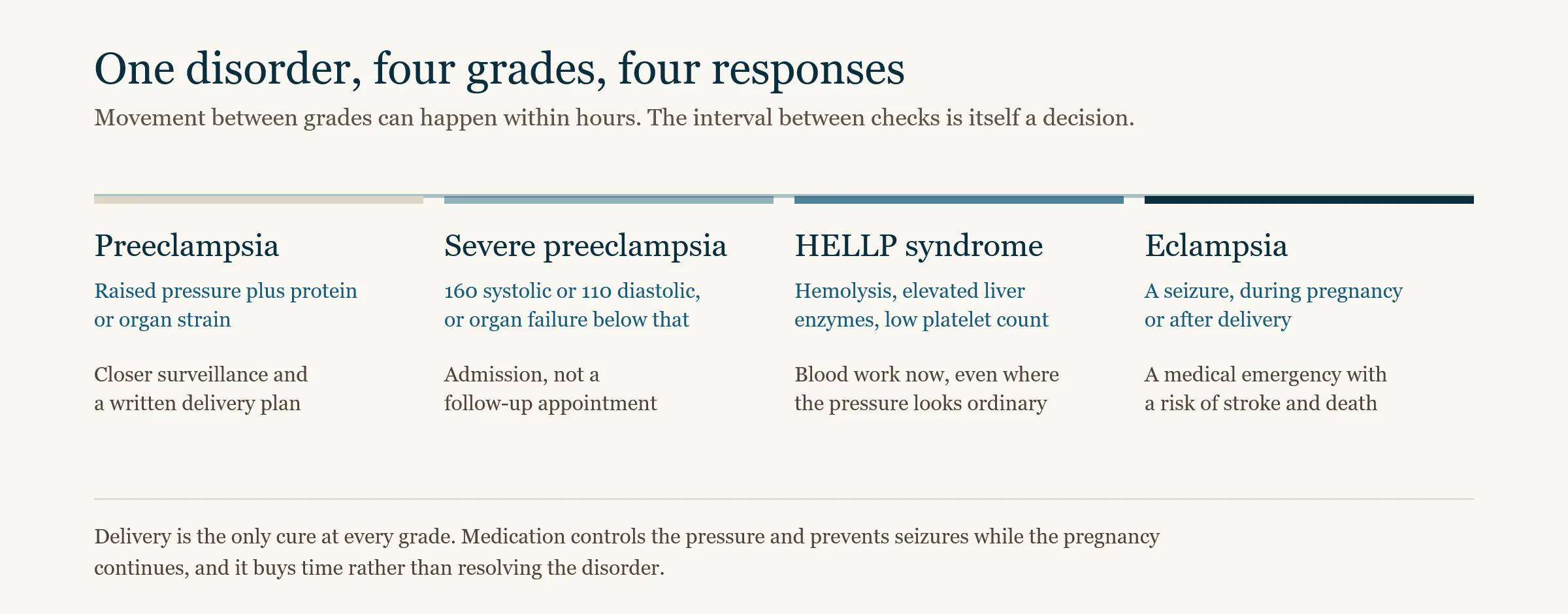
Preeclampsia progresses at very different speeds in different women. Some hold steady for weeks. Others move from a borderline reading to a life-threatening condition inside a day. That variation is the reason the interval between checks is itself a clinical decision.
Warning signs a prenatal visit exists to catch
Preeclampsia is found by looking for it. The signs below are why blood pressure and urine are checked at every visit.

Severe headaches A persistent headache that does not respond to ordinary pain relief is a neurological warning sign.
Upper abdominal pain Pain below the ribs on the right side points at the liver. Abdominal pain in the second half of pregnancy is a reason to draw blood.
Visual changes Blurred vision, flashing spots and sensitivity to light all reflect injury to small blood vessels.
Sudden weight gain Rapid weight gain across a few days reflects fluid retention.
Swelling of the face and hands Ankle swelling is ordinary in pregnancy. Facial swelling is not.
Reduced fetal movement A mother reporting that the baby has slowed down may be describing a fall in the baby’s oxygen supply.
Preeclampsia symptoms are easy to attribute to an ordinary pregnancy. That is exactly why the accepted response is to measure.
Risk factors a provider is expected to act on
Some pregnancies carry a known elevated risk, and pregnant women in those groups are expected to be watched more closely. The standard of care asks a healthcare provider for that closer surveillance, and a medical history taken at the booking visit is where most of these factors are recorded.
- A first pregnancy, or preeclampsia in an earlier one
- Chronic high blood pressure, kidney disease or diabetes before conception
- Carrying twins or more
- A family history of the condition
- Maternal age over forty, obesity or an autoimmune disorder
Risk factors do not cause preeclampsia. They change what a reasonable healthcare provider does about the possibility of it. A prenatal chart that records the risk factor and carries no matching plan is evidence in its own right.
What monitoring should look like after a diagnosis
There is an accepted way to manage preeclampsia and none of it is improvised. Four things run at the same time once the diagnosis is confirmed. Each of them leaves a record with a time on it.

Maternal monitoring
The mother’s blood pressure is checked frequently and sometimes several times a day. Repeat urine tests track the protein. Blood work tracks the liver enzymes, the platelet count and kidney function. The point of that schedule is to catch deterioration early. A widening gap between checks is one of the clearest signs in a chart that nobody was watching.
Fetal monitoring
Fetal monitoring runs alongside it, because the baby’s health depends on a placenta that is no longer delivering what it should. Heart rate tracing shows whether the baby is tolerating that. Growth ultrasound looks for intrauterine growth restriction (IUGR), the pattern of a baby who has stopped growing at the expected rate. A falling growth curve and a concerning baby’s heart rate are both arguments for delivering sooner. Fetal distress on a tracing is an argument for delivering now, and fetal health is the second half of every decision made in these pregnancies.
Medication
Magnesium sulfate is given to prevent a seizure. Blood pressure medication brings severe range readings down and reduces the risk of a stroke. Corticosteroids are given ahead of an anticipated early delivery to mature the baby’s lungs. None of these treat preeclampsia itself. Magnesium sulfate and antihypertensives make it safer to continue the pregnancy for a further hours or days.
Delivering the baby
The decision to deliver weighs the risk of continuing against the risk of prematurity. Severe preeclampsia at or beyond thirty-four weeks is generally delivered. Earlier than that a team may hold on under close observation, and holding on is a defensible choice where the monitoring is genuinely happening. An early delivery is the treatment once the readings say the pregnancy can no longer continue safely. The record shows which of those two things occurred. It carries the readings, the tracings, the orders and the hour each was entered.
How preeclampsia harms the mother
Preeclampsia is one of the largest causes of serious maternal harm in a developed health system, and almost all of that harm follows delay. The serious complications are well described. Uncontrolled blood pressure can cause a stroke. Sustained pressure damages the kidneys and can end in organ failure. The liver can bleed or rupture. A seizure can arrive with no preceding complaint at all.
Preeclampsia also raises the risk of placental abruption, in which the placenta prematurely separates from the uterine wall. Placental abruption causes severe bleeding and it endangers both the mother and the baby at once. Some mothers are left with permanent injuries. Some do not survive. Their surviving family members are the people who then bring the claim.
How preeclampsia harms the baby
The baby is harmed through the placenta. A placenta with poor blood flow delivers less oxygen and fewer nutrients than a growing baby needs. The serious complications that follow are mostly consequences of that shortfall.
Restricted growth Intrauterine growth restriction leaves a baby smaller and less able to tolerate the stress of labor.
Premature birth Delivery is often brought forward to protect the mother. Babies born prematurely face respiratory distress, feeding difficulty and time in intensive care. A premature birth at an early gestational age carries severe complications of its own, and a preterm birth before thirty weeks carries the most.
Oxygen deprivation Abruption or acute fetal distress can cut the baby’s oxygen supply sharply. Prolonged oxygen deprivation causes brain injury, and cerebral palsy and developmental delays can follow from it. Zinda Law Group covers that mechanism in detail on the page for hypoxic-ischemic encephalopathy claims.
Stillbirth Where the placenta fails completely the pregnancy can end in the loss of an unborn child.
Preeclampsia complications for the baby usually trace to the same delay that harmed the mother. One missed diagnosis produces both.
When preeclampsia becomes medical malpractice
Not every bad outcome is malpractice. Preeclampsia can be diagnosed promptly, managed correctly and still injure a mother or a baby. A claim needs more than a diagnosis and a poor result. Two findings are required, and both of them. That the medical care fell below the accepted standard. That the failure caused the injury. Medical negligence in these cases usually takes one of three forms.

Missed diagnosis
Elevated readings appear in the prenatal chart and nothing follows them. No urine test is ordered. No repeat visit is scheduled. A reported symptom is written down and attributed to ordinary pregnancy. A doctor’s failure to diagnose preeclampsia at the visit where the reading first appeared is the most common allegation in this area. It is usually plain on the face of the visit note.
Failure to monitor
The diagnosis is made and then the surveillance thins out. Checks that should be daily become weekly. Repeat blood work is not drawn, so a falling platelet count is never seen. A healthcare provider who cannot properly monitor a mother on an outpatient basis is expected to admit her. A failure to manage preeclampsia after correctly diagnosing it can constitute medical malpractice on its own. Medical negligence of that kind leaves the plainest record of the three.
Delayed delivery
Severe preeclampsia or fetal distress is documented and the response is to keep watching. The delivery decision is recorded hours after the readings that should have prompted it. Delay produces the worst outcomes for both the mother and the baby. A doctor’s failure to act on a deteriorating picture is also the one the timestamps in a chart describe most precisely.
Who can bring a claim
Three groups of people can bring these claims, and more than one may be involved in a single case.
The mother A mother injured by untreated preeclampsia brings a medical malpractice claim in her own name for her own injuries.
The child A child harmed before or during birth brings a birth injury lawsuit through a parent or a legal guardian. That claim covers the child’s lifetime needs.
Surviving family members Where a mother or a baby died, the family brings a wrongful death claim.
A single delay often supports two claims. A mother left with organ damage and a baby left with a brain injury are separate injured people with separate losses.
The evidence these cases are built on
Medical records decide the case. The account a family was given at the time rarely matches what the file shows.
The prenatal chart Every visit, every blood pressure reading, every urine test and every recorded symptom, with the date beside it.
Laboratory results Liver enzymes, platelet count and kidney function, and the times each sample was drawn.
Fetal monitoring strips The baby’s heart rate through labor, which is where fetal distress and the response to it are visible.
Nursing, physician and delivery notes Who was called, when they arrived, what was ordered, and the hour the decision to deliver was entered against the hour of the readings supporting it.
Medical experts read that sequence and say whether it met the standard. Their opinion is what medical negligence is proved with, and a medical malpractice case turns on it. Gathering the complete file therefore matters more here than in almost any other kind of case. Hospitals commonly produce a discharge summary first. The discharge summary is not the record.
What compensation covers
No average is worth quoting. Published figures for preeclampsia settlements come from law firm marketing rather than a court or any public dataset, so a number taken from them would not survive being checked. What is knowable is what compensation covers.
Medical bills already incurred Hospital care, intensive care for a newborn, surgery and rehabilitation.
Future medical expenses For a child with a permanent brain injury this is usually the largest item. A life care planner calculates it.
Lost income Wages a mother lost while recovering, and earning capacity permanently reduced by her injuries.
Pain, suffering and emotional distress For the mother and, in a claim brought for a child, for the child.
Wrongful death damages Where a mother or a baby did not survive, these cover the family’s loss.
Available insurance The policy limits of the responsible parties set a practical ceiling, whatever a claim is worth on paper. Any lawyer offering a figure before reading the file is guessing.
How long a family has to file
Deadlines are the reason to ask early. Every state sets a limitation period for medical malpractice, and once it passes a claim cannot be brought however strong it is. Three features complicate that in preeclampsia cases. A claim brought on behalf of an injured child usually runs on a longer clock than the mother’s own claim, so two deadlines in one family can differ. A claim against a public hospital can require formal written notice within months of the injury. Some states start the clock when the harm was discovered rather than when it happened. Zinda Law Group brings birth injury claims in Texas, Colorado, New Mexico, Arizona and Florida. The rules differ in each. Checking costs nothing, and assuming there is time has ended cases.
Choosing a lawyer for a preeclampsia case
A preeclampsia claim is an obstetric case before it is a legal one. The skill it needs is reading a prenatal chart and a monitoring strip. That is different work from reading an accident report. A few questions separate a firm that handles birth injury cases regularly from a general practice taking one on.
Which obstetric experts does the firm use A firm that builds these claims can name them without checking. Medical professionals willing to testify against a hospital are not easy to find.
Has the firm tried a birth injury case What a case settles for depends on whether the defense believes it will actually be tried.
Who reads the strips and the labs, and will that attorney stay on the file In a practice handling birth injury cases regularly the reader is a named person. These claims also run for years, so continuity matters more here than in a case that resolves in months.
What happens if the firm declines A family should leave with the records they gathered and a plain explanation of why.
Birth injury lawyers work on a contingency fee basis, so representation costs a family nothing unless the claim recovers. A confidential consultation should also cost nothing. A firm asking for money to review records is not working the way this field works.
Common questions
What are the causes of preeclampsia?
The root cause is the placenta. Blood vessels that should grow into the uterine wall to supply it develop poorly, blood flow falls and the mother’s circulation reacts. Why that happens in one pregnancy and not another is not fully understood. What is understood is who sits at higher risk and what the warning signs look like. That is why the failure in these cases is almost never a failure to prevent the condition. It is a failure to find it.
Does preeclampsia go away?
Delivery is the only cure, and the condition usually resolves in the days or weeks after birth. Some mothers develop it for the first time after delivery. Postpartum preeclampsia is easily missed, because the pregnancy is over and the checks have stopped. A severe headache or a visual change in the weeks after birth is a reason to have blood pressure taken.
Why is preeclampsia more common in first pregnancies?
A first pregnancy is a recognized risk factor, and the usual explanation involves how the mother’s immune system responds to placental tissue it has not met before. The clinical significance is simpler than the biology. A first pregnancy is one of the factors that should already have raised the level of surveillance before any symptom appeared.
Can I get disability for preeclampsia?
Preeclampsia itself resolves after delivery, so it rarely supports a disability claim on its own. Lasting consequences can. Kidney damage, the effects of a stroke and chronic high blood pressure are assessed on their functional impact. A child left with cerebral palsy or a similar permanent injury is assessed separately.
Can I sue both the doctor and the hospital?
Yes. An obstetrician, a nurse, a hospital and a medical practice can each be named for medical malpractice where each contributed. Hospitals are also answerable for staff acting within their employment. Naming every responsible party matters, because insurance limits often decide what a claim can actually recover.
How long does a case like this take?
Longer than most personal injury cases. The medical records have to be gathered and reviewed by experts before anything is filed, several states require an expert affidavit with the complaint, and a case brought for an injured child is often held open until the long-term picture is clear. A confidential consultation at the outset costs nothing and gives a family a realistic view of the path.
Speak with a birth injury lawyer
If preeclampsia went unrecognized in your pregnancy and you have never been told plainly what happened, the answer is in the record and the record can be read. Zinda Law Group will review it at no cost. There is no fee unless the claim recovers.
Our birth injury lawyers handle preeclampsia and other maternal complication claims across five states. Call (800) 863-5312 or use the online form to arrange a free and confidential consultation.