












An oil rig injury lawyer handles claims for workers hurt on offshore rigs and platforms in the Gulf of Mexico. Offshore work usually runs under federal maritime law, not the state workers’ comp rules that govern a land rig. That difference shapes every claim, from the first medical bill to a lawsuit against the companies responsible. An oil rig accident lawyer investigates who is liable, secures the evidence before it is lost and pursues compensation for medical expenses, lost wages and pain and suffering.
Zinda Law Group reviews offshore injury cases for injured oil rig workers and their families. A free consultation starts with three questions: where the rig was, what kind of rig it was and who employed the injured worker.
Article summary
Key things to know
- Offshore oil rig injuries usually fall under federal maritime law, not state workers’ comp.
- A worker with a substantial connection to a vessel may qualify as a seaman and bring a claim against the employer.
- Many workers on fixed platforms are covered by the Longshore Act instead.
- Maritime claims run on their own filing deadlines, which can differ from a state injury claim.

What an oil rig injury lawyer does after an offshore accident
The first job is to sort out which law governs the claim. That depends on the structure, the worker’s job and where the rig sat. The answer decides whether the claim runs under the Jones Act, the Longshore Act or state law.
Next comes the evidence, and time matters because deadlines run and records can be lost. Offshore records stay on the rig, with the operator or with the drilling company, and crews rotate off every few weeks. Incident reports, crane and lifting records, maintenance logs, the daily drilling report and the names of the crew all matter. Our lawyers ask for that material in writing and early.
Then the legal team identifies every company that may be responsible. One location can have an operator, a drilling contractor, a boat owner, catering and service contractors and equipment makers, each working under a different contract. Each one may carry its own insurance policy.
Free case review
Unsure whether an offshore injury may qualify?
Maritime law often decides these claims, so the first question is whether you qualify as a seaman.
Offshore rigs in the Gulf of Mexico
Offshore oil and gas companies in the Gulf of Mexico drill from several kinds of structures. The kind of structure matters because maritime law treats a vessel differently from a structure fixed to the seabed.
Fixed platforms
A fixed platform stands on legs anchored to the ocean floor. The Supreme Court has held that fixed platforms in federal waters are treated as artificial islands, with federal law supplemented by the law of the adjacent state, rather than as vessels.
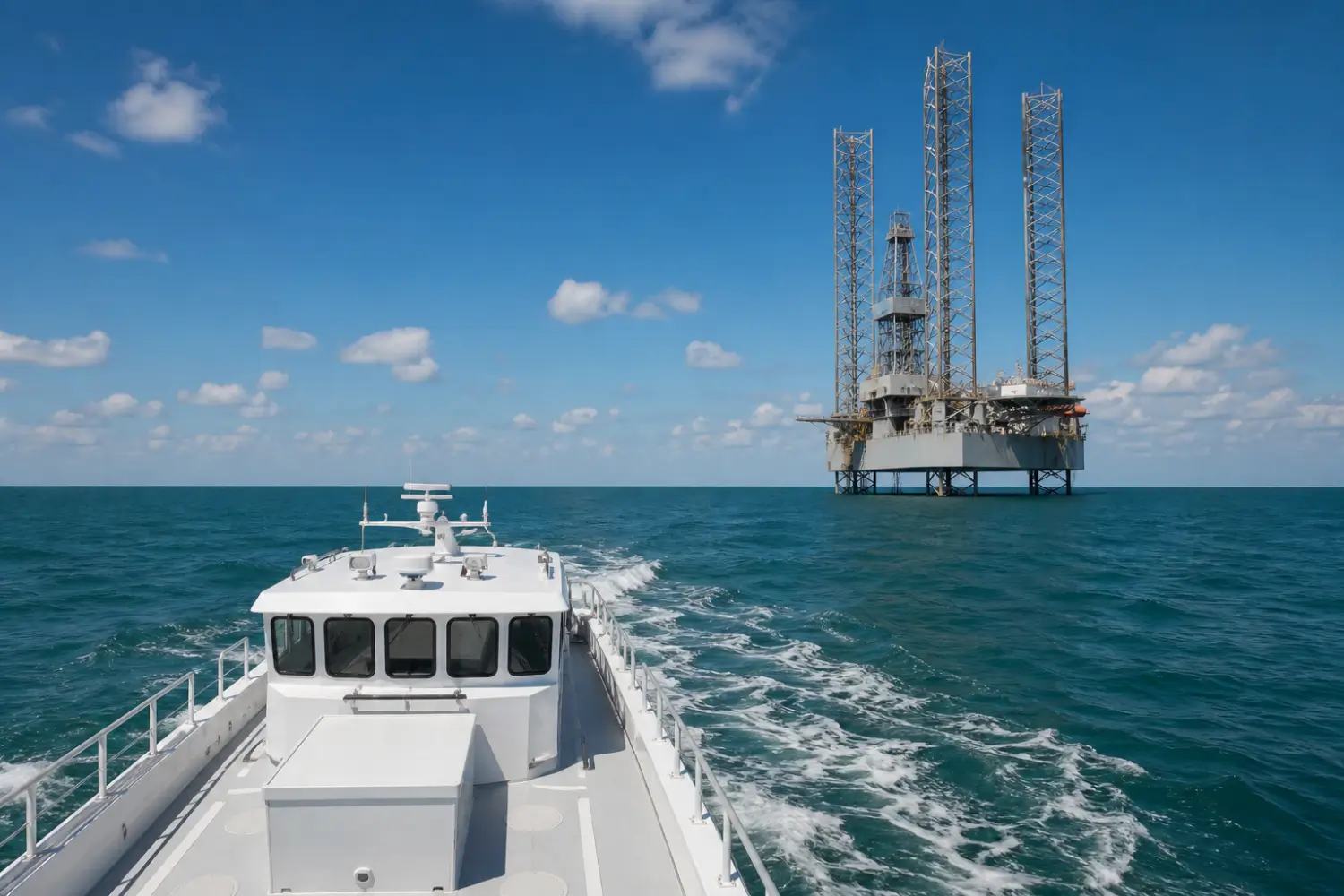
Jack-up rigs, semi-submersibles and drillships
Other drilling units can float or be moved from site to site. Federal law defines a vessel as any watercraft or other artificial contrivance used, or capable of being used, as a means of transportation on water. Courts ask whether that use is a practical possibility or only a theoretical one. Whether a particular drilling rig counts as a vessel turns on its facts. It is one of the first things an oil rig accident lawyer checks.
Which law covers an offshore oil rig injury
Maritime law is not one statute. The key laws for an oil rig accident include the Jones Act and the Longshore and Harbor Workers’ Compensation Act, along with court-made rules and the Death on the High Seas Act. One accident can involve more than one of them.

The Jones Act and seaman status
Under the Jones Act, a seaman injured in the course of employment may bring a civil action against the employer. In plain terms, an injured seaman can sue the employer for negligence. The Act applies the federal rules for injured railway workers, which make an employer liable for an injury caused in whole or in part by its negligence. Congress passed it in 1920.
Not every offshore worker qualifies. The Supreme Court requires a connection to a vessel in navigation, or a fleet of vessels, that is substantial in both duration and nature. In Chandris, Inc. v. Latsis (1995), the Court said that as a rule of thumb, a worker who spends less than about 30 percent of working time in the service of a vessel in navigation should not qualify. The Court calls that figure a guideline, not a fixed line.
Unseaworthiness claims
Seamen also have a claim against the owner of the vessel. The owner’s duty to furnish a seaworthy vessel does not depend on proving negligence. The Supreme Court has described it as independent of the employer’s duty of reasonable care. Unsafe equipment or a dangerous condition aboard can make a vessel unseaworthy. Punitive damages are not available on this claim.
Maintenance and cure
An injured seaman is owed maintenance and cure by the employer under general maritime law. Maintenance covers food and lodging, and cure covers medical treatment. The obligation does not depend on fault. When an employer willfully and wantonly refuses to pay it, the Supreme Court has held that punitive damages remain available.
The Longshore Act on platforms
Many oil and gas workers offshore are not seamen, and the Longshore Act covers many of them. The Longshore and Harbor Workers’ Compensation Act is a federal workers’ compensation law for injured maritime workers on navigable waters and adjoining areas. It excludes the master and crew of a vessel.
The Outer Continental Shelf Lands Act extends Longshore Act benefits to injuries that result from operations to develop the natural resources of the Outer Continental Shelf. That covers much of the work on fixed platforms in federal waters. These benefits pay for medical care and disability compensation. A worker who receives them may still file a personal injury lawsuit against a third party, meaning a company other than the employer.
State waters and state law
Closer to shore, state law can apply. Federal law recognizes that some Gulf states’ boundaries can extend up to three marine leagues into the Gulf of Mexico, farther than the three geographical miles that apply in most other waters. An accident in state waters can bring in that state’s injury and workers’ comp rules. The location of the rig matters from the first day.
Common causes of offshore oil rig accidents
The oil and gas industry is dangerous work on land and at sea. The U.S. oil and gas extraction industries lost 65 workers in 2024, according to the Bureau of Labor Statistics. CDC researchers reported that the industry’s fatality rate averaged seven times the rate for all U.S. workers from 2003 to 2013.
Offshore, the Bureau of Safety and Environmental Enforcement tracks incidents reported to it in federal waters. For calendar year 2025, operators reported 192 injuries, 401 lifting incidents, 182 fires and 2 explosions. They reported 223 injuries and 1 fatality in 2024. Those numbers count only incidents reported to BSEE, but they show where accidents on offshore rigs happen.

Crane and lifting accidents
Lifting incidents were the largest category BSEE counted in 2025. Cranes move pipe, containers and heavy machinery between supply boats and the deck. A dropped load or a swinging load can strike or crush workers below. The lift plan, crane records and the operator’s certification are some of the first records requested.
Fires, explosions and gas releases
An offshore rig sits on top of flammable oil and gas with no easy way off. BSEE counted 182 fires, 2 explosions and 121 gas releases in 2025. Oil and gas wells can also release hydrogen sulfide, a toxic gas that at high concentrations causes a loss of the sense of smell. Burns, smoke inhalation and exposure to toxic chemicals follow fires and releases.
Falls, slips and dropped objects
Slip and fall accidents happen on decks wet with seawater, drilling mud and oil. Crews climb stairways, ladders and derricks in wind and swell. Falls from height and dropped objects cause broken bones, spinal cord injuries and traumatic brain injuries offshore just as they do on land.
Crew boats, supply vessels and helicopters
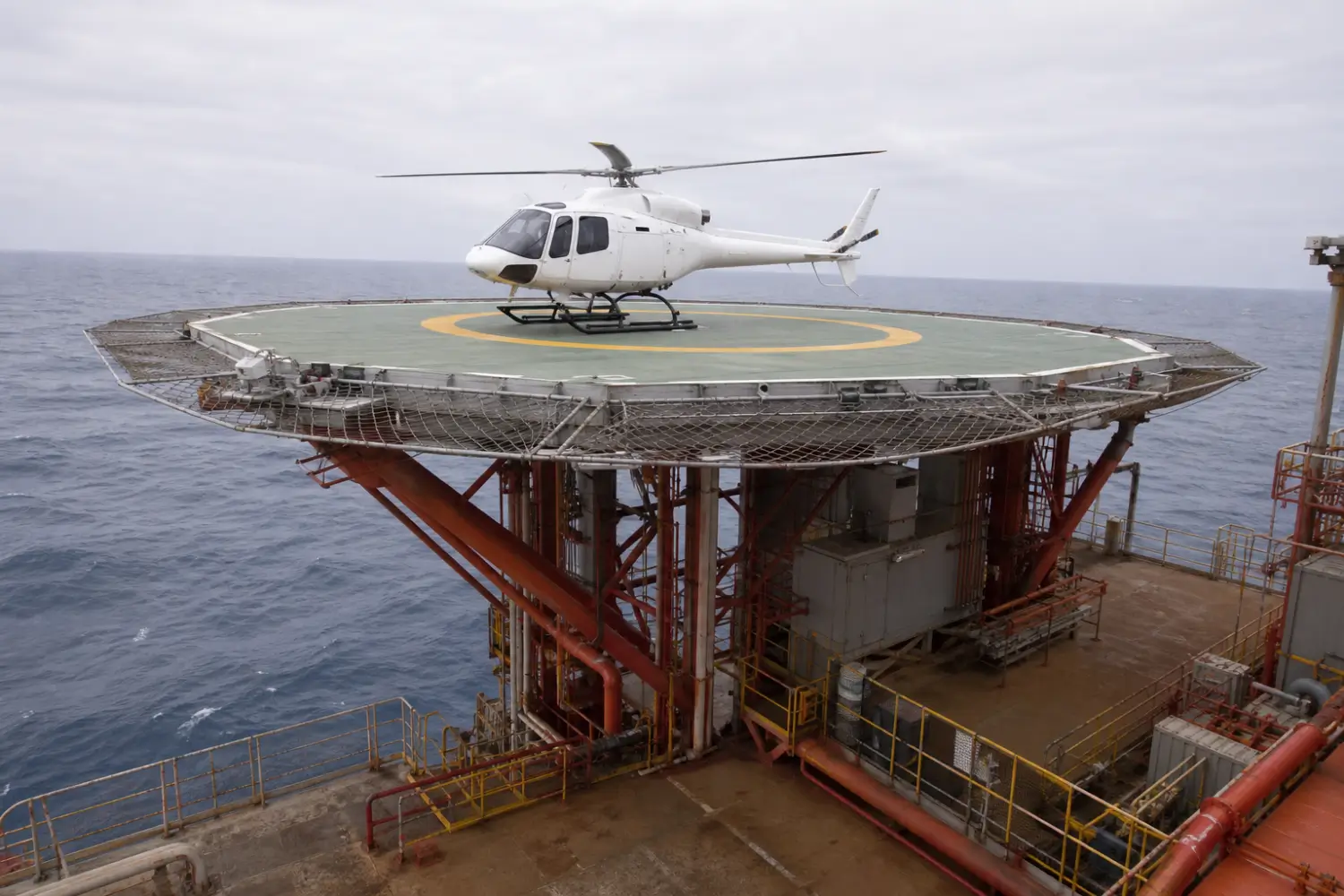
Getting to and from the rig is part of offshore oil rig work. Crew boats, supply vessels and helicopters carry workers and equipment offshore. BSEE’s 2025 figures count 11 collisions. A transfer accident at sea can bring in the boat owner and maritime law even when the worker’s job is on a fixed platform.
Common injuries suffered by oil rig workers
Workers injured offshore often have severe injuries, and medical care can be hours away by boat or helicopter. The list below covers common injuries in these claims.
- Crush injuries and amputations. Hands and limbs caught under a load, in winches or between equipment.
- Broken bones. Falls on deck, falls from stairways and strikes from swinging loads.
- Traumatic brain injuries (TBI). Dropped objects and falls from height.
- Spinal cord injuries. Falls and heavy lifting accidents.
- Severe burns. Fires, explosions and chemical exposure.
- Drowning and near drowning. Falls overboard and transfer accidents.
- Fatal injuries. Explosions, crushing accidents and incidents at sea.
These serious injuries often need surgery and months of medical care onshore. Medical expenses keep growing after the worker comes home. An injured worker may never return to offshore work, and that changes future earnings for years.
Who may be responsible for an oil rig accident
Offshore work puts several companies on the same rig, and more than one of them can share responsibility for a single accident.

Operators and oil companies
The operator is usually one of the oil companies that holds the lease. It often sets the schedule and the safety rules for the whole location. When a safety rule was ignored, the operator’s own records can show it.
Drilling contractors and vessel owners
The drilling company runs the rig and the crew. When the rig or a supply boat is a vessel, its owner owes the duty of seaworthiness. A seaman’s negligence claim runs against the employer, which is often the drilling contractor.
Service contractors and equipment makers
Catering, wireline, well testing and other service contractors share the deck. Cranes, winches, blowout preventers and safety equipment can fail because of how they were designed or built. A claim against the maker of defective equipment sits outside any workers’ compensation claim, as it does in other workplace accidents. Our page on equipment failure claims covers them in more depth.
State-specific deadlines
Questions about how much time you have?
How long injured oil rig workers have to file
Every offshore injury claim has a filing deadline, and federal maritime law sets several of them. The clock for a maritime injury claim starts when the cause of action arose.
| Claim | General deadline |
|---|---|
| Injury or death from a maritime tort | Generally 3 years after the cause of action arose (46 U.S.C. 30106) |
| Vessel owner’s limitation of liability action | Must be filed within 6 months after a claimant gives the owner written notice of a claim (46 U.S.C. 30529) |
General rules current as of September 2026. Exceptions apply.
A limitation filing can pull every injury claim against the vessel owner into one federal court. Longshore Act claims and state workers’ comp claims have their own notice rules.
Compensation for injured oil rig workers
Compensation after an offshore accident depends on which claims apply. Maintenance and cure pays for food, lodging and medical treatment for an injured seaman, and it is one way an injured worker can recover compensation. Longshore Act benefits pay for medical care and disability compensation. A seaman’s negligence claim, or a personal injury lawsuit against another company, can reach a wider range of losses than the set benefits of the Longshore Act. Through those claims a worker may be able to recover compensation for lost wages, medical bills, future medical costs and pain and suffering.
Punitive damages are limited in maritime cases. They remain available for a willful and wanton failure to pay maintenance and cure, and they are not available on an unseaworthiness claim.
Deaths on offshore oil rigs
After fatal accidents offshore, the family’s claim depends on where the death happened. When a death is caused by a wrongful act, neglect or default on the high seas more than 3 nautical miles from the U.S. shore, the Death on the High Seas Act lets the personal representative bring a civil action for the family. The Act compensates the families of workers killed on the high seas. Recovery under it is fair compensation for the pecuniary loss of the family members the claim is brought for.
A seaman’s family may also have claims under the Jones Act. Surviving family members can read about a wrongful death claim after a fatal oilfield accident and wrongful death claims.
Land drilling rig accidents
Many oilfield workers in Texas and New Mexico work on land drilling and workover rigs, and CDC researchers found that only 4.3 percent of oil and gas worker deaths from 2014 to 2019 happened during offshore operations. An oil field accident on a land drilling rig runs under state law. An oil field injury claim there usually means a workers’ compensation claim and, when another company is at fault, a personal injury lawsuit. Texas workers’ comp caps income benefits: for injuries from October 1, 2025 through September 30, 2026, the maximum weekly temporary income benefit is $1,271, and for injuries from October 1, 2026 through September 30, 2027 it is $1,314, according to the Texas Department of Insurance. Oilfield workers hurt on land should read our guide from the oil field injury lawyers at Zinda Law Group, which also covers oil truck accidents on lease roads.
What to do after an offshore oil rig injury
The first days after an offshore accident shape both recovery and the claim.
- Get immediate medical attention. Report every injury to the medic on board, even one that seems minor, and ask for the record. Seek medical attention again onshore. The medical record starts there.
- Report the injury to your supervisor in writing. Keep a copy and note who received it.
- Write down how the accident happened. Note the time, the task, the equipment, the weather and the names of the crew.
- Keep the evidence. Photographs, pay stubs, medical bills and any maintenance and cure payments all matter.
- Decline a recorded statement to insurance companies until an oil rig accident attorney has reviewed the claim. Statements to an insurer can be used to limit the claim.
When you are ready
Talk through the next step.
How we help oil rig accident victims
Our law firm answers your questions in a free consultation, before anyone signs anything. We do not get paid unless we win your case.
Our oil rig injury lawyers start with the rig: the incident report, the crane and maintenance records and the daily drilling reports. From there they identify every company on the location, whether the worker was a seaman, and every insurance policy that may apply.
Insurance companies often try to limit what they pay, so the legal team handles every negotiation and explains each offer before you decide. When an offer falls short of fair compensation, the case can go to trial to hold the responsible parties accountable. For seamen’s claims, read our page on Jones Act claims.
Call (800) 863-5312 to talk about the rig and your injury.