

“A lawyer won’t take my case” can feel like the end of the road after a loved one dies. It does not have to be. A lawyer may decline a wrongful death case for reasons that have little to do with what really happened, and the first story told about an accident is not always the true one.

This is the story of one Texas wrongful death case that came to Zinda Law Group after the family had been turned down by other lawyers. Names and identifying details are left out to protect the family’s privacy.
Jack Zinda, the founder of Zinda Law Group, walks through the case on The Effective Lawyer podcast. You can hear the full episode at the end of this article.
Why a Lawyer Won’t Take Your Case
Many personal injury lawyers work on a contingency fee basis, which means the fee depends on the outcome of the case. The Texas State Law Library notes that attorneys’ fees normally do not cover court costs, and that a client on a contingent fee may still owe court costs whether the case is won or lost.
Because the fee depends on a recovery, a personal injury lawyer weighs two questions before taking on a personal injury claim: can the claim be proven, and is there enough insurance or other money to recover compensation?
When a lawyer says no, the answer may come from how the case looks on paper in the first few days. Reasons can include:
- The accident report says the person who died was at fault.
- The insurance coverage and assets the lawyer can see look too small for the harm.
- Proving negligence and causation would take an investigation the lawyer cannot fund or staff.
- The case involves minor rather than serious injuries, so a lawsuit could cost more than it recovers.
- The statute of limitations has already run.
- The lawyer does not practice in that area of law, such as wrongful death claims.
None of those reasons, on its own, means the claim has no merit. They describe what was known at the time. A police report is an officer’s opinion based on the evidence at hand, and insurance coverage is not always fully disclosed at the start.
If no lawyer will take your case, it is fair to ask each one why, and to ask whether more investigation could change the answer. The reason tells you which legal options are still open, and a competent lawyer should be able to explain it in plain terms.
What Happened in This Case
A mother of two young children was walking across a street at an intersection when a truck hit her and dragged her. She died from her injuries. Her family had moved to the United States, and her husband’s English was limited.
At the scene, the driver said she had been jaywalking. The officer accepted that account and wrote it into the crash report, which blamed the pedestrian for the accident. According to Jack, the officer even arranged for a counselor to speak with the driver, while the family was left to make sense of it on their own.
Turned down before the case reached Zinda Law Group
The husband had already been turned down by a couple of lawyers. On paper, the wrongful death claim looked like one where the victim was at fault. A workplace injury lawyer who knew Zinda Law Group referred the family to the firm.
Jack describes the first conversation with the husband this way: “Well, let’s investigate to see what actually occurred before we say you don’t have a case.”
Finding the Video That Changed the Crash Report
The team went to the scene. They visited every restaurant and gas station within a three-block radius that had a view of the intersection and asked managers and employees whether any camera had caught the accident. For a long time, the answer was no.
Then an assistant manager at a restaurant called back. The restaurant’s camera had recorded the crash, but he believed the system had already recorded over it. A restaurant employee had used a phone to film the screen while the footage was still there.
What the video showed
The video showed the mother had the right of way. She was crossing with the walk signal. Under Transportation Code 552.002, a driver must stop and yield to a pedestrian crossing with a “Walk” signal. Section 544.007 says a driver facing a green light must stop and yield to pedestrians lawfully in the intersection or an adjacent crosswalk.
The team brought the video to the officer. The officer changed the crash report. A case that had looked like the victim’s fault now showed the opposite.
Why speed matters for video
Some business camera systems record over old footage on a cycle, and that cycle varies from one system to the next. In this case, for example, the original recording was likely gone. A phone video of a screen was the only copy left. If you think a camera near the accident may have caught it, ask the business to keep the footage as soon as you can. If the police report blames your loved one, that evidence matters even more.
Finding Insurance Coverage the Defense Had Not Disclosed
At first, the defense said there was $1 million in insurance coverage. For the death of a young mother, that was far less than the harm her family members suffered.
Documents produced in the case mentioned another policy but did not say clearly whether it applied. The team sent requests for admissions asking the defendant to confirm whether other policies existed. The answers hedged, so the team filed a motion to compel and took a deposition of a corporate representative about coverage.
That deposition confirmed an additional $5 million policy that had not been disclosed. The defense called it an oversight. Jack says on the episode that an undisclosed additional policy turns up in many of the firm’s wrongful death lawsuits, which is why the firm keeps asking until the answers are clear.
Telling the Story of the Mother the Family Lost
Liability and insurance were only part of the case. The family members also had to show who she was and what her children and husband lost.
The team made a day in the life video, sometimes called an impact video. Her parents were flown in for their depositions and spoke about their daughter. Her sister, her former employers, and people who knew her from school spoke too. People at her children’s school said she came to every parent-teacher conference.
Jack expected the defense to suggest, without ever saying it outright, that the family deserved less. The video gave the family’s loss a face and a voice.
Proving Her Pain Under the Texas Survival Statute
Texas allows two kinds of claims after a death. A wrongful death claim under Section 71.002 covers a death caused by another’s wrongful act, neglect, or carelessness, and under Section 71.004 it compensates the surviving spouse, children, and parents.
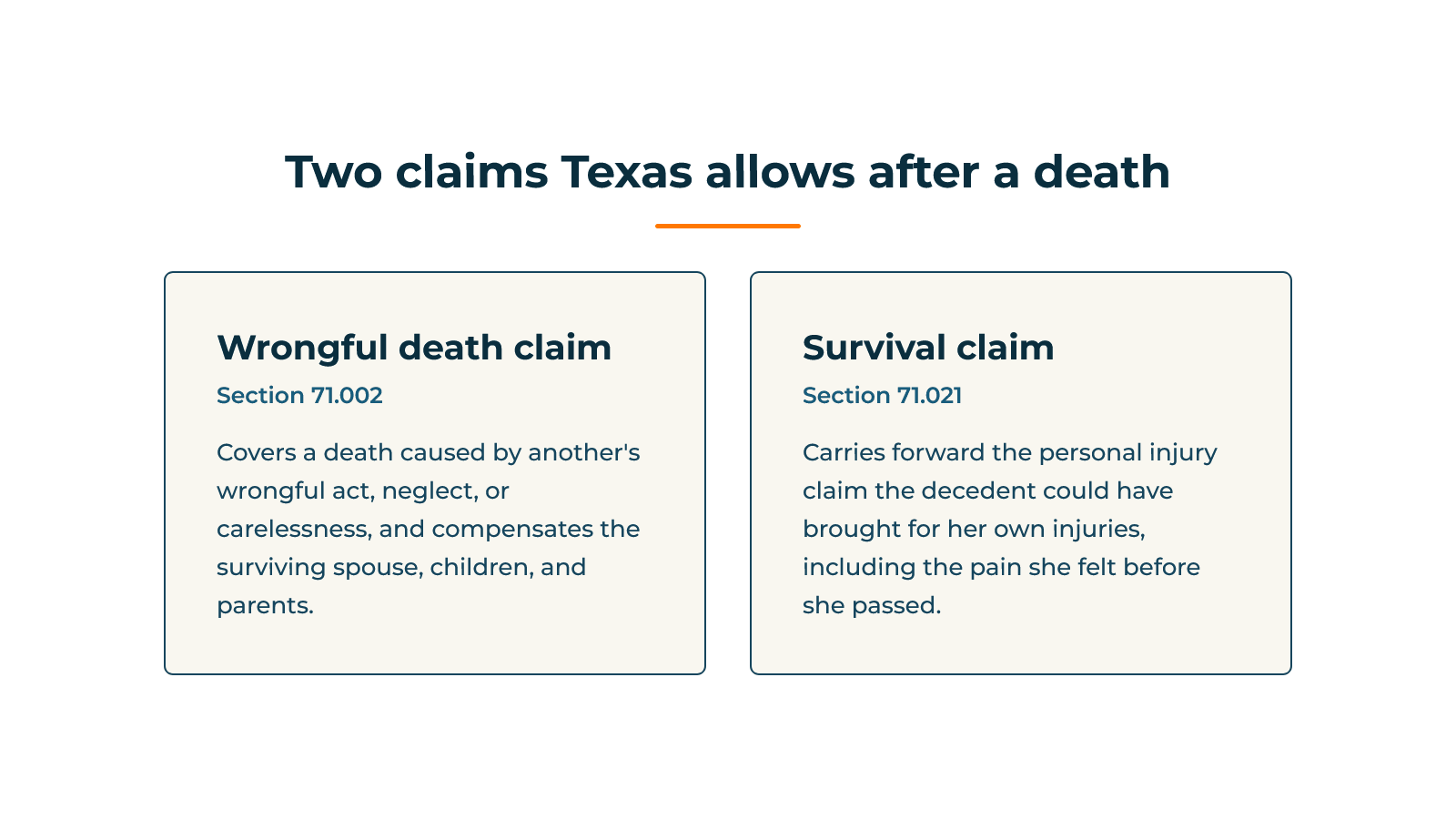
A survival claim under Section 71.021 carries forward the personal injury claim the decedent could have brought for her own injuries, including, in practice, the pain she felt before she passed. This is often called a survival action.
Under that section, the action survives in favor of the heirs, legal representatives, and estate of the injured person. In practice, the survival claim is brought for the deceased person’s estate, and a personal representative can bring it on behalf of the estate.
Proving conscious pain and suffering
The mother was conscious and in pain for a period of time after the collision. To prove the pain the decedent suffered, the team hired a medical examiner who focuses on conscious pain and suffering and gathered witness accounts of that time.
The defense hired an expert to say she did not feel conscious pain. In his deposition, Jack says, the expert could not support that opinion. You can learn more in our guide to survival actions.
How the Case Resolved
The defense asked for an early mediation to discuss settlement, before all of this work was finished. It went nowhere. Jack recalls the insurance adjuster telling him directly, “This case doesn’t give me heartburn.” The team kept a picture of the adjuster and the children on a desk for a year.
About a year later, the case reached a wrongful death settlement of $7,713,000. The family had started with no offer at all. Past results do not guarantee a similar outcome. Every case is different, and you may not obtain the same or similar results.
What This Means If a Lawyer Turned You Down
Every wrongful death case turns on its own facts. This one does not mean a different case will end the same way. It does show why an early “no” is worth a second look. Here are steps you can take if you still want to pursue a claim:
- Ask the lawyer who declined why they said no. The reason tells you what is missing.
- Get a copy of the crash report and read what it says about fault and about each person involved.
- Write down every business, home, and traffic camera near the scene, and ask each owner to keep the footage.
- Keep every insurance letter, policy document, and copy of the medical records you receive.
- Talk with a wrongful death attorney before the statute of limitations gets close.
Texas Wrongful Death Basics
Who can file a wrongful death lawsuit in Texas
Under Section 71.004, a Texas wrongful death claim is for the deceased person’s surviving spouse, children, and parents. One or more of them may bring it on behalf of all. If none of them files within three months of the death, the executor or administrator, the estate’s personal representative, must bring it unless all of them ask the executor not to.
Wrongful death damages a family can recover
In a wrongful death lawsuit, Section 71.010 lets the jury award damages in an amount proportionate to the injury resulting from the death. The awarded damages are divided among the surviving family members entitled to recover.
Section 41.001 defines compensatory damages as two separate types of financial compensation, economic and non-economic damages:
- Economic damages cover actual financial loss, such as lost wages. Future loss of earnings includes lost income, wages, or earning capacity, and loss of inheritance.
- Noneconomic damages cover losses such as pain and suffering, mental anguish, loss of consortium, and loss of companionship and society.
When the death is caused by a willful act or omission or the gross negligence of the defendant, Section 71.009 allows exemplary damages as well. Section 41.001 says exemplary damages include punitive damages. Punitive damages are awarded as a penalty or by way of punishment, not for compensatory purposes.
Statute of limitations for wrongful death lawsuits
Under Section 16.003, a suit for an injury resulting in death generally must be filed within two years of the day of the death. Some exceptions can change that date, so ask an attorney about your deadline early.
FAQs About Being Turned Down by a Lawyer
What should I do if a lawyer won’t take my case?
Keep looking. Each lawyer decides for their own reasons, and another attorney may see the case differently or be able to investigate it further. Ask each personal injury attorney why they declined so you know what the next one should look at.
Does a police report decide who was at fault?
No. A crash report is evidence, and it can be challenged. In this case, the officer changed the report after seeing new video. An insurance company or a jury can weigh other evidence too.
Does it cost money to ask for a second opinion?
Some personal injury law firms, including Zinda Law Group, offer a free consultation or case evaluation. Ask how the fee works and who pays court costs before you sign anything.
How much compensation can a family recover in a wrongful death case?
No lawyer can promise an amount. Under Section 71.010, the jury decides wrongful death damages based on the injury resulting from the death, and every case is different. A family that pursues a claim after a loved one’s death may recover damages only if the evidence supports them.
Talk With Zinda Law Group
If a lawyer has turned down your family’s case, a Texas wrongful death lawyer at Zinda Law Group can review what happened and tell you what we see. We offer a free consultation. If we do not win, you will not be responsible for attorney’s fees, court costs, or litigation expenses. If you do win, these expenses and unpaid medical bills will be taken from your share of the recovery.
You can reach us through the case evaluation form.
Listen to the Full Episode
Jack Zinda talks through this case on The Effective Lawyer podcast, including the scene investigation, the insurance search, and the story the family needed to tell.
Founder and CEO
John C. (Jack) Zinda
Jack founded Zinda Law Group and focuses his practice on catastrophic personal injury, 18-wheeler accidents and wrongful death.